
To make the "SELF-MANAGED ROAD SECTION" model more practical.
(Baonghean) - The purpose of "Self-managed Road Sections" is to raise community awareness and responsibility regarding environmental sanitation. In recent years, many localities in the province have had "Self-managed Road Sections" that have contributed significantly to maintaining environmental hygiene, ensuring traffic order and safety, and security in residential areas. However, for these self-managed road sections to become truly effective and sustainable, much work remains to be done...
(Baonghean) - The purpose of "Self-managed Road Sections" is to raise community awareness and responsibility regarding environmental sanitation. In recent years, many localities in the province have had "Self-managed Road Sections" that have contributed significantly to maintaining environmental hygiene, ensuring traffic order and safety, and security in residential areas. However, for these self-managed road sections to become truly effective and sustainable, much work remains to be done...
Effective models
The "Self-managed Road Section" model involves organizations such as veterans' associations, farmers' associations, women's associations, and youth unions taking responsibility for managing a specific road section, contributing to the "National Unity Movement for Building a Culturally Rich Life in Residential Areas." In rural areas, "Self-managed Road Sections" are often associated with maintaining environmental hygiene, while in urban areas, besides reminding people not to litter, they also prevent encroachment on sidewalks and roads, ensure businesses operate in designated areas, and maintain security and order.
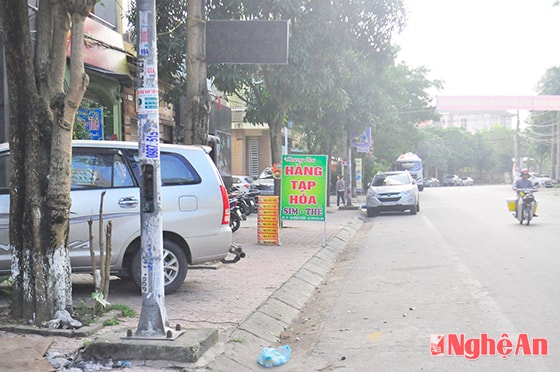 |
| The section of road managed by the Women's Union of Truong Thi Ward (Vinh City) still has problems with sidewalk encroachment. |
Since 2010, the section of Dang Nhu Mai road running through Ngu Phuc hamlet, Hung Loc commune (Vinh City) has been maintained and beautified by the hamlet's women's association. Through hamlet meetings and association activities, the women's association has educated residents and raised awareness about maintaining environmental hygiene on Dang Nhu Mai road and other roads in the hamlet. Every week, the women's association mobilizes households to clean both sides of the road and take care of the trees... Mr. Dang Van Binh, a resident living on Dang Nhu Mai street, said: "Since the Women's Association of Ngu Phuc hamlet implemented the 'Self-managed green, clean, and beautiful road section' model, each resident here has become more aware of maintaining general hygiene, no longer the situation of 'everyone's responsibility is nobody's responsibility' as before; garbage trucks now reach even the narrow alleys, and we no longer have to carry garbage to the garbage collection point like before. Now, Dang Nhu Mai street is always guaranteed to be green, clean, and beautiful, and we are very proud of this."
Since 2010, the Con Cuong District Farmers' Association has launched a movement encouraging farmers to take responsibility for self-managing rural roads. Accordingly, local farmers' associations are responsible for placing signs indicating self-management, protection, and maintenance of the roads within their villages. A prime example of this movement is the Quyet Tien village farmers' association (Chi Khe commune), which mobilized member families to contribute labor, materials, and resources to build rural roads. To date, the rural roads have been paved with concrete, facilitating the transportation of goods to the fields and improving the movement of local people. In particular, after the rainy season, the villagers actively participate in dredging canals, clearing drainage ditches, and clearing bushes to improve the aesthetics and ensure smooth traffic flow within the villages; they also excavate and fill sand and gravel to repair sections of roads damaged by erosion caused by floods.
At the same time, the branch also set regulations on maintaining environmental hygiene, implementing commitments with member families not to litter on the road, not to encroach on the road and sidewalks, and not to dry straw and agricultural by-products on the road. When the road is damaged, families are responsible for repairing it immediately, and children organize daily cleaning of the village roads... Mr. Vi Van Binh - Vice Chairman of the Con Cuong District Farmers' Association said: "The movement of farmers competing to take responsibility for self-management of rural roads not only positively impacts the awareness of adults, but also changes the awareness of children in road maintenance and environmental hygiene. Since the roads were marked with self-management signs, the environmental hygiene situation in many villages and hamlets in communes such as Chi Khe, Lang Khe, Chau Khe, Mon Son... has improved significantly, contributing to strengthening community bonds and neighborly relations, and other activities of the branches and hamlets are also implemented more smoothly."
To make the movement truly effective.
However, alongside this, many sections of road, despite being managed by community organizations and having designated signs, still suffer from largely superficial self-management. In the wards of Vinh City, littering and encroachment on sidewalks for business purposes are prevalent even on these self-managed sections. For example, Alley No. 25 on Phan Sy Thuc Street, despite being designated a "Youth Self-Managed Road" and recognized as a "Civilized Alley," still sees residents frequently littering or accumulating construction materials that obstruct the walkway. Similarly, Hoang Van Tam Street in Block 10, Truong Thi Ward, is a self-managed road managed by the Women's Association of Block 10, yet at any time of day, garbage bags are found in front of residents' houses. Not far from there, on An Duong Vuong street running through Block 15, Truong Thi ward, despite having signs indicating self-management by the block's local association, numerous shops and stalls brazenly encroach on the sidewalks right behind these signs. Many residents say that this encroachment on sidewalks and roads for business has been going on for many years, but no organization has reminded or warned against it, and these violations are only dealt with when the police or urban inspectors intervene.
Not only in urban areas but also in rural areas, many road sections, although marked with "self-managed" signs, have not been effectively managed by community organizations. Mr. Nguyen Thanh Tung, Secretary of the Party Branch of Xuan Dong hamlet, Nghi Duc commune (Vinh City), stated: “In our hamlet, there are three self-managed road sections overseen by the Veterans Association, the Women's Association, and the Youth Union, with the aim of maintaining environmental hygiene. However, it must be acknowledged that the hamlet's community organizations have not truly paid attention to self-managing the road sections they are responsible for, despite repeated reminders in Party branch meetings, hamlet meetings, and by the hamlet's leadership committee. Every day, these road sections still suffer from indiscriminate littering. Only when the hamlet launches a general environmental cleanup campaign or during local holidays, festivals, and anniversaries do these organizations step forward to mobilize residents to participate.”
It can be said that establishing self-managed road sections is a necessary way to promote the movement of maintaining environmental hygiene and urban order, aiming to strengthen the awareness and responsibility of each individual and organization towards the common movements of the locality... However, to prevent this model from becoming merely a formality, it requires the active participation of grassroots organizations. The selection of road sections for self-management needs careful discussion among Party committees, government authorities, and organizations to ensure effective implementation and create exemplary models that can be replicated. Once organizations undertake self-managed road sections according to the established criteria, they need to actively promote, supervise, and remind people to adhere to those criteria to create a genuine and sustainable movement, avoiding a focus on achieving targets for the sake of appearances.
Text and photos:Minh Quan