

Dietary supplements: Understanding them correctly, using them properly.
(Baonghean.vn) - Functional foods are developing rapidly due to real-world demand. However, this development is accompanied by a very new and still developing management system. Meanwhile, the increasing number of functional food products of unknown origin on the market, with their diverse business practices, threatens consumer health. Therefore, consumers need to have a proper understanding of functional foods...
According to statistics from the Food Safety Department (Ministry of Health), there are currently nearly 10,000 functional food products in Vietnam, with nearly 1,800 businesses producing and trading them, and this trend is increasing year by year.
Functional foods are used to support the functions of the human body, creating a state of well-being, increasing resistance, and reducing the risk of disease. However, some consumers still do not understand functional foods correctly, and some businesses and mass media outlets, for various reasons, advertise them as miracle cures or medicines, misleading consumers.
Although functional foods have only been introduced to Vietnam for over 10 years, their growth has been rapid, with many establishments and businesses violating regulations on functional food advertising. To manage the business of advertising functional foods, the Ministry of Health issued Circular No. 08/2013/TT-BYT dated March 13, 2013, guiding the advertising of food products under the management of the Ministry of Health, including functional foods.
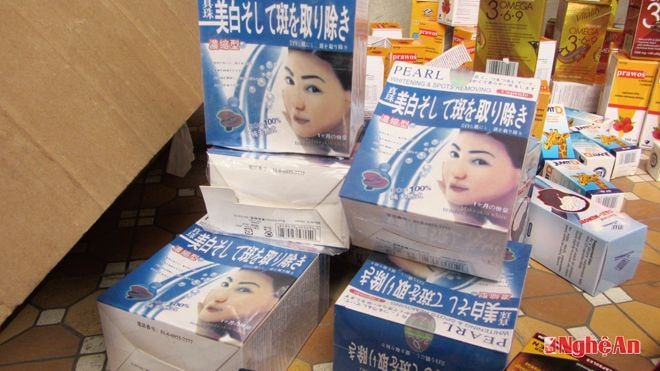 |
| Skin whitening pills of unknown origin. Photo: Nhat Lan |
According to Circular No. 08/2013/TT-BYT, functional foods must have their advertising content certified by the competent authority before being published in the mass media. Also according to this circular, functional food products must include the phrase or statement "This product is not a medicine and does not have the effect of replacing medicine." In particular, businesses are prohibited from advertising through articles by doctors, pharmacists, or medical staff describing the food as having therapeutic effects, using images, reputation, or letters from medical units, medical staff, or thank-you letters from patients, etc.
 |
| Counterfeit goods destruction campaign before Lunar New Year. Photo: Hoang Vinh |
Currently in Nghe An province, the business of functional foods is quite common, taking various forms such as organizing conferences and seminars to introduce products, multi-level marketing, or retail distribution through pharmacies.
Sharing information about management and licensing, Mr. Dao Trong Dung, Head of the Nghe An Food Safety and Hygiene Sub-Department, said that most functional food products currently circulating in the Nghe An market have been granted Product Standard Certificates; Confirmations of Conformity with Food Safety Regulations; and Advertising Acceptance Certificates and Advertising Content Confirmations by the Food Safety Department. A small number of products enter the market through unofficial channels or as smuggled goods.
According to Circular 08/2013/TT-BYT, the Food Safety and Hygiene Sub-Department is responsible for receiving applications for organizing seminars and conferences to introduce functional foods. Businesses operating in the functional food sector are only permitted to organize seminars and conferences after receiving confirmation of their application from the Food Safety and Hygiene Sub-Department. However, while many food product lines have received Product Standard Certificates; Confirmation of Conformity with Food Safety Regulations; and Advertising Acceptance Certificates; and Confirmation of Advertising Content from the Food Safety Department, in reality, only a small number of companies advertising functional foods comply fully with the law.
On the other hand, many companies that register multi-level marketing for functional foods at the Department of Trade Management - Department of Industry and Trade do not register to organize seminars and conferences to introduce their products with the Food Safety and Hygiene Sub-Department. They still organize conferences and seminars to advertise and introduce their products in villages, hamlets, and communes, thus limiting the monitoring of these activities. Furthermore, in reality, some companies and businesses exaggerate the benefits of functional foods in their advertisements or overstate the value of their products, easily misleading consumers.
Investigations at several long-established pharmacies and drugstores in Vinh City reveal that the wide variety of functional food products makes selecting items for retail sales a difficult task. Sharing her experience, Ms. Nguyen Thi H, the owner of a pharmacy on Nguyen Thi Minh Khai Street in Vinh City, stated that to ensure a reliable supply, she only sources from large, reputable companies and only obtains products with complete certifications and advertising approvals from the Food Safety Department and the Nghe An Food Safety and Hygiene Sub-Department.
Ms. H's statement reflects the common opinion of many pharmacies. They also assert that counterfeit versions of some foreign-made dietary supplements are common, while counterfeit versions of domestic products are rare, with some even saying they haven't appeared at all. This is easily explained because counterfeiting foreign products allows for quick and high profits, as foreign dietary supplements are significantly more expensive than their domestic counterparts.
Another reason is that if counterfeit foreign goods are discovered, they are more difficult and slower to process because the original company abroad handles them. In contrast, if counterfeit or fake domestic goods are found, the local manufacturer will actively seek to find the source of the counterfeits, and preventing them is not too difficult.
The mindset of consumers regarding dietary supplements can also be divided into many groups. Some are knowledgeable due to their long-term experience using them, while others are completely unaware of dietary supplements, buying only based on seller recommendations or advertisements. Therefore, finding the right, high-quality dietary supplements remains a concern for many. Many types of dietary supplements have reached consumers through various forms, including those imported via personal shipments or sent back by people returning from abroad, but this is a difficult issue to control.
Meanwhile, when asked about the fight against counterfeit goods this year, especially in the period leading up to the Lunar New Year, Mr. Tran Dang Ninh - Deputy Director of the Department of Industry and Trade - Head of the Market Management Sub-Department, affirmed that the issue of increasing quantities of functional foods of unknown origin has also emerged. This stems from the current demand, as many people seek out these products to buy as gifts for relatives and friends during the Tet holiday, especially due to the preference for foreign goods among many Vietnamese people.
According to statistics from the Nghe An Provincial Market Management Department, recent inspections have uncovered numerous smuggled goods of unknown origin, such as Cell Pack solution, Vitamin E Acetate raw material, Male Max dietary supplement, PEARL skin whitening pills, All Natural Maxi, Fulap Vitahty Mega, Triple Royal, Prawos Syrup, Calcium Vitamin, Juvit D3, Premium Omegas 3, etc.
Therefore, knowing how to buy and use functional foods correctly is not an easy matter. Regarding this issue, Mr. Dao Trong Dung, Head of the Nghe An Food Safety and Hygiene Sub-Department, also offered some recommendations for consumers when using functional foods: only use functional food products that are officially distributed on the market, have been certified by the Food Safety Department with product standards; confirmed compliance with food safety regulations; have received advertising approval; have had advertising content confirmed; and have been issued a certificate by the Food Safety Sub-Department confirming the registration dossier for organizing conferences and seminars introducing functional foods.
According to Mr. Dung, before using any product, it is necessary to carefully read the uses and instructions, as well as the manufacturer's recommendations. If any symptoms appear as described in the recommendations or other unusual symptoms, it is necessary to go immediately to the nearest medical facility for timely advice, diagnosis, and treatment.
Distinguishing between dietary supplements and medicine Mr. Dao Trong Dung also provided some criteria to help readers easily distinguish between functional foods and medicines. *Define:Functional foods are products used to support (restore, enhance, and maintain) the functions of various parts of the body, providing nutritional benefits, promoting well-being, boosting immunity, and reducing the risk of disease. Medicine, on the other hand, is a substance or mixture of substances used for humans for the purpose of preventing, treating, diagnosing, or regulating physiological functions. This includes finished drugs, drug raw materials, vaccines, and medical biological products, excluding functional foods. *Announcement:Dietary supplements are declared as dietary supplements (manufactured according to Food Law), while medicines are manufactured according to Pharmaceutical Law. *Labeling:Dietary supplements are labeled as dietary supplements, supporting the functions of various body parts, while medicines must be labeled as medicines, with indications, dosage, and contraindications. *Terms of use:Consumers can buy dietary supplements at markets and supermarkets, while medicine requires a doctor's prescription. *Target audience:Dietary supplements can be used by both sick and healthy people, while medicine is only for sick people. *Distribution conditions:Dietary supplements can be distributed through retail, supermarkets, direct sales, or multi-level marketing, while medicines must be sold at pharmacies and multi-level marketing is prohibited. *Use:The use of dietary supplements can be frequent and continuous without causing complications, so there are no restrictions on their use. However, medications must be taken in cycles and carry a risk of complications, so their use should be limited. *Source of ingredients:Dietary supplements are derived from natural sources, while medicines are a combination of both natural and synthetic sources. Classification of functional foods Functional foods are foods used to support the functions of various parts of the human body, providing nutritional benefits, promoting well-being, boosting immunity, and reducing the risk of disease. They are typically classified according to their composition and effects. Functional foods are divided into several groups: Vitamin and mineral supplement group:This type of supplementation has developed in the US, Canada, European countries, Japan, etc., such as adding iodine to table salt, iron to spices, vitamin A to granulated sugar, vitamins to soft drinks and milk. This supplementation has become mandatory and legalized to address the "hidden hunger" caused by micronutrient deficiencies (iodine deficiency, vitamin A deficiency, iron deficiency). For example, powdered milk fortified with folic acid, vitamins, and minerals is very popular in the US, while the addition of vitamins and minerals to energy drinks is thriving in Thailand, South Korea, Japan, and China. Foods in tablet form:This is the most diverse and varied group. Depending on the manufacturer, there are various forms such as capsules, tablets, and effervescent tablets, containing bioactive substances, vitamins, and minerals. Examples include effervescent vitamin C tablets, energy-boosting tablets, and tablets for preventing osteoarthritis, etc. The group of functional foods that are "fat-free," "sugar-free," and "low-calorie":This group commonly includes herbal teas produced and processed to support weight loss, reduce fat, prevent disorders of certain physiological, neurological, and digestive functions, and boost energy and immunity (e.g., slimming tea, ginseng tea...). These products are intended for people who want to lose weight, have diabetes, etc. The group of soft drinks and energy drinks:Produced and processed to supplement energy, vitamins, and minerals for the body during physical activity, exercise, and sports... Foods rich in dietary fiber:Dietary fiber is a non-starch polysaccharide that forms the framework and support structure of plant tissues and cells, and resists human digestive enzymes. Group of substances that enhance intestinal function:This includes both probiotics and prebiotics, which are beneficial for the symbiotic gut microbiota. Special functional food group:For example, food for pregnant women, food for the elderly, food for babies starting solid foods, etc. |
An Nhan