
A cautionary tale.
(Baonghean) - The horrific massacre with a large number of casualties that occurred on June 24, 1964, in Muong Long commune (Ky Son district) is a sad story about the period when the enemy tried to incite people in the high mountainous region to oppose the cause of building socialism in the North. Mr. Xong Ba Sua - Chairman of the People's Committee of Muong Long commune, reflected: "Due to complacency, we paid a very high price. We must not forget, but always remember the lesson of vigilance to do better in maintaining security and order."
(Baonghean) - The horrific massacre with a large number of casualties that occurred on June 24, 1964, in Muong Long commune (Ky Son district) is a sad story about the period when the enemy tried to incite people in the high mountainous region to oppose the cause of building socialism in the North. Mr. Xong Ba Sua - Chairman of the People's Committee of Muong Long commune, reflected: "Due to complacency, we paid a very high price. We must not forget, but always remember the lesson of vigilance to do better in maintaining security and order."
We met with Ms. La Thi Dao, who is quite knowledgeable about the massacre that occurred in Muong Long half a century ago. Ms. La Thi Dao, now 70 years old, was formerly the Standing Deputy Secretary of the District Party Committee and Vice Chairman of the People's Committee of Ky Son District. In early 1963, the provincial agricultural sector's plant nursery was located in Muong Long. The province deployed young people (mainly from Thanh Chuong and Nam Dan) to work as nursery workers. During this period, the security and political situation in the border region was quite complex due to hostile forces carrying out many fierce sabotage measures aimed at destroying the achievements of peace in the North. Our army and people constantly faced the threat of deploying commandos and spies, and luring people to join the rebels. Therefore, the nursery was also equipped with rifles and grenades, both for self-defense and to support the local militia in protecting security and order in the area.
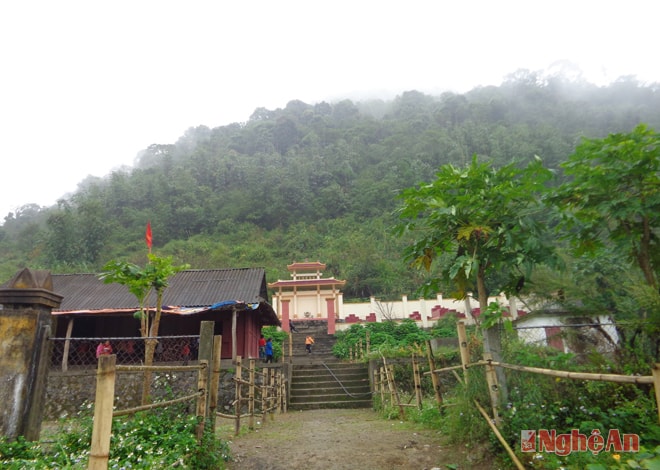 |
| The massacre took place on June 24, 1964, in Muong Long commune (Ky Son district). |
According to Ms. La Thi Dao, the most challenging task was confronting and fighting against "local bandits." This meant that some villagers were lured and incited by the enemy to oppose the government and disrupt the lives of the local people. This group was "friendly during the day, and hostile at night," posing a significant danger. Therefore, upon learning that a delegation of provincial and district officials was staying at the camp, the opposing forces launched a surprise attack in the early morning of June 24, 1964. Armed men simultaneously stormed the camp, the primary school, the trading post, and the People's Committee of Muong Long commune. The massacre claimed the lives of 33 people and injured 10. This was a truly heavy loss. From this incident, local officials and the people clearly recognized the barbaric crimes and insidious tactics of the bandits, and from then on, they were determined to use all means to successfully "suppress the bandits," stabilizing the situation within about two years.
To better understand the details of this story, we sought out a witness to the massacre, Mr. Le Van Toan, one of the 10 injured, currently residing in Muong Xen Town (Ky Son District). At 75 years old, Mr. Toan remains remarkably sharp, his mind still vividly recalling the horrific events that unfolded just as he finished his guard shift. That day, several provincial and district health officials were visiting My Ly to instruct on spraying insecticide to kill flies and mosquitoes. On their way back, they stopped to sleep at the breeding farm. Mr. Toan finished his shift and had just lain down when a deafening gunshot rang out. He immediately lay down on the ground, moved towards the stove, and hid inside to defend himself.
In the darkness of night, the sounds of gunfire and groans from wounded men filled the air. Mr. Toan sustained a wound to his abdomen and another to his groin. At dawn, due to the resistance of the surviving soldiers, the bandits retreated into the forest. Immediately afterward, three small planes successively circled the Muong Long basin, dropping commandos by parachute. The wounded crawled into the tunnels and caves behind the camp for shelter. The enemy planes continued their search until the end of the third morning before finally withdrawing. The burial of the dead was completed on the afternoon of the third. The massacre resulted in 33 deaths, mostly among the seed farm workers, two trade store officials, five provincial and district officials, one carpenter, one commune official, and 10 wounded. On the first day, someone had already fled to Muong Xen to report the situation, but due to difficult roads, the district's task force only arrived in Muong Long on the third day. Afterward, Mr. Toan was transported by horse to Muong Xen, then taken to A1 Hospital in Vinh for treatment; he was granted disability benefits of category 4/4…
We returned to Muong Long commune. The person who guided us to the site of the massacre years ago, which is also where the cemetery for the martyrs who died on the night of June 24, 1964, is Mr. Xong Ba Sua – Chairman of the People's Committee of Muong Long commune. The cemetery is located about 100 meters from the People's Committee office. Many graves have now been exhumed and moved to their hometown cemeteries. The house in front of the cemetery is one of the houses that the bandits attacked, preserved as a historical record. On the day we arrived, Muong Long Primary School was temporarily using this house for 5th grade students while the school built new classrooms. In the place where the enemy caused such tragedy half a century ago, the sounds of students studying now fill the air...
Mr. Xong Ba Sua said that the massacre happened when he was only 2 years old. Half a century has passed, but for the people of Muong Long, the story feels like it happened yesterday. The most poignant lesson remains the lesson of putting the people first. According to Mr. Sua, the reason they were able to successfully suppress and eliminate the bandits within just a few years was thanks to effective mobilization of the people. The profound lesson about security and order in border areas and ethnic minority regions is that it's not enough to just be close to the people and understand them; you also have to make the people close to you and understand you. Only then will the bad guys not be able to entice and manipulate the people. Because at that time, a segment of the population "became bandits if they held guns, and became ordinary citizens if they laid down their guns." When the entire political system, cadres, and party members are closely connected with the people, there will be no more people following the bandits, and then the bandits will have no place to exist. That is also a lesson in vigilance, a lesson in political security that the officials of Muong Long have always kept in mind, enabling Muong Long to maintain security and order for the past several decades.
Duc Duong