

Ceasefire agreement in Ukraine: An indefinite break.
(Baonghean) - On Tuesday, December 9th, a ceasefire agreement was signed between the Kiev government and pro-Russian separatist rebels. To date, both sides are adhering to the agreement; however, this does not appear to be the final conclusion to the eight-month-long conflict in eastern Nghean.
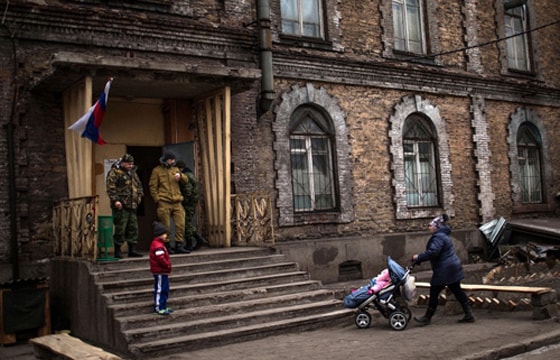 |
| Eastern Ukraine on a day without gunfire. |
| RELATED NEWS |
|---|
Looking back at the political negotiations between the two sides directly involved in the fighting, which began with an agreement signed on September 5th in Minsk, it is evident that a state of limbo has persisted without any significant progress. The rebel faction controls territory in the east of the country, stretching from Donetsk City to the Ukrainian-Russian border in the Lougansk province. The administrative apparatus there is organized as the self-proclaimed "Democratic Republic" of Donetsk and Lougansk. On November 2nd, the separatist leaders were elected by the local population as their political representatives. Local figures replaced the Russian political representatives who headed these regions during the early stages of the civil war (from spring to August 2014).
This phase concluded with the defeat of the Ukrainian army, after rebel forces received Russian aid. Weapons and military equipment were transferred by the Moscow government to eastern Ukraine via a continuous border strip controlled by the rebels. Notably, this border line includes two checkpoints where 142 OSCE observers are present – responsible for monitoring and ensuring the ceasefire is observed. However, fighting continues between the Ukrainian army and the opposition forces. The hotspots of the conflict are Donetsk Airport and its surrounding area – under Kyiv's control. Additionally, Debaltsevo to the east of the airport and Chastye south of the city of Lougansk are also affected. Since September 5th, approximately 1,000 civilians and soldiers have been killed. The overall UN statistics put the total number of casualties at 4,300 since the beginning of the civil war.
The Minsk ceasefire agreement in September served as the foundation for negotiations between all parties involved. Among its 12 provisions were agreements on prisoner exchanges, the withdrawal of Russian troops and military equipment from Ukrainian territory, and the handover of border control to the Kiev government. However, in reality, these agreements were only partially adhered to. Almost immediately, the ceasefire was broken, followed by numerous other ceasefires, much to the disappointment and hope of the international community. Moments of relative calm seemed to occur only before crucial diplomatic talks for Russia (the Asia-Europe Summit in October and the G20 summit in November).
Numerous meetings between the parties continued in Minsk but yielded no significant results. In particular, the elections organized by the rebels seemed to extinguish any hope of political negotiations, as they stubbornly maintained their autonomy over the territories they occupied. In response, Kyiv cut off all supplies to the region – a retaliatory measure for the election results, which Kyiv never recognized. The only path back to the Minsk agreement is for the pro-Russian opposition to annul the election results, recognize Kyiv's control, and negotiate some degree of autonomy within Ukraine. Furthermore, neither side has fully complied with the prisoner exchange agreement or the establishment of a 30-kilometer buffer zone separating the warring forces.
Following this rather bleak negotiation process, what is being hoped for at a new negotiating table in Minsk? A mutual agreement on troop withdrawal and redeployment to facilitate a respected ceasefire. Additionally, the separatists are demanding negotiations on the lifting of economic sanctions against the areas under their control. However, with the current stalled negotiations, hopes for a new breakthrough should be put on hold. Instead, the focus should be on a factor that could encourage the parties to consider sitting down together and resolving the dispute definitively. Russia is the first name that comes to mind, as it is widely believed to bear the greatest responsibility for the crisis in Ukraine. A series of sanctions against Russia have been imposed by the European Union and the United States. Recently, the drop in oil prices will undoubtedly negatively impact the country's already isolated economy.
On December 7th, French President Francois Hollande declared: "Russian President Putin has pledged to work towards ensuring the full and complete observance of this ceasefire agreement." In return, France reiterated its opposition to Ukraine joining NATO – a desire expressed by the Kiev government. However, the international community seems unconvinced by this statement, recognizing that Russian President Vladimir Putin is an unpredictable figure. Before welcoming the French President, the Kremlin's "iron man" issued a statement unfavorable to the West, accusing the European Union and the United States of exploiting the Ukrainian revolution against Russia. Thus, the crisis in this small country is not simply a civil war, but a confrontation between the two poles of the world. Therefore, it would be no surprise if Kiev and the separatists do not sit down at the negotiating table as long as the West and Russia have not yet reached a reconciliation.
Thuc Anh
According to Le Monde