

Spring arrives in Co Noong village.
(Baonghean) - From Vinh City, we traveled nearly 200 kilometers to Co Noong village, Muong Ngoc commune, Que Phong district. At 9 am, the village was still shrouded in fluffy clouds on the verdant hills. But a new day for the villagers had long since begun, our footsteps bustling as we followed the rhythm of the looms and weaving of the women, the creaking sounds becoming clearer and closer with each passing moment…
(Baonghean) - From Vinh City, we traveled nearly 200 kilometers to Co Noong village, Muong Ngoc commune, Que Phong district. At 9 am, the village was still shrouded in fluffy clouds on the verdant hills. But a new day for the villagers had long since begun, our footsteps bustling as we followed the rhythm of the looms and weaving of the women, the creaking sounds becoming clearer and closer with each passing moment…
Welcoming us, Mr. Lo Van Ha, head of Co Noong village, warmly shook our hands: “We are very excited! Co Noong village has just been recognized as a traditional weaving village by the Provincial People's Committee. Therefore, the villagers are very happy this spring, and we love even more the craft that has been so closely associated with our community for so many years.” The people of Co Noong village are mainly Thai ethnic minorities, whose main occupation is agriculture, including rice cultivation, forestry, and livestock farming.
Like the Thai people in other localities, the people of Co Noong village have also known how to weave and embroider for a long time. Mrs. Lo Thi Nhan (75 years old) proudly showed us a piece of cloth she had just finished weaving: “Making a piece of cloth like this is very laborious. Nowadays, we can buy the materials for weaving at the market, but in the old days, the villagers had to grow cotton, and after harvesting, it went through many stages to get the cotton bolls to spin the yarn. Spinning had to be very even and skillful so that the thread would be smooth and beautiful. I don't know when this craft originated, but in the old days when people were hungry and lacked clothing, the Thai people found their own ways to survive. Then, when the Party and Uncle Ho gave us literacy, life became more prosperous. The custom of the Thai people is to always have hand-embroidered and woven cloths as wedding gifts. Girls from around 6 or 7 years old are taught how to spin yarn by their mothers and grandmothers, and by the age of 10 they are proficient weavers. At that time, whenever they had free time, the women would weave, and on busy harvest days, they would light lamps and weave until late at night.”
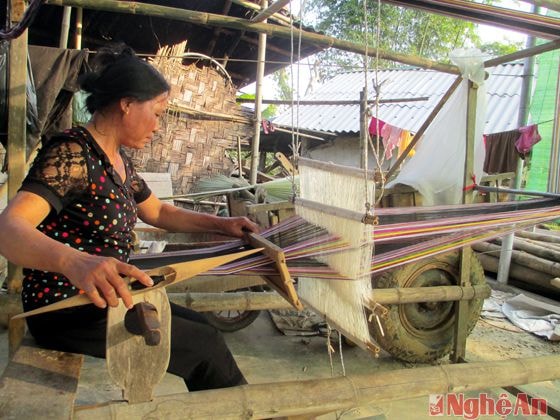 |
| Ms. Luong Thi Hong (from Co Noong village, Muong Ngoc commune, Que Phong district) is diligently working at her loom. |
Thai brocade fabrics are vibrant in color, with lively patterns featuring intricate details of flowers, birds, and animals, reflecting the familiar and intimate beauty of the mountains and forests. Inspired by the beauty of nature and daily life, the Thai people recreate these images on fabrics used for skirts, blankets, and scarves, serving the daily lives of the villagers. There are no fixed patterns for the decorative motifs on the fabric; everything depends on the skillful hands and creativity of each woman.
The Thai people believe that a well-woven fabric with harmonious colors is a criterion for judging a gentle and virtuous girl. Therefore, each girl pours all her thoughts, feelings, and dedication into the fabric she embroiders. If you look closely, you can see differences in the decorative patterns between young girls and older women. Young girls often embroider flowing floral patterns in bright colors, depicting dreamy, picturesque, and vibrant natural scenes, while older women tend to prefer more subdued colors with firm, symmetrical embroidery, evoking a sense of melancholy and philosophical reflections on life. However, all these embroidery patterns embody the age-old Thai people's aspirations for the flourishing of all things, a prosperous and peaceful life, and lasting harmony with nature amidst the vast, deep forests.
In Co Noong village, the locals often mention the familiar Thai saying, "Nhinh weaves cloth, chai xan he," meaning "girls weave cloth, boys weave fishing nets." It seems that weaving is deeply ingrained in the blood and flesh of the Thai people. Through the ups and downs of life, they have preserved this cultural identity, creating a unique feature in the overall Vietnamese cultural landscape. Beyond its traditional beauty, the art of brocade weaving today is also a form of production that helps the villagers improve their economic situation. Visitors, especially foreign tourists, often admire the skillful and talented hand embroidery on the brocade scarves, skirts, and bags of the Thai people. Therefore, nowadays, the people of Co Noong village not only weave cloth to meet their daily needs but also sell it to many other places. The skillful and hardworking hands of the Thai women are weaving brocade fabrics that are shipped throughout the country.
Meeting us after returning from a delivery, Ms. Sam Thi Nguyet happily said: “I often go down to Hoa Tien Cooperative (Quy Chau) to get raw materials for weaving fabric. Once finished, I take the finished products there for sale and export. Nowadays, people weave fabric for wages, so they don't have to worry much about the cost of raw materials or where to sell them.” According to Ms. Nguyet, if it's not busy with the harvest season, she can normally weave 10 lengths of coarse fabric in about a week. The embroidery process takes more time, requiring agility, skill, and creativity from the weaver.
In late December 2014, the Co Noong village was officially recognized as a traditional brocade weaving village by the Provincial People's Committee. The villagers were overjoyed, hoping for the preservation of their culture for generations to come. Lo Minh Tung, a cultural officer of Muong Ngoc commune, shared: “The recognition of Co Noong village as a traditional craft village is a great honor for the local government and the villagers. This helps to establish a brand for the products made by the villagers, making them easier to sell. More importantly, it preserves and safeguards cultural values.” In today's market economy, where many handcrafted textile products with attractive and convenient designs are available, preserving traditional values like brocade weaving is highly meaningful. During the villagers' leisure time, after the farming work is finished, classes are organized with government funding, inviting skilled weavers to teach their experience to the women in the village. The beauty of culture is thus passed down from generation to generation.
We said goodbye to Co Noong as the sun shone brightly over the mountaintop, peach and apricot blossoms adorning a corner of the sky. The Lunar New Year was approaching, and Thai girls, dressed in their colorful brocade dresses, swayed to the rhythmic sounds of the bamboo flutes and pipes played by the village boys.
"I spin the yarn into mulberry flower shapes."
I weave the loom into a diagonal brocade.
I weave silk into a golden flower.
People from the villages and wards wanted to cry.
They all wished she would embroider a scarf for them…
Phuong Thao