

Inadequacies in mooring and storm shelter for ships and boats.
(Baonghean) - Nghe An currently has about 4,200 boats and ships, of which over 1,200 have a capacity of 90 horsepower or more. However, the mooring areas for these vessels are both inadequate and insufficient, failing to meet the needs of fishermen, especially during the rainy and stormy season...
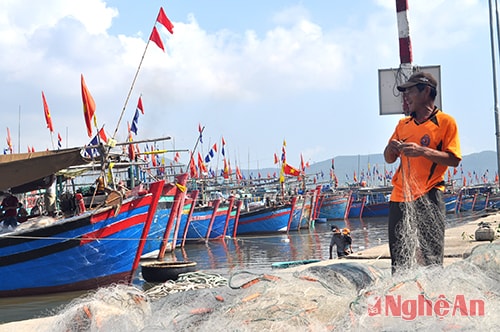 |
| Fishing boats are anchored at Lach Corn (Hoang Mai town). |
Overcrowding at mooring areas.
We arrived at Cờn estuary – the mooring place for fishing boats from Quỳnh Phương and Quỳnh Dỵ wards and Quỳnh Lập commune (Hoàng Mai town). On the shore, fishermen were busily tidying up their fishing gear; at the dock, dozens of boats were moored close together. Fisherman Hồ Trung Cần from Thân Ái block, Quỳnh Phương ward, was busily untangling his nets while expressing his concern: “Recently, more and more people have invested in larger boats for fishing, but whenever we hear weather forecasts predicting monsoon winds and storms, we are very worried because there is no safe place to take shelter, especially for large boats, as it is difficult to pass under Cờn bridge. Normally, when the water level is low, we can pass; but on days with high water levels, especially when Vực Mấu reservoir releases a large amount of water, the only way is to go to Hoàng Mai bridge. Sometimes, Hoàng Mai bridge is also overloaded, and we have to go all the way to Thanh Hóa. We fishermen hope that the government will invest in upgrading the waterway so that we can feel secure going out to sea.”
At Quèn estuary, dozens of boats are anchored along the channel. Having worked in the profession for over a decade, Mr. Hồ Mậu Dương, a fisherman from Hamlet 5, Quỳnh Minh (Quỳnh Lưu), said: “Normally, anchoring isn’t too difficult, but it depends on the tides and the day. The hardest part is during stormy weather, when boats lack shelter. Currently, on the Quỳnh Thiện side of Quèn estuary, there are no more than 10 boats anchored, and on the Tiến Thủy side, only a few dozen vessels, while in reality there are about 400 boats from the communes of Tiến Thủy, Quỳnh Long, An Hòa, and Quỳnh Nghĩa. The lack of safe anchorage has also caused many boat owners to lose trust and have led to numerous clashes among fishermen.”
Quynh Luu District currently has two main boat mooring areas: Quen Lagoon and Thoi Lagoon, but there are 1,230 fishing vessels, including 640 large-capacity vessels engaged in offshore fishing. Currently, these mooring areas only accommodate about 50% of the actual number of vessels. The lack of mooring space, especially at the end of the lunar month when boats return, has created overcrowding, making it difficult for boats to enter and exit. Boats arriving early have more space to moor and transport their catch for sale; conversely, boats arriving late have to moor further offshore, making it difficult to transport their catch. Furthermore, due to siltation in the lagoon, boat owners have to wait for high tide to be able to moor. Currently, at Quen Lagoon, construction is underway on three new embankments with mooring posts, totaling 2,000 meters in length; and construction of wave- and erosion-resistant embankments is continuing in the southern part of Hau River in An Hoa commune. Meanwhile, dredging is underway in Thoi Lagoon. Given the current overcrowding situation, the District People's Committee has been promoting and mobilizing resources to upgrade existing mooring areas; proposing to the province to expand mooring areas and fishing ports to serve vessels going out to sea. In addition, it has directed communes to manage vessel traffic and instructed ship owners to organize safe mooring. For large vessels without mooring points, ship owners are encouraged to find suitable locations…
Urgent need for upgrading and expansion.
Nghe An is one of the provinces with the fastest-growing number of fishing vessels in the country, with 80-100 new vessels built each year. This development raises the question of how to provide adequate logistics and storm shelter services to meet the demand. Currently, the province has planned for 5 storm shelter areas: Lach Van, Lach Quen, Lach Thoi, Lach Lo, and Lach Con, and one regional-level anchorage area - the Cua Hoi anchorage area - serving the provinces of Nghe An, Ha Tinh, and Thanh Hoa. These 6 anchorage areas provide shelter for over 3,000 vessels. All anchorage areas have been and are being upgraded. In Dien Chau, the Lach Van storm shelter area has been completed, accommodating over 500 boats; the Lach Lo project, funded by a World Bank loan and managed by the Department of Agriculture and Rural Development, is underway to serve vessels with a capacity of less than 250 horsepower. The Thoi Lagoon anchorage area (Son Hai - Quynh Luu) was invested in 2013 with a total capital of 80 billion VND from the government's storm shelter program. The Cua Hoi storm shelter anchorage area, invested by the Ministry with a total capital of 150 billion VND, is also currently under development. Currently, the Department of Agriculture and Rural Development is also investing in upgrading and expanding the Quen Lagoon fishing port combined with dredging the waterway, and investing in upgrading the Corn Lagoon anchorage area.
However, the problem is that the number of boats and ships has increased significantly, with many large vessels having a capacity of 400-1000 horsepower, while the waterways are shallow, making entry and exit difficult. Mr. Tran Huu Tien, Deputy Director of the Department of Agriculture and Rural Development, recalled last year's typhoon season, when, with only an hour left before the typhoon hit the Nghe An sea area, hundreds of vessels waiting to anchor and take shelter in Van estuary (Dien Chau) were stranded due to shallow waterways and low water levels. Larger vessels had to seek anchorage at Hoang Mai bridge. Mr. Tien stated: "Although we are very concerned, in recent years, due to limited funding and meager capital (only a few tens of billions of VND per year), while investing in typhoon shelters for boats and ships requires significant costs, the implementation has been inconsistent, with many projects delayed and resulting in waste." For example, in 2012, Quynh Luu district received investment for a Cờn estuary mooring area project to accommodate 500 ships with a total capital of approximately 80 billion VND, but the project is currently unfinished due to a lack of funding.
Despite remaining challenges, it must be affirmed that, in terms of policy, investment in the development of the fisheries sector in general, and storm shelters in particular, has received attention. However, with the rapid growth of vessels and the sharp increase in the number of newly built boats in recent years, the logistics of the fisheries sector, including mooring and storm shelter areas, have not kept pace and have become inadequate. Decree 67 on some policies to support the development of fisheries is considered a boost to accelerate the construction of mooring areas.
Text and photos:Thu Huyen