
People from Nghe An living in South Korea
(Baonghean) - Nghe An is the leading province in the country in terms of the number of workers employed in South Korea. In this foreign land, a microcosm of society with diverse aspects of life is unfolding, yet still bearing the strong imprint of the daily life and culture of their homeland...
(Baonghean) - Nghe An is the leading province in the country in terms of the number of workers employed in South Korea. In this foreign land, a microcosm of society with diverse aspects of life is unfolding, yet still bearing the strong imprint of the daily life and culture of their homeland...
 |
| The Nghe An migrant worker community participated in a multicultural festival in Changwon City, South Korea. |
Community responsibility
Workers from Nghe An in South Korea are concentrated in the provinces of Gyeonggy, Incheon, Gyeongnam, and Busan. Through labor export companies, people from Nghe An arrived in South Korea quite early, from the early 1990s, as crew members working on fishing vessels or as trainees.
Since 2004, with the Korean Employment Permit System (EPS) program for foreign workers, the number of people from Nghe An working in Korea has been increasing. An interesting comparison is that while Vietnam leads among the 15 countries sending workers to Korea under the EPS program, Nghe An province leads in the number of workers sent to Korea. According to statistics from 2004 to 2014, 6,273 people from Nghe An went to Korea under the EPS program, not including those who registered through vocational schools and units of the Ministry of National Defense.
From South Korea, the hearts of those living abroad always follow their homeland. Information about natural disasters and floods is shared and exchanged among them. Earning money through hard work in a foreign land is not easy, but they never forget to remind each other of their love and responsibility to their homeland. In a conversation with me, Tuan, who has been in South Korea for 3 years under the EPS Program and manages the "Choa Dan 37" Facebook page in Korea, said: "Our compatriots back home are still facing difficulties. Every year there are natural disasters and floods. Although we work hard, we want to share the difficulties of our people back home with all the love and sincerity of those living far from home."
During typhoons No. 10 and No. 11 in 2013, the Nghe An community in South Korea raised over 150 million VND to support flood victims in Hoang Mai town. The Vietnamese community in the Busan area still remembers the horrific accident involving Thanh and his fiancée, Mai, both from Nghe An. After participating in a community activity, on their way home, Thanh's car was involved in an accident. Mai died instantly, while Thanh was critically injured. The Nghe An Hometown Association, the "Choa is a 37-year-old in South Korea" Facebook page, and their friends handled the legal issues, raised funds, and supported the victim's family with over 20 million won (approximately 20,000 USD) for Thanh's medical treatment and to bring Mai back home. "In a foreign land, the bond of fellow countrymen is the root connecting us to our homeland, making us stronger when facing difficulties and hardships," Tuan confided. Currently, many activities focused on supporting the homeland and sharing with those in difficult circumstances are still regularly maintained on the fanpage.
When mentioning people from Nghe An in South Korea, almost everyone knows about Mr. Vo Trong Kien, a native of Nghe An with many charitable activities for the community. His free Korean language classes have helped many Vietnamese workers and brides overcome their initial language barriers and adapt to their new lives. What is particularly commendable is that, to acquire the Korean language skills to teach his students, Mr. Kien, starting from a working-class background like many others, independently researched and developed lesson plans tailored to the work and lives of these laborers.
Ms. Lan, originally from Vinh City, came to Korea through marriage and now has a happy family there. Working at the Center for Supporting Foreign Workers in Incheon City, Ms. Lan has, over the years, provided legal support and advice to workers, helped with wage and insurance claims, and mediated conflicts between workers and companies. Many others, like Tuan, Mr. Kien, and Ms. Lan, continue to dedicate themselves to these community service efforts, contributing to building a positive image of people from Nghe An province in South Korea.
Passion for football
When talking about people from Nghe An in South Korea, one cannot ignore their passion for football. From Incheon to Busan, wherever the Nghe An dialect is spoken, there are football clubs, and these clubs winning community tournaments is "a daily occurrence." Among them, the most famous is the Song Lam Nghe An Korea team, a team comprised of many outstanding players who have won numerous championships at Vietnamese community sporting events. Their well-organized structure and strength are not surprising, as their squad includes several players who previously trained with Song Lam's youth teams. I asked Mr. Hung, the coach and team owner, about the reason for the team's creation, and he explained: "The Nghe An Hometown Association has many people who are passionate about football and are skilled at it. The team was created to satisfy the members' passion for the sport, strengthen solidarity within the community, and provide a healthy playground for them to improve their health, preventing them from wasting time on pointless entertainment and social vices."
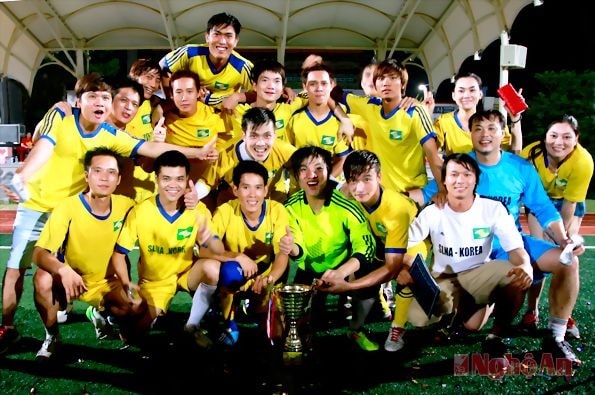 |
| The Song Lam Nghe An Korea football team has won numerous championships at sporting events organized by the Vietnamese community in South Korea. |
During my business trip to South Korea, a friend working at the Embassy invited me to watch the football match between the Vietnam U23 team and the United Arab Emirates U23 team at the Asian Games. There were quite a few Vietnamese fans watching and cheering for their team. What surprised me was that many people in the stands were wearing the traditional yellow jerseys of the Song Lam Nghe An Football Club with the words "Que Choa" (Our Hometown) on the back. Without asking, I knew they were loyal fans of the Song Lam Nghe An team. Being from Nghe An myself, I understand that, wherever they are, the love for football and love for their homeland of the people of Nghe An always has a unique character, something... very Nghe An.
While discussing the situation of Nghe An workers in South Korea with a colleague in labor management, my usually tactful friend half-jokingly remarked, "Nghe An is the best, isn't it?" This remark, tinged with praise but also containing a subtle, hard-to-explain meaning, piqued my curiosity. Thus, my journey in South Korea took on another mission: to uncover the "best" aspects, as my friend described them, of my fellow countrymen.
Sad and happy about job opportunities...
The author of this article is working in monitoring and managing Vietnamese labor in South Korea. During this work, we have observed that many people from Nghe An in South Korea are contributing daily to building a united and thriving Vietnamese community, earning the respect of their Korean friends. Many young people from Nghe An have returned on time after their contracts expired, establishing successful careers in their homeland. They understand that success in life doesn't solely come from money; the accumulated wealth in South Korea is only a foundation, while sustainable development can only be achieved in their hometown. However, there are still those who have broken their commitments to return home, dashing the hopes of young people back home who were waiting for the day they could work in South Korea, a dream they themselves had cherished 5-7 years ago.
There are still stories filled with deep reflection from my fellow Nghệ An natives I met in South Korea. The couple, Mạnh and Loan, live in a town near Kimhe City in southern South Korea. Both are from Nghi Lộc, Nghệ An. Mạnh was an EPS worker who had absconded and been working illegally for three years. Loan came to South Korea through a sham marriage; they met and fell in love in South Korea. When I met them, they were happily welcoming a new member to their family. I was concerned about the legal status of the baby, given that both husband and wife were living illegally and were not legally married. Mạnh shared that, due to their current circumstances, they couldn't register the child's birth. Therefore, when Loan went to the hospital to give birth, they had to use a fake name and documents belonging to his younger sibling (who was working legally). This was also to make it easier for the younger sibling and their spouse to take the child back to their hometown to be looked after by the grandparents later. I felt a pang of sadness, because without legal status, they were deprived of the most sacred and precious privilege of parenthood: the right to have their name on their child's birth certificate.
Following an official from the Vietnamese Embassy in South Korea, we met several illegal laborers being detained at the Immigration Office's detention center in Daegu. Among them was Quan, from Dien Chau, waiting for his employer to pay his wages and for his friends to bring his belongings so he could return home. Quan said he had been arrested the day before yesterday during a raid at the factory along with several other Vietnamese people. I asked: Why didn't you return home on time to take advantage of preferential policies? Quan replied: "My friends told me to stay, others told me to go home. I had just built a house in my hometown and used up all my capital. I thought I could stay for a few years to earn some more money and then return to start a business. I never imagined that after only a few months, I would have no way back to South Korea. If I had known this, I would have gone back to take the Korean language test."
Many people like Quân, after more than four years in South Korea, can accumulate around one billion Vietnamese dong. However, the challenge of managing and using this money effectively to create a stable life and career upon returning home is something few have been able to achieve. Income sent back from South Korea mainly revolves around building large houses and buying expensive amenities. Before they know it, their contracts are over, and their bank accounts are almost empty. This has driven many workers to stay illegally after their contracts expire. According to South Korean immigration law, illegal workers like Quân will have their fingerprints taken and be banned from entering South Korea for five years under any circumstances. The most regrettable thing for Quân is that instead of returning on time to seize the opportunity to work in South Korea again, he chose to stay illegally and was arrested shortly after.
What is worrying is that workers' understanding of this issue is still simplistic; staying after their contract expires seems like a simple choice, without much consideration of the short-term material benefits versus long-term, sustainable rights, as well as personal responsibility and the image and reputation of the community. In the struggle for survival, seeking a better future without legal status pushes them into difficult situations. Their initial dreams may fade with time, and paths that seemed close suddenly become distant due to miscalculations.
In the 2011 Korean language proficiency test, Nghe An province had the highest number of registered candidates, with 13,028 applicants, accounting for nearly 20% of the total number of participants. This number reflects the high demand from young people in Nghe An who wish to work in South Korea. However, the increasing number of workers whose contracts have expired but do not return home will be a major obstacle for Nghe An in sending workers to South Korea in the future. Reducing the rate of illegal labor from Nghe An in South Korea is a difficult problem for the Department of Labor, War Invalids and Social Affairs of Nghe An province and other localities if specific, decisive, and thorough solutions are not implemented. Workers returning home after their contracts expire to await further employment opportunities is not only the responsibility of each individual worker but also reflects their responsibility to their families and society.
Phung Quang Trong
Vietnam Labor Management Office under the EPS Program