

Traditional New Year attire in some Asian countries
During the joyous Lunar New Year celebrations, people in Asian countries wear their finest clothes to visit relatives and friends, and to enjoy the spring festivities. Although society is increasingly developing and many foreign cultures have entered Asian countries, on important occasions like the Lunar New Year, many still choose to wear their traditional national attire as a beautiful and distinctive cultural expression.
Below are some examples of traditional New Year's attire from countries near Vietnam, such as China, Japan, and South Korea.
China
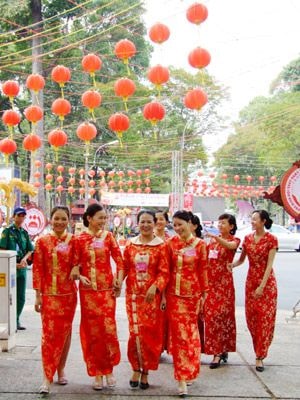 |
Similar to the Vietnamese ao dai, the Chinese cheongsam is a traditional garment deeply rooted in the national culture of the Chinese people, the majority ethnic group in China. The cheongsam hugs the body, accentuating its natural curves and subtly revealing the graceful figure, rounded shoulders, and slender waist of a woman. This style of presentation aligns with the refined and elegant expression of physical beauty by Eastern women.
The cheongsam is a one-piece dress, usually made of brocade or silk. The neckline is fitted and features a row of buttons diagonally to one side. The dress is tailored close to the body, with a high slit extending up to the thigh, creating an elegant and alluring look. The highlight of this garment is often the brightly colored embroidered trim with rich patterns. People often wear this dress during festivals, important occasions, and the Lunar New Year.
The cheongsam is also known as the Shanghai dress or, according to the Cantonese pronunciation, the qipao.
The Qipao is believed to have originated during the Spring and Autumn and Warring States periods, over 2000 years ago, initially called the Baofu. During the Han Dynasty, the Baofu was worn for court ceremonies. The style of the Baofu also changed over time. Han Dynasty Baofu was dark in color, while during the Tang Dynasty it was replaced with a side slit and a flared skirt. During the Ming Dynasty, the Baofu became straighter and wider, and was worn by intellectuals and the ruling class, gradually becoming popular. After the fall of the Qing Dynasty, Qipao continued to exist. In Shanghai – the fashion capital of China – Qipao was modernized, contributing to the "golden age" of the Shanghai cheongsam in the 1930s and 1940s. This is also why, whenever the cheongsam is mentioned, people often associate it with Shanghai as the birthplace of this garment. During this period, the cheongsam was shortened to become more streamlined and elegant, with less ornate patterns and borders. In the 1920s, influenced by Western culture, the Shanghai cheongsam underwent changes in design, becoming more fitted at the waist. From then on, many new ideas emerged, continuously altering the style of the Shanghai cheongsam.
Today, the cheongsam has undergone many innovations, such as sleeves that are sometimes narrow and sometimes flared, long or short hems, and necklines that can be high or low depending on personal preference. People no longer wear this garment only on festive occasions but also on ordinary days.
Japan
 |
When mentioning the land of cherry blossoms, no one can forget the elegant folds of the kimono. These kimonos, distinguished by a layer of fabric that shapes the waist, offer a graceful look to the wearer. And like other Asian countries, the Japanese also favor bright colors for their kimonos during the New Year. In addition, flowers or images of temples and pagodas are often depicted on the kimono, making it even more interesting and striking.
In Japanese, kimono means "winter attire," a noun referring to clothing worn in general. However, today, kimono has become the name for the traditional Japanese garment that is widely known.
In the past, kimonos were worn daily by both men and women. However, nowadays they are usually worn by women as formal attire, while men are only seen wearing them at weddings or other traditional ceremonies.
Structurally, a kimono consists of four main pieces: two bodice pieces, two sleeve pieces, and smaller pieces for the collar and a narrow lining. It also includes accessories such as a belt (obi), ties, and undergarments. Because of its elaborate design, the kimono is difficult to wear and commands a relatively high price.
Men's and women's kimonos differ in pattern. Women's kimonos often feature floral, leaf, and other nature-inspired motifs, reflecting the Japanese love of nature. Men's kimonos, on the other hand, are usually plain, dark in color, and often bear the family crest; black is considered the most elegant color. The color of a kimono can easily reveal the wearer's social status or age. Brighter colors, especially red, are used for children and young unmarried women. The colors of kimonos often symbolize the seasons.
Kimono comes in many types, each with its own meaning and characteristics. For example, Furisode is a type of kimono specifically for unmarried women, with wide sleeves, often worn on major holidays. Yukata is a common kimono, worn in the summer. Houmongi is the ceremonial attire of married women, used for weddings or tea ceremonies. Tomesoda is a formal garment for married women; black Omesode embroidered with family crests is worn for formal events such as a relative's wedding. Shiromaku is the wedding dress of Japanese women, with a long, flowing, rounded train...
Korea
 |
During the Lunar New Year, Koreans typically wear Hanbok, a traditional garment deeply rooted in Korean culture. Hanbok symbolizes the traditional beauty of Korean women and plays a crucial role in showcasing the country's cultural heritage. Although not form-fitting, Hanbok subtly reveals the lovely, delicate beauty of Korean women. A distinctive feature of Hanbok is its vibrant colors, making the streets of Korea during the New Year a dazzling display of cheerful hues.
This type of clothing can cover the body, allowing the wearer to move comfortably while still showcasing the subtle beauty and allure of a woman with every step.
From ancient times to the present day, Koreans have chosen to wear Hanbok on traditional holidays, Lunar New Year celebrations, or joyous occasions such as weddings and festivals. Even on the red carpet today, we still see famous stars in Hanbok with designs that are both traditional and modern.
Essentially, women's Hanbok consists of an outer jacket (jeogori) and a long skirt (chima), while men's Hanbok consists of an outer jacket and wide-legged trousers with pockets (baji). The outer jacket, used by both men and women, includes the gil (the largest part of the jacket), the git (a decorative silk sash for the collar), the dongjeong (a white collar), and the goreum (a belt).
Hanbok is categorized into everyday wear, ceremonial wear, and special wear. Ceremonial wear is further divided into outfits for holidays, birthdays, weddings, or funerals. However, regardless of the type, hanbok always gives the wearer a balanced, harmonious, and refined appearance.
According to Chinhphu.vn