

Did the "Trojan Horse" finish the race in Greece?
(Baonghean) - On Wednesday, February 4th, the European Central Bank (ECB) decided to cut one of Greece's liquidity sources. The consequence of this decision is that negotiations between the government of Alexis Tsipras and the Troika, comprising the ECB, the International Monetary Fund (IMF), and the European Commission, will take place sooner than planned.
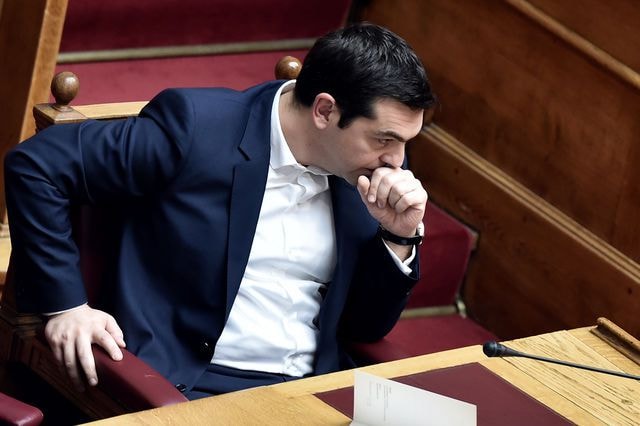 |
| Greek Prime Minister Alexis Tsipras and the difficult question posed to Greece's economic and political destiny. |
Europe's intention is to extend the aid program and allow more time to negotiate with Greece on the terms of a new "contract": reforms, public debt, repayment rates, etc. On Thursday, February 5th, following the ECB's announcement, the pressure on European countries to quickly resolve the "Greek problem" seemed to become even heavier and more urgent, although it cannot be denied that this decision has the potential to lead to a positive change in the situation.
A source from Brussels said: “Mr. Tsipras will quickly realize that he doesn’t have many choices and that respecting European partners is absolutely essential. They are willing to help Greece, but in return, Greece must recognize that some countries, Germany for example, are taking a very hardline stance, and Greece itself must take the initiative to move closer.”
Between now and February 28th, three weeks from now, the Greek government must reach an agreement with its creditors to close the second financial assistance program it has received, which amounted to 130 billion euros and was activated in 2012. Only after closing this program will Greece be eligible for a third aid package totaling approximately 3.6 billion euros, but only on the condition that it implements a series of reforms outlined in the Troika.
This includes a policy of further reducing the size of the state apparatus. However, it is unlikely that Greece will be able to "activate" the third bailout package, because the previous government of Antonis Samaras never reached a consensus with the Troika on the conclusions of the second bailout package. Therefore, European countries are taking a very realistic view of the issue, considering the completion of negotiations within three weeks to be unrealistic, especially with a government that has only been in power for a mere 15 days. In that case, Greece would face significant financial difficulties because it would not receive the aforementioned multi-billion dollar bailout package and would only be able to rely on one instead of two sources of liquidity.
In anticipation of this, Greece's creditors have opened the door to a "technical extension" of the bailout program, for about four to five months, to conclude the second bailout package. This was the message delivered by European Commission President Jean-Claude Juncker on Wednesday, February 4th, during a meeting with Alexis Tsipras in Brussels.
On Thursday, February 5th, German Finance Minister Wolfgang Schauble reiterated the same view to Greek Finance Minister Yanis Varoufakis during the latter's visit to Berlin. What worries Europe is that "Mr. Tsipras and Mr. Varoufakis still haven't realized that Greece is in a 'knife to its throat' situation; if they understood that, things would be resolved. Otherwise, everything will reach a dead end." Furthermore, Mr. Juncker emphasized to Mr. Tsipras that this weekend, before the Greek Parliament, he will have to declare that the country is complying with its commitments to its European partners.
The Greek issue is quite contradictory, as creditors are urging Greece to continue receiving aid. In reality, Greece plays a proactive role in deciding whether or not to activate new aid, as an extension requires a formal request from the borrowing country. So why would Greece refuse such a lucrative opportunity? Because nothing is free: continuing European aid means accepting Troika oversight for many more months.
Thus, this decision not only concerns financial and economic issues but also has a significant political impact. This is especially true since Tsipras's entire election campaign was based on denouncing the harshness and "authoritarianism" of the Troika. On Monday, February 9th, a vote of confidence in the government will take place before the Greek Parliament, and that will be the final deadline for Tsipras to make his ultimate decision: to request an extension of aid or not?
If Greece signals that it “understands the issues and expectations” of European countries, the Eurogroup – the meeting of finance ministers from the eurozone – will be convened in an extraordinary session, likely on February 11th. This date has been scheduled by Brussels for the past week, but “Until the Greeks send a positive signal, convening a meeting is pointless.”
The main purpose of the meeting is to "pave the way" for eurozone countries before making political decisions. At the same time, it serves as a foundation for an informal meeting of the European Commission, bringing together leaders from the 28 EU countries – initially intended to discuss Ukraine and the fight against terrorism – with former Polish Prime Minister Donald Tusk chairing the meeting. It's important to remember that Poland is not part of the eurozone, so convening the Eurogroup is an opportunity for eurozone countries to sit down together, determine common directions and interests directly affecting each member. Following this, on February 16th, the Eurogroup's scheduled meeting will take place – a crucial event in deciding whether to halt the extension of aid to Greece.
Therefore, in the short period from then until the end of February, if Greece requests an extension, the official decision will have to be approved by the parliaments of the member states to be recognized as effective. Notably, Germany and Finland are two countries that are maintaining a rather firm stance on the Greek issue.
It's difficult to hope for successful negotiations in such a critical period, especially given the open animosity between Germany and Greece. During his visit to Berlin on February 5th, Germany flatly refused to forgive Greece's debt and also showed no willingness to revisit the issue of continuing aid programs.
Clearly, Greece is in a rather "awkward" situation, declaring its severe debt crisis but unwilling to provide aid, instead requesting debt forgiveness from European nations. There are concerns about becoming too dependent on and deeply involved with the Troika – a "Trojan horse" in finance and politics? But that "horse" has already gone more than halfway with two extremely large bailout packages, and now it will not be easy for Greece to sever this connection. One thing is certain: the Greek problem will not be resolved anytime soon, as Europe and Greece only "share the view that we do not share the same view," as German Finance Minister Wolfgang Schauble succinctly stated after meeting with his Greek counterpart.
Thuc Anh(According to Le Monde)
| RELATED NEWS |
|---|