

Nam Dan on a new path
(Baonghean) - To create a modern and prosperous new rural landscape and improve the lives of the people, the Party Committee of Nam Dan district advocates promoting the people's right to self-governance so that "the people know, the people discuss, the people do, the people inspect, and the people benefit." Persistently following this direction, after four years of concerted efforts in implementing the national target program for building new rural areas, the district, the birthplace of President Ho Chi Minh, has seen many positive changes.
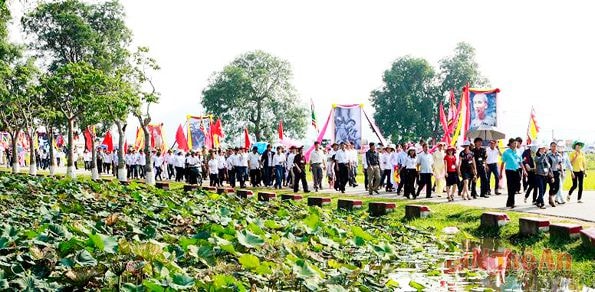 |
| Lotus Village Festival (Kim Lien commune - Nam Dan district). Photo: Sy Minh |
The new rural landscape
Recognizing that the task of building new rural areas would create comprehensive development in each locality and contribute to the overall development of the district, the Nam Dan District Party Committee issued Resolution No. 04 on implementing the national target program for building new rural areas, giai đoạn 2010-2020. Accordingly, Party committees, government agencies, the Fatherland Front, and mass organizations from the district to the grassroots level have actively sought solutions for implementation. The top priority is to strengthen propaganda, promote democratic principles, and effectively implement the motto "the people know, the people discuss, the people do, the people inspect, and the people benefit." Vice Chairman of the District People's Committee Le Thi Hang shared: "Once the mindset is clear and consensus is created among the people, many families are willing to donate land, assets, contribute money, labor, and mobilize maximum external resources from businesses to children living away from home to contribute to building new rural areas."
As a result, after 4 years of implementing the New Rural Development program, Nam Dan district has paved nearly 340 km of rural roads of all types; reinforced nearly 70 km of irrigation canals; built 14 new commune People's Committee offices; 6 commune cultural houses and 69 hamlet cultural houses. New classrooms were built and upgraded at 42 schools of all levels; 15 commune health stations were constructed, and many other projects were upgraded and built. The total investment value for construction exceeded 834 billion VND, of which the people contributed nearly 191.4 billion VND, accounting for 23%. In addition, the people throughout the district voluntarily donated 121,000 m2 of land and contributed more than 20,000 man-days to expand and upgrade rural infrastructure. Consequently, the appearance of hamlets, villages, and communes has undergone significant changes and progress.
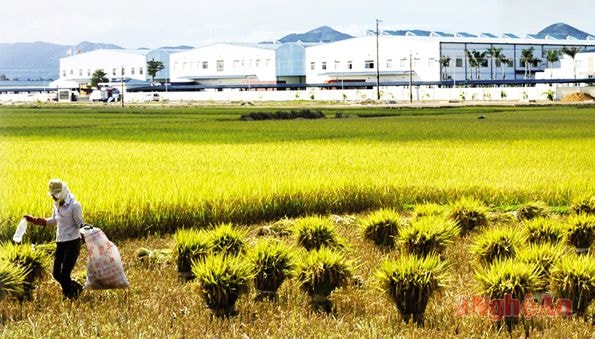 |
| Harvesting the spring rice crop in Nam Giang. Photo: Sy Minh |
Besides building modern infrastructure, localities have also focused on waste collection and treatment, emphasizing tree planting to create a green, clean, and beautiful environment. Many localities have implemented models of waste pits, waste sorting at each household, and centralized processing at the commune's landfill. Some communes, such as Kim Lien, Nam Cat, and Nam Giang, cooperate with the Vinh Urban Environment Company to transport waste for processing at the Nghi Yen landfill. Most communes are actively participating in the "All People Unite to Build a Culturally Rich Life in Residential Areas" campaign. 200 out of 320 hamlets meet the standards of cultural villages, and 82% of families have achieved the title of "Culturally Rich Family." Many communes are paying attention to building cultural institutions and doing a good job of preserving historical and cultural relics. Regarding the quality of education, there has been positive progress, with an average of over 100 students achieving the title of excellent student at the provincial level each year; 10 students have achieved the title of excellent student at the national level. The political system is being nurtured with an increasingly standardized team of commune officials; the activities of the Party committees, government, Fatherland Front, and other organizations are being effectively reformed; the number of communes completing the criteria for the political system has increased to 13 out of 23 communes and towns; and all 23 communes have met the criteria for security and social order.
Improving people's living standards
The goal of the New Rural Development program is not only to change the face of the countryside, but more importantly, to improve the lives and incomes of the people. Therefore, in the process of building new rural areas in Nam Dan, the Party committees, government, and political system have focused on directing and promoting production development, building and replicating economic models, and increasing people's income. In Kim Lien commune, in recent years, successful models such as "Building high-income fields," "Building large-scale model fields," and farm economics combined with the introduction of mechanization have increased income per unit area. Along with agriculture, Kim Lien has promoted the development of trades, services, and commerce with 26 milling and animal feed processing machines, 275 small-scale trading households, 6 construction enterprises, 36 construction and carpentry teams, 25 transport vehicles, and 11 passenger vehicles. At the same time, the commune has promoted labor export, with 247 people working abroad, bringing in approximately 30-32 billion VND in foreign currency annually. Thanks to the correct direction of economic restructuring, the average per capita income has continuously increased, reaching 26 million VND/person in 2014; the poverty rate has decreased to 3.9%.
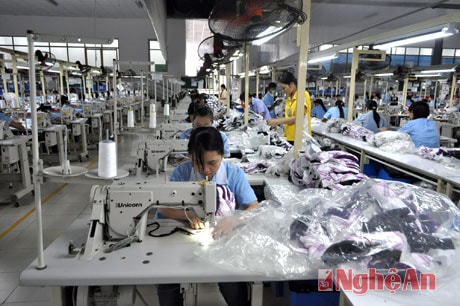 |
| Modern sewing line at Haivina Kim Lien Company - Nam Dan. Photo: MH |
As for Nam Thai commune, a mountainous area and one of the five most disadvantaged communes in the district, the commune has focused on restructuring crop patterns, increasing land use frequency, and enhancing value per unit area to improve people's income. Accordingly, many areas of garden land, hillsides, and mountain slopes in Nam Thai have been exploited, creating commodity production zones, such as models for growing water spinach, jasmine flowers, oranges, tangerines, persimmons, lemons, and green tea commercially. Thanks to this, currently 100% of Nam Thai's production land achieves an income of 50 million VND/hectare/year or more, with nearly 100 hectares yielding over 80 million VND. Notably, some areas of jasmine flowers, water spinach, and shallots generate incomes ranging from 150 to 300 million VND/hectare/year.
Deputy Chairperson of the District People's Committee, Ms. Le Thi Hang, added: All localities in the district are focusing on their strengths in agricultural production towards a commodity-based approach. In fact, looking at the agricultural economic landscape of Nam Dan district at this point, it's easy to see distinct economic "streaks," such as vegetable farming in Xuan Hoa, Nam Xuan, Nam Anh, and Nam Thanh; sweet corn in Nam Thai; export-oriented chili peppers in Hung Tien and Khanh Son; and many farm economic models combining livestock farming with fruit tree cultivation or applying science and technology, introducing mechanization into production, and increasing income per unit area in Nam Cat, Kim Lien, and Nam Giang. Livestock farming has gradually shifted from small-scale to concentrated, commodity-based production. The entire district currently has 685 small and medium-sized farms, including 15 farms with revenue exceeding 1 billion VND/year and 19 farms with revenue ranging from 500 million to 1 billion VND/year. The district proactively strengthens joint ventures and linkages with businesses, from supplying seeds and agricultural materials, providing technical guidance on production to guaranteeing the purchase of agricultural products from farmers. This promotes the restructuring of the agricultural economy, contributing to increased income, poverty reduction, helping people to prosper, and accelerating the process of building new rural areas in each locality. The average per capita income in the district in 2014 reached 24.5 million VND, an increase of 1.4 times compared to 2010.
Thanks to the strong efforts of the entire political system from the district to the grassroots level and the active participation of the people as the main actors, the New Rural Development movement in Nam Dan has achieved many results. By the end of 2014, Nam Dan district had 4 communes that had achieved the New Rural Development standard: Kim Lien, Nam Giang, Nam Cat, and Nam Trung. Based on the success and experience of these communes, the district continues to direct the expansion of the program to the remaining 19 communes, aiming for an additional 6 communes to meet the standard in 2015: Van Dien, Xuan Hoa, Nam Anh, Nam Xuan, Nam Thuong, and Nam Nghia. The results of the New Rural Development program are creating a solid foundation for Nam Dan's comprehensive development towards prosperity, beauty, and civilization, and to soon become a model district as President Ho Chi Minh envisioned.
Mai Hoa