
Poet Phan Quoc Binh: A man lost in the city
(Baonghean) - If one day you see, on the bustling streets of Vinh City, a thin man, wearing a faded gray shirt, with long salt-and-pepper hair falling over the brim of his baseball cap, and eyes that seem bewildered but hold a deep sense of calm, slowly riding an old bicycle with a horizontal frame, that is indeed the poet and painter Phan Quoc Binh.
(Baonghean) - If one day you see, on the bustling streets of Vinh City, a thin man, wearing a faded gray shirt, with long salt-and-pepper hair falling over the brim of his baseball cap, and eyes that seem bewildered but hold a deep sense of calm, slowly riding an old bicycle with a horizontal frame, that is indeed the poet and painter Phan Quoc Binh.
It's easy to get the impression that he's old-fashioned. I used to be mistaken about him too, until I read his poems and I was stunned by the "modernity" in his poetry, not only in its non-conformity to grammar, as the poet Chế Lan Viên put it, but also in its structure, its "perspective," and the poet's perspective.
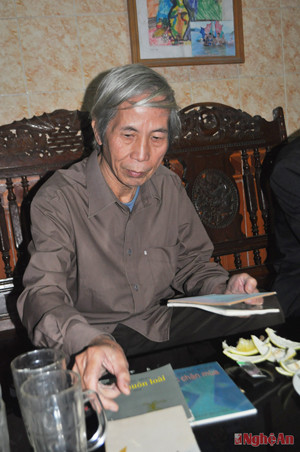 |
| Poet Phan Quoc Binh |
“People reject me / My love has no place to go / My love is carried away by the wind / Sent to the sky, sent to the grass and trees / And people don't know / Every day I live / I walk in the melody of my love” (The poem “Essence”) - that, like a self-confession. That's him, calling poetry melodies rising from the soul, looking at life with a gaze full of love, even in the most sorrowful circumstances always finding something good to believe in, and “with literature alone, life is complete.” I saw those simple beauties when I sat with him, in a house that seemed to retreat a little further from the hustle and bustle of Nguyen Duy Trinh street, amidst the oil paintings that had hung on the walls for decades and the thin volumes of poetry printed on black paper, also from decades ago.
With utmost affection and patience, he conversed with us, sharing stories of the distant past, reminiscing about his literary and artistic careers, and recounting the joys and sorrows of life. I remarked, "You're like someone lost in the city!" He laughed, saying that perhaps the country boy and the mountain man within him were inseparable. "I only lived in my hometown for 18 years, but that was a more profound period than any other," just as the 10 years he spent in the mountains of Northwest Vietnam (Lai Chau) were "an unforgettable experience." His hometown, a peaceful village beside the La River, a river with "sails sailing up and down," and "waiting docks." It was there, in 1948, that young Ngo Quoc Binh was born and grew up with "the jackfruit tree my father planted," the "season of ripe apricot blossoms," and the lullabies of "Chinh Phu Ngam" and "Kieu" sung by his mother. His parents were poor farmers, but they loved literature and had a deep compassion for others. He recounted, "My mother, and her life, was a shining example of kindness, selflessness, and sacrifice. One summer afternoon, when she caught someone climbing a tree to steal jackfruit, she calmly said, 'Don't be afraid, climb down slowly so it doesn't fall. Just pick one, leave some for Binh.' She always shared whatever she had with the neighbors. Because of this, our house was always filled with laughter. I always remembered my mother's words: she didn't expect us to be rich, but only hoped that her children would pursue education and literature."
Phan Quoc Binh was fascinated by poetry, literature, and drawing from a young age. He spent his days studying and tending cattle, and he remembers his first drawings being passionate sketches of rural landscapes on the ground. These drawings nurtured the poor boy's dream of becoming an artist. At 18, Phan Quoc Binh packed his bags and "walked along the train tracks to Vinh to participate in the preliminary selection for the Hanoi Industrial Fine Arts College." The joy that came to him was overwhelming when he received his acceptance letter. After four difficult and arduous years studying at the Industrial Fine Arts College, he graduated and was assigned to work at the Lai Chau Department of Culture, primarily painting propaganda posters. Ten years of his youth were spent in the mountains and forests of Northwest Vietnam, "ten years filled with love for the land and its people," even during the arduous days of the war against the Americans. Phan Quoc Binh said: The melancholic beauty and enchanting charm of the Northwest mountains and forests always stirred his emotions. And he picked up his brush and pen as if it were the only way. During his time in Lai Chau, he wrote about ten volumes of poetry and diaries, and painted many pictures. Later, upon returning to Nghe An, he carried on his back "only paintings and poetry." His first literary success was arguably the poem "Returning to Dien Bien," published in the Army Literature and Arts magazine in 1969. He said that the Northwest region haunted him. Even now, he still dreams of the Northwest moonlight, the moonlight "like water flowing on leaves." And that lingering taste of the mountains and forests permeates his paintings and poems even to this day.
“Along the border as spring arrives / Peach blossoms dance in the breeze / And white bauhinia flowers bloom / Their fragrances playfully chat along the road.”
Unexpectedly, after so many years away, I returned to the plains, and the scent lingered with me, in silence.
(The poem "The Silent Scent")
From the Northwest, Phan Quoc Binh moved to Vinh, initially working with the Nghe Tinh Cheo Troupe, in charge of stage decoration. After a few years, he transferred to the Provincial Fine Arts Workshop. In 1992, Phan Quoc Binh became an editor for Ha Tinh Television (which had just been separated at that time). Throughout those years, Phan Quoc Binh quietly painted and wrote. He rarely published poetry in newspapers. Only occasionally would a small, unassuming collection of poems appear, just like his personality. Some said he was reserved and shy. Others said he was "too gentle, too honest." But Phan Quoc Binh thought: Poetry is written for oneself, a way of confiding in oneself. That's how one gets to live a second life. To express one's feelings is happiness.
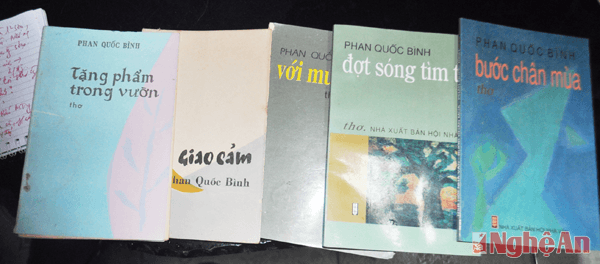 |
To date, Phan Quoc Binh has published five poetry collections and exhibited numerous paintings in regional exhibitions. He became a member of the Vietnam Writers Association in 2003. Whether it's because he's both a poet and a painter or not, reading his poetry always gives me the feeling of discovering different shades of color. I always picture him deep in thought by the late-night lamp, with words flowing from his emotions. Here are the colors of memory, here are the colors of longing and love. Over there, the darkness of night is being painted. Here, the bright light of day shines. There is no harshness, no gloom, no sorrow… His colors are truly beautiful and pure. It spreads a gentle joy, it makes people tremble as if returning to their primal selves: “Suddenly I recognize myself in the birdsong / I recognize myself in the sunlight /… Suddenly I recognize the lingering scent of the years in the garden / The red-tailed bulbul / Wearing the hat of my childhood / The cicadas dancing in the afternoon / Have stolen my melody…”. His poetry also allows people to contemplate, to weep over their own experiences. For example, “Now that I don’t see my father, the wind blows through the two empty rooms / My mother sits staring on the mat / Over eighty, I am so lonely… I wonder if there will be another life / When my father will give birth to me again?” (Father), “Returning to the old garden, the jackfruit tree stands bewildered / Time echoes / Tears bid farewell to father now lost beneath the deep earth / The day mother passed away, the seasons changed over my head / From now on, I have no home, no shelter / The jackfruit tree father planted under the orphaned sky” (The Jackfruit Tree Father Planted), “Continuing the lineage, I am born, following in my father’s footsteps / My face reflects the familiar features of my ancestors / At six months old, I recognize my father and want to be held / The country in my father’s hands sings / Father transforms into me, babbling / Now father has a place to return to, a bustling house / Life sprouts more seeds” (With My Child)
In Phan Quoc Binh's poetry, his inner self is clearly revealed. It's not simply about feelings of joy or sorrow; it's also a declaration of life, the paths he chooses for himself. He grieves with the pain of a leveled hill, weeps at the cries for help in the night… and no matter what, he believes in goodness, “his intense love once again surging.”
For Phan Quoc Binh, poetry is the music of the soul, an echo of his own emotions. The naturalness of his emotions creates a modern style in his writing, in every word. He believes that poetry must always be creative and always new. "If you are old, you have run out of creative inspiration," Phan Quoc Binh said. Therefore, for him, poets and artists must always work hard and diligently. A poet needs independent opinions, a clear worldview, and cannot seek profit in literature.
At our farewell, poet Phan Quoc Binh saw us off to the road. He stood there watching until our car was completely out of sight. His small figure, in the twilight of the city lights, filled us with a sudden warmth. It was as if a flame of faith had been ignited within us—faith in love, in kindness, in the wonderful and beautiful things that blossom in life…
Thuy Vinh - Lam Khanh