

Mr. Son: Maximizing the effectiveness of hybrid gac fruit cultivation.
(Baonghean) - After nearly a year of implementation, the model of growing hybrid gac fruit on hilly garden land in Anh Son district has proven its adaptability and superior economic efficiency compared to some other crops. However, many issues remain to be addressed in order to expand the model and further enhance the value of gac fruit in this area.
In March 2014, following the policy of the District Farmers' Association, Mr. and Mrs. Nguyen Quang Dung in Hamlet 9, Linh Son Commune, Anh Son District, planted 120 hybrid black gac fruit seedlings on their garden land. Thanks to proper investment and care, after nearly a year of cultivation, their gac orchard yielded a beautiful harvest, averaging 30-35 fruits per tree, with a total yield of over 5 quintals of gac fruit. At a selling price of 7,000 VND/kg, Mr. Dung earned 4-5 million VND per sao (approximately 1000 square meters) on previously fallow land, 4-5 times higher than some traditional crops.
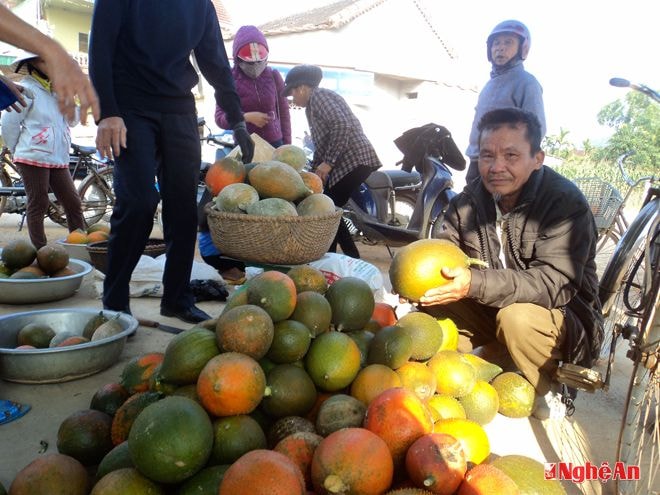 |
| Farmers in Tao Son commune (Anh Son district) are harvesting gac fruit. |
According to Mr. Ha Duc Doan, Chairman of the Farmers' Association of Linh Son commune, the policy of introducing gac fruit trees to be planted on unproductive garden land to increase people's income has initially been implemented in the area with 2,311 gac seedlings at 58 households, averaging 40 trees per household. The model has yielded nearly 3 tons of fruit, averaging 1.5 kg per fruit, higher than the traditional local gac variety. Based on these results, in the spring of 2015, the commune encouraged people to continue improving unproductive gardens and hilly land to expand the planting area.
In Tao Son commune, during the spring of 2014, 14,000 hybrid black gac fruit trees were planted on mixed garden land, hillside land, and elevated land belonging to 102 farming households, with many households planting 500-700 trees each. Mr. Hoang Van Cam, Chairman of the Farmers' Association of Tao Son commune, said: "Many hamlets proactively invested in concrete pillars, greenhouse structures, and drilled wells to grow gac fruit. In the first year of implementation, the model achieved 7-8 quintals/sao (equivalent to 14-16 tons/hectare), generating an income of 14-21 million VND/sao, many times higher than growing corn (3 corn crops/year yield 5-6 million VND/sao). Based on this success, in the spring of 2015, the commune decided to expand the area for gac fruit cultivation on hillside land, fertile land, and mixed garden land."
In practice, gac fruit is a highly sought-after agricultural product in both domestic and international markets. For a long time, many families have been cultivating gac fruit, but on a small scale, failing to meet market demand. To increase farmers' income, the Anh Son District Farmers' Association, in coordination with the District Department of Agriculture, has partnered with Nafoods Company (Nghe An Food Joint Stock Company, branch located in Quynh Thang, Quynh Luu District) to implement a project to cultivate 66 hectares of black hybrid gac fruit in 21 communes and towns within the district.
Mr. Nguyen Dang Khoa, Vice Chairman of the Anh Son District Farmers' Association, said: "The company has supplied over 100,000 seedlings, provided training on planting and caring for gac fruit, and committed to purchasing the product from farmers at 7,000 VND/kg for three consecutive years. In the first year, the average income from the models reached 4-5 million VND/sao (approximately 1000 square meters), with Hoa Son and Tao Son communes achieving exceptionally high gac yields. The company purchases the product directly from the fields. In 2015, the district continued to encourage farmers to improve their land and gardens, striving to plant 10 hectares of new gac fruit, bringing the total area of commercial hybrid gac fruit in the district to 76 hectares."
However, upon investigation, expanding the area and maximizing the effectiveness of the hybrid gac fruit cultivation model in Anh Son district is facing several difficulties that need to be addressed. These include the problem of gac fruit dying due to drought and the lack of monitoring and technical guidance from company staff or technical staff of the association; the high percentage of male gac fruit trees, causing concern among the people. Mr. Ha Duc Doan - Chairman of the Farmers' Association of Linh Son commune, said: When implementing the gac fruit cultivation model, the commune received 2,311 seedlings, of which 1,246 were male, and 786 died due to drought. In addition, technical training and guidance at the local level have been inadequate, leading to a haphazard planting approach, infrequent watering, and the failure to design proper planting trenches and holes, resulting in waterlogging of the plants.
Luong Mai