

Shortage of maritime workers
(Baonghean) - The fishing industry provides employment and income for thousands of workers, contributing to economic development and ensuring social welfare for many coastal districts in our province. However, besides the surplus of female labor in coastal areas, the shortage of seafaring workers and skilled fishermen affects the efficiency of exploiting marine resources.
Nearly half a month after the Lunar New Year of the Goat, boat owner Hoang Van Hoa, from Block 10, Nghi Thuy Ward (Cua Lo Town), has made three fishing trips. With two large 470 HP fishing boats and one transport vessel, Mr. Hoa harvested over 10 tons of fish, including anchovies, small fish, shrimp, and squid; after deducting expenses, he earned a net profit of over 80 million VND. This first trip of the year was considered "lucky" because fuel and food costs were significantly lower than previous trips. However, his biggest worry is the difficulty in finding laborers for the fishing trip. To accommodate 16-18 workers for each trip, he has to hire an additional 7-10 freelance workers.
Every year after Tet (Lunar New Year), the workforce disperses; some celebrate the holiday, others seek other job opportunities, or go abroad for work, or work in electric vehicle or hybrid vehicle services, etc. Ship owners have to hire workers before Tet, even those without prior seafaring experience. This is not to mention that if a fishing trip is successful, the workers will continue on to the next; if not, they are ready to "jump ship" to another vessel…
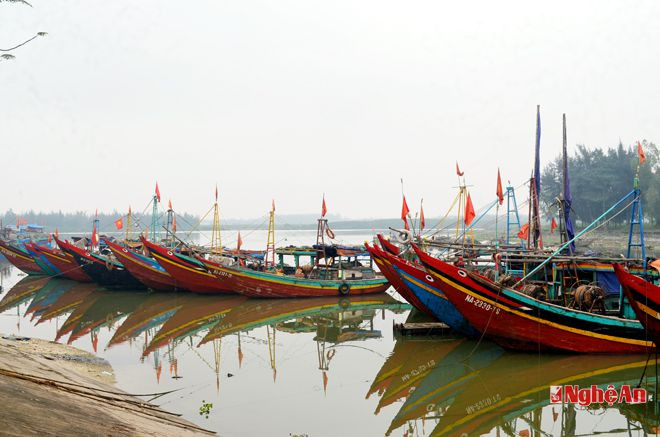 |
| Boats are anchored at Lach Van (Dien Chau). |
We met Mr. Pham Van Bang and Mr. Vu Duy Cuong from Yen Quang hamlet, Dien Ngoc commune (Dien Chau district), who were busy repairing their 450CV fishing boat. Mr. Bang said: "A fishing trip lasts about a week and requires 16 workers. Since 2014, we've had to go to great lengths to hire fishermen from many communes in Dien Kim, Dien Trung, and Dien Thinh. Currently, we can't hire workers from those communes, so we have to raise the wages of local workers to 4-5 million VND per worker per month for them to accept our jobs, and even then, the number is still insufficient. We have many orders from production facilities, but the boat is still waiting for workers."
Mr. Nguyen Van Thanh, from Rong hamlet, Quynh Lap commune (Hoang Mai town), is also concerned about the unstable employment situation on fishing vessels, with workers frequently moving from one ship to another, especially when they have invested in multiple fishing boats.
Besides the shortage of laborers skilled in traditional fishing methods (using compasses) at sea, the workforce proficient in using onboard machinery such as sonar, nautical charting, and offshore communication is even rarer. In Dien Ngoc commune (Dien Chau district), over 65% of the population is involved in seafood harvesting and processing. The commune has 398 fishing vessels, including 16 with a capacity of 450 horsepower or more, employing 650 boat owners and 1,400 workers at sea. Each year, the people of Dien Ngoc produce over 13,000 tons of seafood, generating revenue exceeding 200 billion VND.
Mr. Nguyen Van Dung, Vice Chairman of the People's Committee of Dien Ngoc commune, said: "For a long time, marine workers have mainly worked manually, relying on experience. Currently, only 60% of the commune's marine workers have received short-term training courses and certificates for captains, motorboat operators, and crew members; the remaining 40% have not received any technical training. In addition, the opening of training courses to provide a workforce with sufficient knowledge and high technical skills seems to have not received adequate attention from the workers themselves. This is a major obstacle to the effective exploitation of aquatic resources and the promotion of the economy."
Not only is there a shortage of fishing labor, but in many traditional shipbuilding villages and workshops, it is very difficult to recruit apprentices and workers to meet orders. The head of the Trung Kien - Nghi Thiet shipbuilding cooperative (Nghi Loc) expressed concern: The cooperative has many orders to build large-capacity ships, but often lacks enough shipbuilders, and especially, very few young people are learning carpentry to build ships because the work is arduous. Although the cooperative has paid very high wages, sometimes up to 300,000 VND per day, there is still a shortage of shipbuilders. Young people today are also less committed to traditional crafts.
Due to the inherent risks, unstable income, and the lack of legally binding contracts for freelance seafood harvesting, many fishermen are voluntarily quitting their jobs. Another factor is that fishing involves long periods at sea, making many workers reluctant and opting for less strenuous occupations. Furthermore, many ship owners are now investing in and collaborating to purchase large fishing vessels with engines of 90 horsepower or more, requiring technical expertise and knowledge of maritime law, which many workers lack, leading to incidents that endanger the lives of fishermen.
The shortage of seafaring labor, especially skilled seafarers, has been a common problem for many years in Cua Lo town, Nghi Loc district, Quynh Luu district, and Dien Chau district.
Mr. Chu Quoc Nam, Deputy Head of the Fisheries Exploitation and Protection Sub-Department of Nghe An province, said: In recent years, the exploitation, fishing, and processing of aquatic products for domestic and export markets in our province has become a key economic sector. Currently, there are over 3,900 fishing vessels in the province, including over 1,200 vessels with a capacity of 90 horsepower or more. The most concerning issue is the shortage of seafaring labor, especially the low level of technical skills among seafarers, particularly in Hoang Mai and Quynh Luu districts. From 2013 to the present, implementing the decisions of the Provincial People's Committee on mechanisms and policies to support fisheries vocational training, the Sub-Department, in coordination with Nha Trang University, has organized training courses and issued certificates to over 300 captains of class 4 and 5, 140 chief engineers, and 118 crew members each year. The number of trainees is insufficient compared to the demand, and training workers for maritime professions is very difficult...
Another problem is that ship owners find it difficult to attract seafarers from landlocked districts because the laborers lack the necessary skills and knowledge in fishing, not to mention their limited understanding of maritime regulations. In the long term, localities, ship owners, and fishing associations in coastal areas need a systematic strategy for training maritime workers to proactively engage in fishing and develop traditional fishing methods, especially advanced fishing techniques being applied in the modernization of the fleet and compliance with national and international regulations on fishing and resource exploitation at sea.
Luong Mai