
Dedicated to my homeland...
(Baonghean) - On the occasion of the 60th Vietnamese Doctors' Day, a reporter from Nghe An Newspaper had a conversation with Associate Professor, Dr. Nguyen Trung Chinh, senior advisor of Nghe An Oncology Hospital.
(Baonghean) - On the occasion of the 60th Vietnamese Doctors' Day, a reporter from Nghe An Newspaper had a conversation with Associate Professor, Dr. Nguyen Trung Chinh, senior advisor of Nghe An Oncology Hospital.
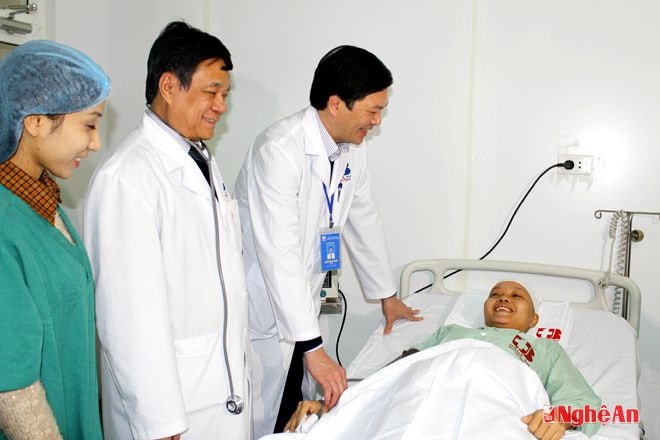 |
| Associate Professor, Doctor Nguyen Trung Chinh (center) visits a patient. |
- Professor Nguyen Trung Chinh, we understand that you are currently one of the leading scientists in the country in the field of oncology; in particular, despite being a renowned scientist and Head of the Oncology Department at the Central Military Hospital 108, you decided to return to Nghe An – which many consider a "medically disadvantaged region." Is this perhaps a desire to return to your roots and repay your debt to your homeland?
- I was born in 1953 in Vinh City. I grew up and passed the entrance exam to the Polytechnic University, but I volunteered for military service. As a soldier who fought in the Central Highlands before the liberation of South Vietnam, I witnessed countless times my comrades writhing in pain, and I myself suffered from wounds. Healing those war wounds was the motivation, determination, and empathy that drove me to pursue a career in medicine. In 1976, I studied at the Military Medical University and graduated in October 1982. My medical career entered a new phase – the field of oncology – when I was assigned by the Ministry of National Defense to work at the Hematology Department of Hospital 7, Military Region 3. From 1983 to 1987, I was sent to study preliminary hematology and blood transfusion specialization level 2 and specialization level 1 at Hanoi Medical University. While studying and working, in December 1994, I successfully defended my doctoral thesis and was also the first person in Vietnam to conduct research on autologous blood transfusion with very good applications... I was always troubled by my homeland – Nghe An in particular and Central Vietnam in general – which had not yet healed from the wounds of war and was now facing the worry of rampant disease, especially cancer. Here, the number of cancer patients is very high due to the lingering effects of Agent Orange. This motivated me to do something meaningful for my homeland.
In September 2007, I had the opportunity to work with the then Secretary of the Nghe An Provincial Party Committee, Mr. Nguyen The Trung. I proposed establishing a Cancer Hospital right in my hometown of Nghe An to help cancer patients suffering from the lingering effects of war. With the determination of the provincial leadership, especially Comrade Phan Dinh Trac (now the Deputy Head of the Standing Committee of the Central Internal Affairs Commission), and my personal efforts, this idea was approved and became a reality. In August 2011, the Nghe An Cancer Hospital was established, and I requested to work as a senior expert and advisor at the hospital from the Ministry of National Defense. Every week, I flew back and forth between Hanoi and Vinh to complete my work at both units. In 2013, I retired, and was able to dedicate myself wholeheartedly to serving my homeland.
- Professor, could you tell us about your significant contributions to the national medical field and to the people of Nghe An province?
- Throughout my research, studies, and work, I consider myself to have successfully completed two important research projects with high and wide-ranging applications. Firstly, bone marrow transplantation (autologous hematopoietic stem cell transplantation) for malignant lymphoma. This research direction has successfully performed bone marrow transplants on 10 patients with non-Hodgkin's lymphoma at Military Central Hospital 108 and Nghe An Oncology Hospital. Secondly, bone marrow transplantation research on multiple myeloma patients, identifying a specific treatment protocol for multiple myeloma patients. This protocol focuses on pre-transplant conditioning for multiple myeloma and has successfully performed two multiple myeloma transplants. In addition, I have several other research directions with high scientific and practical value, such as allogeneic bone marrow transplantation, umbilical cord blood collection, and evaluating the results of chemotherapy treatment for non-Hodgkin's lymphoma.
At Nghe An Oncology Hospital, stem cell transplantation for cancer treatment was officially implemented in late 2013, and to date, seven cancer patients have been cured. Recently, the hospital held a discharge ceremony for two patients who underwent the first autologous hematopoietic stem cell transplantation for breast cancer in Vietnam. These successes are shared achievements, and they are very significant as they are being carried out in Nghe An – a poor province with limited medical facilities. The successful transplants have opened up prospects for patients to be completely cured of cancer. In the near future, my team and I will perform stem cell transplantation for cervical cancer and lung cancer.
- Professor, you once turned down a lucrative and prestigious position to stay at the Nghe An Oncology Hospital. Could you share your thoughts on that? Living in Hanoi while working in Nghe An, what difficulties have you encountered?
- During my time working there, I assisted and supported the Vinmec International General Hospital's Oncology Center in establishing the Vinmec Bone Marrow Transplant Center. This center boasts extremely modern equipment. Vinmec International General Hospital offered me the position of director of this center, with a salary of $5,000 USD per month. But as I said, I returned to Nghe An to help my homeland, to be a dutiful son, not for money or fame. The Nghe An Oncology Hospital is my brainchild, and it has always received the attention and investment of the Provincial Party Committee and the Provincial People's Committee, so I have had all the necessary conditions to develop my skills and continue my research.
My current routine is no different from before. I fly to Vinh at the beginning of the week and fly back to Hanoi at the end of the week. For a scientist, food and accommodation are simple: I eat at a local restaurant right outside the hospital during the day and sleep in my office at night. I feel completely comfortable with my work and life. I promised my wife and two children that I would return to my hometown to help out for three years before going to Hanoi to rest and retire. But I'm afraid I might break that promise because there are still many cancer patients in my hometown who need me…
Thank you, Associate Professor, for this conversation. I wish you good health and continued important contributions to the medical field in our country and homeland!
Thanh Son(Perform)