
Turning folk songs into a tourism product.
(Baonghean) - Currently, our province has 25 provincial and regional festivals lasting from January to November. Many of these festivals have incorporated traditional art forms to serve tourists, becoming unique tourism products…
(Baonghean) - Currently, our province has 25 provincial and regional festivals lasting from January to November. Many of these festivals have incorporated traditional art forms to serve tourists, becoming unique tourism products…
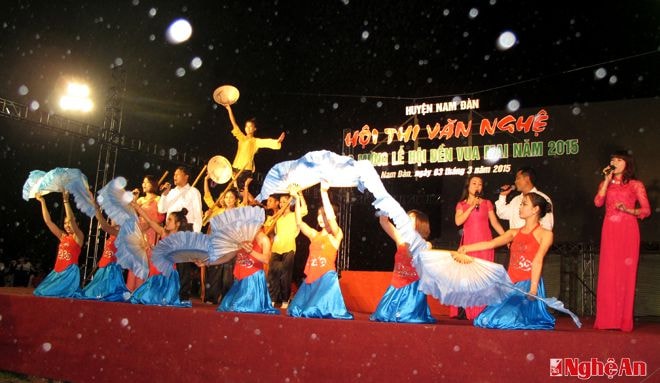 |
| A performance in the King Mai Festival (Nam Dan). Photo: Canh Nam. |
Nghe An is a region deeply marked by a rich cultural identity, home to six ethnic groups living together. It boasts a diverse range of traditional art forms, such as the folk songs and dances of the Kinh people, the traditional dances and customs of the Thai people, and the gong and drum dances of the Tho people. These performances are deeply moving and captivating. The most vivid portrayal of this cultural identity is reflected in the typical spring festivals such as the King Mai Festival, Hang Bua Festival, Cuong Temple Festival, Corn Temple Festival, Qua Temple Festival, and Bach Ma Temple Festival. Each festival possesses its own unique cultural character, but all are oriented towards the sacred traditions of our ancestors, embodying the principle of "drinking water, remembering the source" and the spirit of unity. Festivals also serve as a place for people to socialize, meet, and share after a year of hard work. These traditional festivals have, to some extent, met the spiritual needs and reflected the thoughts, aspirations, and feelings of the people.
Like many other villages along the Lam River, folk songs and <i>ví giặm</i> (a type of Vietnamese folk singing) have deeply ingrained themselves in the hearts of the people of Nam Dan. Every time Tet (Lunar New Year) comes around, or during village festivals, these heartfelt and gentle melodies resonate, enduring through the years. However, the biggest concern for the people of Uncle Ho's hometown is how to turn <i>ví giặm</i> into a tourism product to serve visitors. And incorporating folk songs and <i>ví giặm</i> into the annual King Mai Festival is the direction Nam Dan is choosing. Mr. Dinh Xuan Tinh, head of the Xuan Hoa Folk Song Club in Nam Dan, believes that the setting of the King Mai Festival is very suitable for <i>ví giặm</i> melodies (with mountains and rivers). In the past, mothers and sisters would row boats and sing <i>ví</i> songs on the Lam River. Similar to the Lim Festival in Bac Ninh, they organize exchanges and competitions of <i>quan ho</i> singing in camps and on boats, attracting many tourists. Many tourists come to the Lim Festival to have the opportunity to listen to Quan Ho folk singing. This is also an opportunity to promote the image of a traditional festival to the people and friends in the country. It is also an opportunity for clubs to exchange ideas. And with a scale like the King Mai Festival, it is not impossible to achieve.
And Mr. Dinh Xuan Tinh's dream came true when, at this year's King Mai Festival, Nam Dan district organized an exchange and singing competition of Vi and Giam folk songs between clubs in the district. The competition attracted a large number of locals and tourists. Mr. Thai Ba Nam (a tourist from Do Luong) said: "In the serene atmosphere, amidst the sacred sounds of the festival commemorating the merits of King Mai, the folk songs sounded even sweeter, so moving, especially listening to Vi and Giam folk songs in the very land of Nam Dan, a land of 'spiritual and talented people'."
It is known that the idea of incorporating folk songs, including "ví" and "giặm," into the festival's entertainment section of the King Mai Festival was attempted once before a few years ago but was not very successful. However, this year, the district has decided to maintain this activity to help promote folk songs to tourists visiting the King Mai Festival.
While Nam Dan district is known for its authentic folk songs, the ancient land of Hoan Chau, now Dien Chau, is considered the cradle of Nghe An's Ca Tru (traditional Vietnamese singing). Mr. Vo Sy Tai, Head of the Culture Department of Dien Chau district, stated: In August 2002, the Dien Chau Ca Tru Club was officially established under the guidance of teachers Nguyen Nghia Nguyen and Tran Cong Hoi from Dien Yen, along with a singing group from Dien Lien and Dien Yen communes. Gradually, the Dien Chau Ca Tru Club has grown, developed, and attracted an increasing number of members. It is gratifying that in recent years, visitors to the Cuong Temple Festival on the 15th day of the second lunar month have been able to enjoy Ca Tru performances by members of the Dien Chau Ca Tru Club. Amidst the sacred atmosphere of the Cuong Temple Festival, with the fragrant scent of incense wafting through the air, only the sounds of drums, the zither, the rhythmic clappers, and the melodies of the female singers remain: "Celebrating the beautiful land of the Fatherland/ All three regions quickly welcome the arrival of Spring…".
Regarding the Cuong Temple Festival, which features Ca Tru singing, other festivals such as the Duc Hoang Temple Festival (Yen Thanh) organizes exchanges of Tuong opera between clubs, and the Hang Bua Festival (Quy Chau) features Nhuon, Xuoi, and Khap singing – one of the distinctive melodies of the Thai ethnic group in Nghe An… Mr. Tran Duy Trinh – Deputy Director of Vietravel Tourism Company, said: When localities actively participate like this, travel companies will have the opportunity to promote and develop more attractive tourism products. Why don't we try a comparison: The Lim Festival has the specialty of Quan Ho folk singing from Bac Ninh, so Nghe An should build the largest regional festival in the province so that every time tourists visit, they can enjoy Nghe An's Vi and Giam folk songs. And the Lang Sen Festival is a festival that we must create and promote this precious heritage. How can we ensure that every year, the Lotus Village Festival attracts visitors from within the province, across the country, and internationally, all eager to enjoy the unique and unforgettable folk songs and melodies of the region? How can we ensure that when people mention the Lotus Village Festival, it is always associated with the distinctive folk songs and melodies of the region?
Ms. Nguyen Thi Huong, Director of the Tourism Promotion Center, believes that incorporating traditional art into tourism offerings to enrich tour products is a concern for many localities with developed tourism industries in Vietnam, such as Da Nang and Quang Ninh. Nghe An, in particular, possesses abundant potential in traditional arts such as Tuong, Cheo, and Ca Tru singing, and especially with the recognition of Nghe An's Vi and Giam folk songs as an Intangible Cultural Heritage of Humanity. This necessitates collaboration and cooperation among tourism and cultural professionals to promote these art forms. In the short term, during spring festivals, localities with tourism potential and the cradle of Vi and Giam folk songs, such as Nam Dan, Thanh Chuong, and Do Luong, need to develop long-term strategies for preservation and promotion.
Thanh Thuy