

"Every inch of land is worth its weight in gold."
(Baonghean) - The other day I read about farmers in a commune suffering huge losses because of a bumper chayote crop. So many tons of chayote went unsold, having to be used as animal feed or left to rot at the base of the plants as fertilizer. After a few years of "shining" as a "savior" for farmers, the area planted with chayote expanded spontaneously, leading to an oversupply...
Our ancestors often taught, "Too much of anything is not good," yet paradoxically, our people generally like everything in abundance, sometimes to the point of excess. Eating and drinking must be extravagant to show off wealth and hospitality. As for nutritious food, regardless of whether it's from East or West, ancient or modern, yin or yang, or the five elements, as long as it's rare or precious, they'll devour it without question. In reality, this is a way of thinking and living that is both unscientific and wasteful.
Not only in matters of food and consumption, but the preference for large numbers seems to be deeply ingrained in the subconscious of a large number of people. A very obvious example is that whenever a store or product is successful, everyone rushes to do business with the same product, using the same methods, even under the same brand name. This leads to entire streets where stores all display the same name, and to differentiate themselves, they add words like "authentic," "genuine," "original," etc. Even more ironically, there's the issue of brand theft: Seeing a store owner's business thriving, the landlord decides to terminate the lease and then opens their own store, using the same brand name. Of course, after a while, customers will be able to distinguish between the "authentic" brand and the counterfeit versions. To be clear, passivity, laziness in thinking, and a preference for "easy wins" cannot lead to success.
Returning to the story of chayote, some might say: what connection does this have with the aforementioned trademark theft? In essence, the spontaneous expansion of chayote cultivation is also a form of intellectual property theft. However, it's not entirely bad, as it stems from the commendable intention of learning from and applying successful models. Nevertheless, a lack of planning, a failure to accurately assess market demand and scale, led to an oversupply, causing chayote prices to plummet and even making it impossible to find buyers. If, instead of mechanically copying the chayote cultivation model, people had considered other vegetables and fruits, or related services such as transportation and purchasing agents, they could have protected the economic value of this easy-to-cultivate agricultural product with high economic potential.
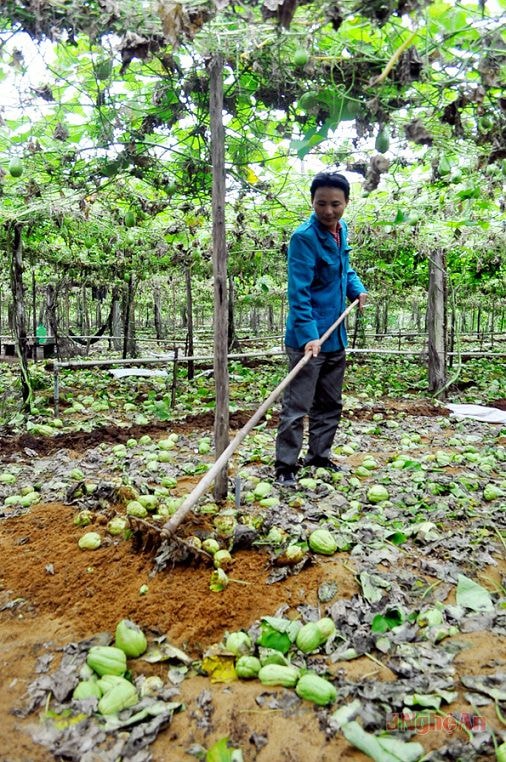 |
| Mr. Ho Van Duoc (Hamlet 6, Quynh Lien Commune) collects chayote fruits to use as fertilizer. |
Ultimately, it all comes down to a lack of dynamism, a poor mindset, and a mechanical thinking. A naive, mechanical belief that a product's position in the market is immutable. But no, economic value is a function of two closely related variables: supply and demand. If the relationship between supply and demand is relatively balanced, the product's value will remain stable. Any discrepancy between these two variables will cause the product's economic value to fluctuate, either increasing or decreasing, but inevitably reaching a saturation point. Similarly, people must adapt and respond to the ever-changing needs of society to ensure their value and place in it. Passivity, laziness, and a lack of creativity will eventually lead to the saturation and oblivion of a ripe chayote after a bad harvest. Where do you want to stand in this society? Everyone wants to choose a good piece of land, but too many people will deplete even the most fertile land. Finding empty spaces, "reclaiming" them, and "planning" them into valuable assets—that's the way to assert your own worth!
Hai Trieu
| RELATED NEWS |
|---|