

Vietnam - India Joint Statement
At the invitation of Indian Prime Minister Narendra Modi, Prime Minister of the Socialist Republic of Vietnam Nguyen Tan Dung and his wife paid an official visit to the Republic of India from October 27 to 28, 2014. During the visit, the two sides issued a Vietnam-India Joint Statement.
| RELATED NEWS |
|---|
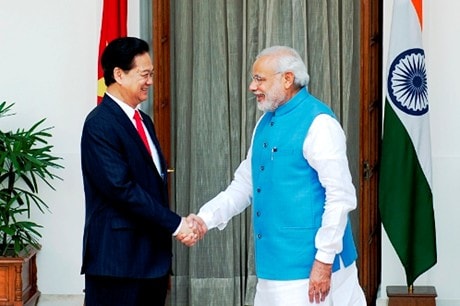 |
| Prime Minister Nguyen Tan Dung and Indian Prime Minister Narendra Modi. |
1. At the invitation of Indian Prime Minister Narendra Modi, Prime Minister of the Socialist Republic of Vietnam Nguyen Tan Dung and his wife paid an official visit to the Republic of India from October 27 to 28, 2014.
2. During the visit, Prime Minister Nguyen Tan Dung attended the official welcoming ceremony at the Presidential Palace (Rashtrapati Bhavan) and laid a wreath at the Mahatma Gandhi Memorial at Raj Ghat; held a private meeting and talks with Indian Prime Minister Narendra Modi and attended a state banquet hosted by Prime Minister Modi; met with Indian President Pranab Mukherjee, met with Vice President and Chairman of the Upper House Shri Hamid Ansari, received the Speaker of the Lower House Smt. Sumitra Mahajan and the Minister of External Affairs Sushma Swaraj. Prime Minister Nguyen Tan Dung visited Bodh Gaya city; and received the Chief Minister of Bihar Shri Jitan Ram Manjhi. Within the framework of the visit, the Vietnam-India Business Forum was held with the participation of numerous leading businesspeople from both countries.
3. The two Prime Ministers welcomed the recent developments in the Vietnam-India Strategic Partnership and reaffirmed their commitment to the comprehensive development of this Strategic Partnership. They agreed that a strong partnership between India and Vietnam will bring peace, prosperity, and stability to the people of both countries and the region. Prime Minister Modi reaffirmed that Vietnam is an important pillar in India's Look East policy. Prime Minister Nguyen Tan Dung welcomed India playing a greater role in the region and the world.
4. The two Prime Ministers acknowledged that the strategic partnership between the two countries is based on traditional friendship, unwavering trust, mutual understanding, mutual support and assistance, and similarities in views on many regional and international issues. The two Prime Ministers expressed pleasure at the success of the State visit to Vietnam in September 2014 by Indian President Pranab Mukherjee. They also welcomed the success of the visit to Vietnam in August 2014 by Foreign Minister Sushma Swaraj. The two Prime Ministers proposed further strengthening exchanges of delegations at all levels through established dialogue mechanisms and effectively implementing the agreements signed between the two countries.
5. The two Prime Ministers expressed satisfaction with the progress made in defense cooperation, including delegation exchanges, the annual Defense Policy Dialogue, cooperation between branches of the armed forces, exchange of visiting ships, training, capacity building, and cooperation in regional forums, including the Humanitarian Mine Action Program. The two Prime Ministers requested the early implementation of the US$100 million credit agreement provided by India to Vietnam for defense procurement. The two Prime Ministers expressed hope that the currently strong India-Vietnam defense and security cooperation will continue to be strengthened through regular exchanges of high-level delegations.
6. The two Prime Ministers agreed that strengthening economic cooperation is a strategic objective of bilateral relations. They welcomed the strong growth in bilateral trade in recent years, particularly following the signing of the India-ASEAN Free Trade Agreement on Goods Exchange, and emphasized that the signing of the India-ASEAN Free Trade Agreement on Services and Investment will further boost economic cooperation between India and ASEAN in general, and with Vietnam in particular. The two Prime Ministers instructed their respective agencies to utilize established mechanisms such as the Joint Sub-Committee on Trade, through public-private partnerships (PPP), and business-to-business (B2B) cooperation to further promote trade and investment between the two countries. The two Prime Ministers called for close cooperation towards the implementation of the Regional Comprehensive Economic Partnership (RCEP).
7. Prime Minister Nguyen Tan Dung was accompanied by a large business delegation, which held numerous working sessions with leading Indian trade and industrial partners such as the Chamber of Indian Industry (CII), the Federation of Indian Chambers of Commerce and Industry (FICCI), and the Association of Indian Chambers of Commerce (ASSOCHAM). The two Prime Ministers requested that business leaders from both countries explore business opportunities on both sides. Business leaders from both countries identified priority areas for cooperation including: gas, electricity, infrastructure, tourism, textiles, footwear, healthcare and pharmaceuticals, information technology, electronics, agriculture, agricultural products, chemicals, machine tools, and other supporting industries. Both Prime Ministers expressed satisfaction with the stable growth of bilateral trade and investment through effective cooperation between business leaders from both countries. Both sides agreed to take measures to strongly promote and diversify bilateral trade for mutual benefit, agreeing to achieve a target of US$15 billion in bilateral trade by 2020. To achieve this goal, the two Prime Ministers urged business leaders and policymakers from both countries to make effective use of events such as the India-CLMV (Cambodia, Laos, Myanmar, and Vietnam) Business Forum.
8. The two Prime Ministers reaffirmed the importance of investment for economic development as well as the ways to create an environment that attracts greater investment. Prime Minister Nguyen Tan Dung welcomed Indian companies investing in Vietnam and affirmed Vietnam's commitment to creating favorable conditions for Indian investors; Prime Minister Modi invited Vietnamese businesses to participate in India's economic growth promotion program called 'Make in India' to jointly benefit from this new initiative. The two Prime Ministers agreed to implement the Customs Cooperation Agreement and the Maritime Transport Agreement between the two countries to facilitate deeper economic cooperation.
9. The two Prime Ministers welcomed the signing of the Oil and Gas Exploration Agreement for new projects in Vietnam between ONGC Videsh and Vietnam National Oil and Gas Group. Prime Minister Nguyen Tan Dung welcomed Indian oil and gas companies taking advantage of new opportunities to participate in midstream and downstream oil and gas activities in Vietnam.
10. The Prime Ministers of both countries welcomed the State Bank of Vietnam's approval in principle of the establishment of a branch of the Bank of India in Vietnam.
11. The two Prime Ministers emphasized the importance of connectivity between Vietnam and India and welcomed the signing of the Joint Venture Agreement between Jet Airways and Vietnam Airlines, under which Jet Airways flights to Ho Chi Minh City will commence from November 5, 2014. Both sides expressed hope that Vietnam Airlines would soon open a route to India. They also encouraged airlines from both countries to promote the opening and operation of flights between Vietnam and India. Both sides also agreed on the need to promote maritime cooperation between the two countries, initially by establishing and strengthening shipbuilding cooperation.
12. The two Prime Ministers welcomed the signing of the Memorandum of Understanding on the Conservation and Restoration of Cham architectural works at My Son by the Archaeological Survey of India; and supported the strengthening of tourism and cultural exchanges between the two countries. The two Prime Ministers welcomed the signing of the Memorandum of Understanding on the establishment of Nalanda University as a symbol of the shared Buddhist heritage of Vietnam and India. Prime Minister Narendra Modi thanked Prime Minister Nguyen Tan Dung for the establishment of the Center for Indian Studies at the Ho Chi Minh Academy of Politics and Public Administration in Hanoi; and welcomed the cooperation between the Ho Chi Minh Academy of Politics and Public Administration and the Indian Academy of Public Administration. The two Prime Ministers appreciated the organization of the 3rd ASEAN-India Scholars Network Roundtable Conference in Hanoi in August 2014.
13. The two Prime Ministers welcomed cooperation in establishing capacity-building research institutes in Vietnam in information technology, English language training, business development, high-tech computing, and other fields; and called for the early completion of planned cooperation projects, including the establishment of an English and Informatics Training Center at the University of Information and Communication Technology in Nha Trang, a Software Development and Training Talent Center in Ho Chi Minh City, and a Satellite Signal Detection and Image Data Reception Center in Ho Chi Minh City. Both sides also agreed to continue cooperation on the peaceful use of nuclear energy and to promote cooperation in the space sector, including satellite launches.
14. The two Prime Ministers highly appreciated the cooperation and coordination between the two countries in regional and international forums; and agreed to strengthen cooperation, especially in ASEAN, RCEP, ARF, ADMM+, EAS, the United Nations, the Non-Aligned Movement, ASEM and WTO, as well as other regional cooperation mechanisms. Both sides believed that Vietnam's role as Coordinator of ASEAN-India relations from 2015-2018 would further promote closer cooperation between the two countries, as ASEAN moves towards achieving its goal of becoming a Community by 2015. The two Prime Ministers also agreed to strengthen Mekong-Ganges Cooperation (MGC). They emphasized the urgent need for reforming the United Nations and expanding the Security Council, both permanent and non-permanent, with full representation of developing countries. Prime Minister Narendra Modi thanked Vietnam for its consistent support for India's bid to become a permanent member of the UN Security Council upon its expansion. The two Prime Ministers reaffirmed their mutual support for their respective candidacies for non-permanent seats on the United Nations Security Council, Vietnam for the 2020-2021 term and India for the 2021-2022 term. India also agreed to assist Vietnam in building and enhancing its capacity to participate in peacekeeping operations.
15. The two Prime Ministers reaffirmed their desire and determination to jointly maintain peace, stability, development, and prosperity in Asia and the world. Both sides agreed that freedom of navigation and overflight in the South China Sea cannot be impeded and called on all parties concerned to exercise restraint, refrain from the use or threat of force, and resolve disputes through peaceful means in accordance with recognized principles of international law, including the 1982 United Nations Convention on the Law of the Sea. The two Prime Ministers welcomed the joint commitment of all parties concerned to abide by and implement the 2002 Declaration on the Conduct of Parties in the South China Sea (DOC), working towards the development of a Code of Conduct in the South China Sea (COC) based on consensus. The two Prime Ministers called for enhanced cooperation in areas such as ensuring the security of sea lanes, maritime security, combating piracy, and search and rescue operations.
16. Prime Minister Narendra Modi and Prime Minister Nguyen Tan Dung witnessed the signing of the following agreements: (i) Memorandum of Understanding on Nalanda University; (ii) Memorandum of Understanding on the Conservation and Restoration of Cham architecture at My Son, Quang Nam province; (iii) Memorandum of Understanding on the establishment of an English Language and Information Technology Training Center at the University of Information and Communication Technology in Nha Trang; (iv) Cultural Exchange Program for the period 2015-2017; (v) Memorandum of Understanding on radio cooperation between Voice of Vietnam and Prasar Bharati Radio; (vi) Framework Agreement on cooperation between OVL and PetroVietnam; (vii) Memorandum of Understanding on cooperation between ONGC and PetroVietnam.
17. The talks between the two Prime Ministers took place in a warm, sincere, and friendly atmosphere. Prime Minister Nguyen Tan Dung thanked Prime Minister Narendra Modi for the warm welcome extended to him and the Vietnamese delegation, and invited Prime Minister Modi to visit Vietnam at a suitable time. Prime Minister Narendra Modi happily accepted the invitation. The timing of the visit will be arranged through diplomatic channels.
New Delhi, October 28, 2014
According to chinhphu.vn