

Kim Lien: Stepping up the construction of model new rural areas.
(Baonghean) - “Building a model new rural area is unprecedented in the country. Because there is no precedent, we will have to implement it while simultaneously learning from experience…” This was the statement of Mr. Tran Le Chuong - Vice Chairman of the People's Committee of Kim Lien commune (Nam Dan district) when asked about building Kim Lien into a model new rural area.
The challenges ahead
According to the province's draft "Guidelines for Building Model New Rural Communes in the 2015-2020 Period," a unit is only recognized as a "model" if the majority of criteria meet 90% or more. This means that the "standards" of the new rural commune criteria are raised to a higher level. Compared to some localities in the province, Kim Lien commune has more advantages because its planning, infrastructure, transportation, irrigation, environment, and cultural institutions have been invested in and built quite comprehensively from the beginning. However, in reality, this commune has a large agricultural production rate, accounting for 77%. Meanwhile, due to its unique characteristics, Kim Lien does not have a plan or orientation for industrial development. This can be considered a factor that, to some extent, impacts the economic structure and income of the commune. Furthermore, despite having over 1,174 hectares of agricultural land, accounting for 77% of the total natural land area, the commune lacks a strong advantage in rice or crop production. This also means that farmers can hardly rely on the value of agricultural products to fundamentally improve their income and living standards.
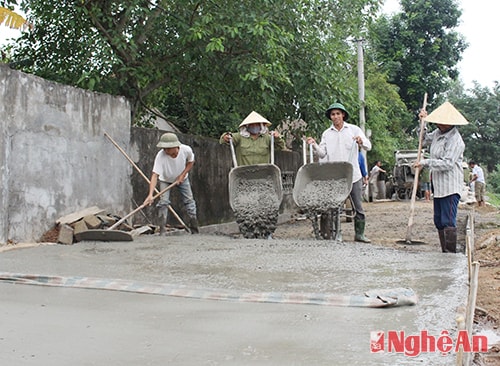 |
| Residents of Van Hoi 2 hamlet, Kim Lien commune (Nam Dan district) are building a rural road. |
Overcoming those obstacles and achieving the goals of the New Rural Development program ahead of schedule demonstrates the determination of the Party Committee and the government, as well as the unanimous agreement of the people. However, to become a model unit for new rural development, the government and the people must make even greater efforts. As Mr. Chu Van Ngu, Secretary and Head of Van Hoi 2 hamlet, Kim Lien commune, said: "When there is consensus on any policy, the people will contribute wholeheartedly..." However, Mr. Ngu also expressed concern that while the people are not afraid of difficulties and hardships, the hamlet only has 70 households with 347 people, with agricultural labor accounting for nearly 100%. Therefore, the direction of new development is also a matter of concern.
Therefore, continuing the campaign to collectively realize the "model" criteria under the current conditions is not easy. Regarding contributions alone, households have made significant efforts in the past. For example, the family of Ms. Tran Thi Bon - Van Hoi 2 Hamlet, with 6 members, contributed 700,000 VND per person in 2014 alone. This totaled over 4 million VND for the new rural development program. According to Ms. Bon, continuing another fundraising campaign at this time is difficult for many families, even though the people are always willing. Mr. Tran Le Chuong - Vice Chairman of the Kim Lien Commune People's Committee acknowledged that: "The biggest difficulty is investing in the construction of technical infrastructure. This area requires a large investment, while the awareness of the people is not the same for everyone. Another reality is that some new rural development criteria in the commune are not yet truly sustainable."
Promoting cultural values to create momentum for building model communes.
Despite recognized challenges, Kim Lien commune possesses unique potentials and advantages. It is a land of rich cultural heritage, steeped in tradition and the cultural identity of Vietnamese villages. Kim Lien is the birthplace of many patriotic scholars and revolutionary figures, and notably, the hometown of President Ho Chi Minh. It is home to numerous historical and cultural relics of profound value to the spiritual life of the people of Nghe An, especially the Kim Lien Historical Site, which preserves artifacts connected to President Ho Chi Minh's hometown, family, and childhood. In 2012, the Kim Lien Historical Site was recognized by the Government as a Special National Monument. From a cultural tourism perspective, these are potentials that can be integrated into the goal of building a model new rural commune. The reason we are mentioning this is because, for a commune with unique characteristics like Kim Lien, realizing the integration of historical and cultural relics with tourism would contribute to solving a range of socio-economic problems.
According to the "Project to build Kim Lien commune into a model new rural commune in the period 2015-2020," in the field of tourism and services, Kim Lien will mobilize resources and invest in building key tourist destinations of Nghe An and the North Central region, and an attractive historical and cultural tourist destination of the nation. In fact, on the province's tourism map, Kim Lien has been planned to become a key tourist area for many years. Every year, millions of pilgrims visit Kim Lien; however, the revenue generated from tourism and service activities remains limited. According to statistics, the total value of production in the service and trade sector of Kim Lien commune in 2014 was estimated at 26.4 billion VND, an increase of 177.2% compared to 2010. For a locality like Kim Lien commune, these figures are still modest and not truly commensurate with its existing potential. According to many economic experts, the primary reason is that the service system here is inadequate and unattractive, the tourism products are too monotonous, while many people in the commune still seem "unfamiliar" with tourism services aimed at increasing family income.
The goal is for the service sector to account for approximately 35% of Kim Lien's economic structure by 2020. This is a high percentage in the economic balance that the commune aims for. However, achieving this in reality is not simple. Currently, the commune is directing a gradual shift in its economic structure towards: services - trade - tourism - construction industry - agriculture. The main economic development direction still revolves around services - trade - tourism. Mr. Tran Le Chuong added: “The commune always encourages people to produce tourism products that meet the criteria of being approachable and friendly. In addition, we are maximizing the use of land to develop diverse cash crops to serve tourists, such as sticky corn and sweet potatoes; identifying and establishing areas for growing safe flowers and vegetables; and encouraging people to build ecological gardens to create relaxing spaces.”
Following this direction, many households in the commune have boldly removed their overgrown gardens and planted fruit trees to serve tourists on-site, with varieties proven suitable for the local climate and soil, such as custard apple, sapodilla, and pomelo. With investment from various sources, the commune will renovate and restore many tangible and intangible cultural architectural works to serve tourists, aiming to increase revenue. Currently, folk singing clubs, traditional weaving clubs are being restored to attract tourists…”. Along with the above solutions, Kim Lien commune aims to improve the effectiveness of the “All people unite to build a cultured life in residential areas” movement and build appropriate behavioral culture. The above “fundamental” solutions are expected to promote the value of the cultural heritage system, relics, and scenic spots, open up new types of services, contribute to job creation, and increase income for the people. On that basis, reinvestment will be made in other criteria and items, realizing the goal of making Kim Lien a model commune for new rural development in Nghe An and the whole country.
Text and photos:Dao Tuan