

Exploiting trade and services in border areas.
(Baonghean) - Over the years, Ky Son district has focused on investing in infrastructure in key areas, while closely coordinating with functional forces in the area to create the best conditions for import and export activities with neighboring Laos. This has helped to effectively exploit the advantages of a border locality with an international border gate and vital transportation routes to develop the trade and service sector, contributing to increasing people's income.
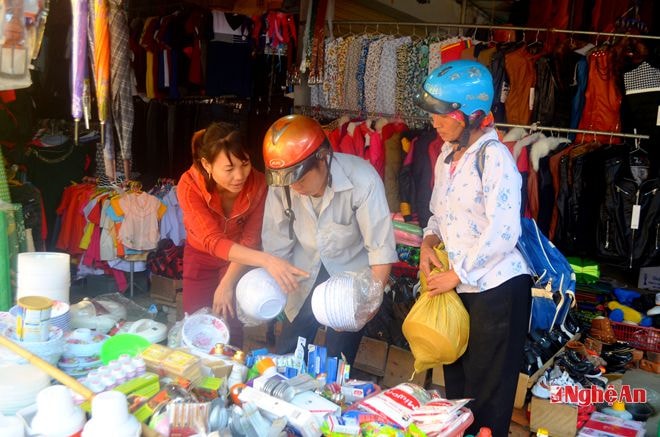 |
| A stall at Muong Xen market (Ky Son). |
In the first days of the Lunar New Year, we traveled along National Highway 7 to the highlands of Ky Son. At this time, it was the dry season, the weather was very hot and humid, but trading and import/export activities had quickly returned to their normal rhythm after Tet. At Muong Xen Town Market, the largest trading center in the district, traders, mostly from the lowland districts, were bustling with activity. Walking around the market, we saw a wide variety of goods for sale, from vegetables and fruits to consumer goods, clothing, and shoes.
Ms. Tran Thi Linh, originally from Nghi Tan ward (Cua Lo town), who has been selling clothes and other goods at Muong Xen market for over 10 years, said: “I only packed up my goods to go home for Tet on the 29th of the Lunar New Year (Year of the Goat), but after Tet I had to arrange my family affairs to come back early to open my stall and serve the people. The number of customers is gradually increasing. The business environment in Muong Xen is also very good. The authorities at all levels create the most favorable conditions for small traders to do business, especially since the new market was completed and put into use.” In a corner of the market, at the kiosk of Ms. Nguyen Thi Tuyet, from Do Luong, we met Mr. and Mrs. Lau Tong Po from Cha Lat village, Muong Tip commune, buying goods to prepare for their child's wedding. Speaking with us, Mr. Pó happily shared: “Now, all daily necessities are delivered right to the commune, which is very convenient for the people. But if we want to buy more items, we have to go to Mường Xén market, where the goods are very diverse and the prices are also reasonable.”
Ms. Tuyet said she bid for a stall for 12 years at a price of 400 million VND to have more stable and favorable trading conditions… Muong Xen Town Market was upgraded and built into a level 2 market with a total investment of nearly 12 billion VND and put into operation from the end of 2013. Speaking with us, Mr. Nguyen Ba Luong, Head of the Muong Xen Market Management Team, said: “The total floor area of the market is about 1,600 square meters. Currently, 251 stalls have been bid on by traders and are in operation.” Therefore, Muong Xen Town Market plays the role of a center for wholesale and retail sales, distributing goods to local markets in the district and supplying traders to commune centers, clusters of communes, and villages.”
Besides Muong Xen Town Market, Ky Son district also has Huoi Tu and Muong Long markets, which operate on a monthly basis and have a lively trading atmosphere. With existing market infrastructure combined with the improving living standards of the people, purchasing power has increased. According to statistics from the Department of Industry and Trade, the total value of retail goods circulation and service revenue in the district in 2014 was estimated at over 680 billion VND, exceeding the plan by 120 billion VND. In addition to Muong Xen Town Market, the markets in the cluster of communes in Ky Son also demonstrate positive effectiveness. However, in a conversation with us, Mr. Doan Van Toan, an official from the District's Department of Industry and Trade in charge of commerce and services, stated: "Huoi Tu and Muong Long markets were built with funding from Program 135, but due to their long operating history, they have deteriorated. Therefore, the district proposed to the province to renovate and upgrade them, and this has been approved. As for Muong Xen Town Market, we are currently developing a plan for bidding on market operations, but we are also facing difficulties. Regarding the development of the market network in the district, the plan includes the establishment of additional markets in Nam Can, Na Loi, Ta Do, and Chieu Luu, and we are currently seeking investment approval."
...We arrived at Nam Can border commune, home to an international border gate connecting with Laos. It was just after the Lunar New Year, so the number of Vietnamese people crossing into Laos for work and, conversely, Lao students entering Vietnam for study was quite large and bustling. Alongside this, there was a constant stream of transport vehicles entering the country, carrying various goods. According to statistics from the Nam Can International Border Gate Customs Sub-department, in 2014, the total import and export turnover through the border gate reached 71 million USD, of which exports reached 18 million USD, mainly construction materials, and imports reached 53 million USD, mainly wood and agricultural products from Laos. Tax revenue reached 108 billion VND, equivalent to 108% of the plan. In a conversation with us, Mr. Phan Van Nham, Deputy Head of the Nam Can International Border Gate Customs Sub-department, said: "On the 6th day of the Lunar New Year, import and export activities resumed very actively."
In 2015, to continue effectively achieving the set goals, from the beginning of the year, we focused on creating a transparent environment and favorable conditions for businesses; strengthening customs supervision and tax management, as well as effectively utilizing the Automated Customs Clearance System and the National Single Window mechanism (VNACCS/VCIS) to create the best conditions for import and export activities. In addition, the unit also promoted good coordination with functional forces in the area and local Party committees and authorities to carry out inspection and control work, combat smuggling, trade fraud, and drug trafficking across the border to ensure security and order in the area, thereby creating a stable environment for economic and social development and trade between the people of Vietnam and Laos.
With its unique geographical location, including an international border gate and a national defense-economic transportation belt, Ky Son border district possesses all the necessary elements for developing the service and trade sectors for both domestic and export markets. While the statistics above are modest compared to many other localities in the province, they partly demonstrate this potential. However, facing numerous difficulties, particularly the low income of the people (only 13.8 million VND/person/year in 2014) and limited infrastructure, comprehensive solutions involving multiple levels and sectors are required. In addition, the district is focusing on accelerating poverty reduction and increasing people's income; thereby enhancing purchasing power and effectively exploiting the local trade and service potential. Speaking with us, Mr. Nguyen Anh Doai, Head of the Industry and Trade Department of Ky Son district, said: “We are focusing on supplementing and perfecting mechanisms and policies to encourage businesses and establishments to invest in expanding production and business; at the same time, we are promoting information and communication activities on trade promotion to sell post-harvest products for farmers; developing linkage models between production facilities, traditional craft villages and businesses… From there, we will promote the development of trade and services in the area, especially making good use of the local potential with an international border gate.”
Nhat Le
| RELATED NEWS |
|---|