

A referendum requires the approval of more than 50% of the voters.
On the afternoon of February 25th, the 35th session of the National Assembly Standing Committee heard and commented on the draft Law on Referendums presented by the Chairman of the Vietnam Lawyers Association, Nguyen Van Quyen.
According to the plan, the Law on Referendums will be submitted to the National Assembly for comments at the 9th session (May 2015) and passed at the 10th session (October 2015) of the 13th National Assembly.
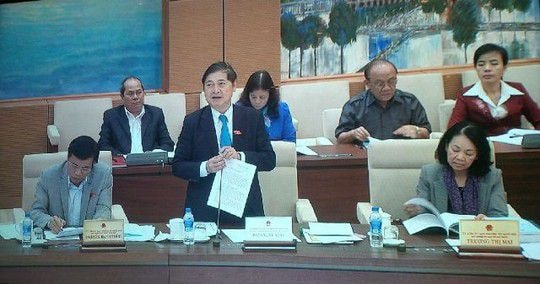 |
| 35th Session of the Standing Committee of the National Assembly |
Explaining the draft law, Mr. Nguyen Van Quyen stated that the draft law stipulates that voters in a referendum are the same as voters in elections for National Assembly representatives and People's Council representatives at all levels. Specifically, "Citizens of the Socialist Republic of Vietnam who are 18 years of age or older as of the date of the referendum, and who have full civil capacity, except for those who are not registered on the voter list according to the provisions of this Law, have the right to vote in a referendum."
The bill proposes that after the Standing Committee of the National Assembly sets the date for the referendum vote according to the National Assembly's decision, at least 80 days before the referendum vote, the Standing Committee of the National Assembly shall establish a Central Referendum Committee, whose chairman is the Chairman or Vice-Chairman of the National Assembly. The Central Referendum Committee is established to assist the Standing Committee of the National Assembly in organizing the referendum and ceases its activities after completing its task. In addition, local referendum committees (down to the commune level) will also be established.
In reviewing the draft law, the Standing Committee of the National Assembly's Law Committee agreed with the provisions of the draft law because this is consistent with the authority to decide on and organize referendums belonging to the National Assembly and the Standing Committee of the National Assembly, as stipulated in the Constitution and the Law on the Organization of the National Assembly.
On the other hand, for issues related to the lives of people in certain localities or territories, the law has and will continue to supplement regulations to ensure the participation of people directly affected (for example, the need to solicit opinions from local people in cases of merging, dividing, or adjusting administrative boundaries...). The nature and legal value of these forms of soliciting opinions from specific groups or geographical areas differ from referendums conducted nationwide. Therefore, it is proposed that the law only stipulate the scope of referendums nationwide and not at the local level.
However, according to the Chairman of the Legal Committee, Phan Trung Ly, some argue that there are important national issues decided by the National Assembly that mainly affect the interests of a segment of the population or directly impact one or more specific localities (such as the construction of nuclear power plants in a certain territory, the granting of special powers to local governments in special administrative-economic units, border areas, and islands...). Therefore, if the draft law only stipulates that referendums are conducted nationwide, it is insufficient and inappropriate. It is suggested that the draft law should stipulate that referendums have a nationwide scope, but in some cases, they can also be conducted within one or more specific administrative units.
The draft law stipulates the responsibilities of relevant agencies and organizations in supervising referendums. The Standing Committee of the Legal Affairs Committee believes that, in order for referendums to be conducted democratically, objectively, openly, and transparently in accordance with the law, it is necessary to regulate the responsibilities of agencies, organizations, individuals, and citizens in supervising referendums. However, the authority and responsibility of elected bodies and the Vietnam Fatherland Front in supervision are already stipulated in the Law on Supervisory Activities of the National Assembly, the Law on the Organization of People's Councils and People's Committees (which will soon be further regulated in the Law on Supervisory Activities of the National Assembly and People's Councils and the Law on the Vietnam Fatherland Front). Accordingly, agencies and organizations, within their assigned tasks and powers, are responsible for supervising the implementation of laws in all areas of social life, including laws on referendums. Therefore, it is proposed that the issue of supervision not be included in the Law on Referendums to avoid duplication.
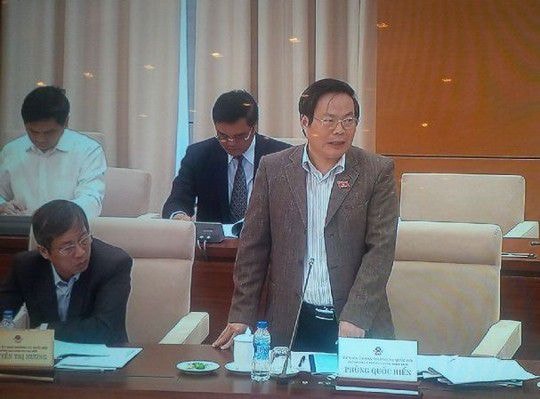 |
| Delegates give their opinions on the draft Law on Referendums. |
The draft law presents two options regarding the entities entitled to propose a referendum. Option 1 includes the Standing Committee of the National Assembly, the President, the Government, or at least one-third of the total number of National Assembly deputies as having the right to propose a referendum; Option 2 expands this to include other entities as well.
Regarding this matter, the Standing Committee of the Legal Affairs Committee proposes that the entity entitled to propose a referendum be defined as in Option 1.
The draft law presents two options regarding the results of the referendum. Option 1: A valid referendum requires more than half of the registered voters to cast their ballots. The referendum option that receives more than half of the valid votes is announced and implemented. Option 2: In addition to the conditions in Option 1, this option adds a provision that for referendums on the Constitution, a valid referendum requires more than two-thirds of the registered voters to cast their ballots, and the option that receives more than two-thirds of the valid votes is announced and implemented.
According to Mr. Ly, the Standing Committee of the Legal Affairs Committee agrees with the provision of a "double majority" to ensure the validity of the referendum results, as in Option 1.
Regarding this issue, some argue that to ensure the legality of the referendum results, the National Assembly should issue a resolution confirming the referendum results announced by the Standing Committee of the National Assembly. However, others argue that the Constitution has already granted the Standing Committee of the National Assembly the authority to organize referendums, so when the Standing Committee announces the referendum results, it already ensures the objectivity and legality of this activity. Therefore, the National Assembly does not need to issue a resolution confirming the referendum results.
Mr. Nguyen Van Giau, Chairman of the Economic Committee, expressed concern that Vietnam's institutional framework differs from that of many other countries, and therefore any references to it must be based on this reality.
Regarding the scope of the referendum, the Chairman of the Committee on Science, Technology and Environment, Phan Xuan Dung, proposed a nationwide referendum but conducted regionally. Mr. Dung cited the example of a hydroelectric power plant construction project in a particular region, where a public opinion referendum is necessary.
Chairperson Truong Thi Mai suggested that specific regulations are needed regarding issues requiring public consultation. She proposed: “Issues that touch upon national security and sovereignty… require public consultation. There must be specific conditions; general regulations are not clear.”
Chairman of the National Assembly's Ethnic Affairs Committee, Ksor Phuoc, stated that life presents many issues requiring public consultation. Major policy decisions must be made, and it's necessary to clarify which issues require nationwide consultation. Regarding the scope of public consultations, Mr. Ksor Phuoc agreed that a nationwide referendum is necessary, but emphasized the need for consultations on specific issues.
Chairman of the National Defense and Security Committee Nguyen Kim Khoa acknowledged that this is an important but also highly sensitive bill. Mr. Khoa suggested that issues subject to public consultation "need to be carefully studied," ensuring they do not contradict the Constitution or laws. Mr. Khoa argued that the provision regarding the decision-making authority, as stated in Option 1 of the draft – "the result only requires half of the voters to agree" – is too low, proposing that a two-thirds majority must agree to ensure legal validity.
To prevent negative behaviors during referendums, it is necessary to stipulate prohibited behaviors in this law. A separate article on prohibited behaviors should be designed within the chapter on general provisions to clarify what behaviors are prohibited. There were differing opinions on this matter, but the drafting committee agreed with the majority opinion and did not include this provision in the draft. Chairperson Truong Thi Mai suggested that regulations should clearly define issues that are not subject to referendums, particularly those related to the state budget and laws. Agreeing with Ms. Mai's opinion, Chairman of the National Assembly's Ethnic Affairs Committee Ksor Phuoc proposed that regulations should strictly prohibit referendums on issues that violate the Constitution. |
According to NLDO
| RELATED NEWS |
|---|