

A sacred mountain realm
(Baonghean) - In the late autumn days, the capricious, fleeting rain turns out to be the catalyst, stirring up astonishment at the breathtaking beauty of the golden season in the border region. Chau Kim (Que Phong) - the Muong Ton and Muong Ca areas of yesteryear - glows with vast expanses of fragrant rice and warm sunshine, interspersed with the radiant green of Pu Quai mountain, like a crown of nature, highlighting the fresh yet mysterious beauty of this sacred mountain realm...
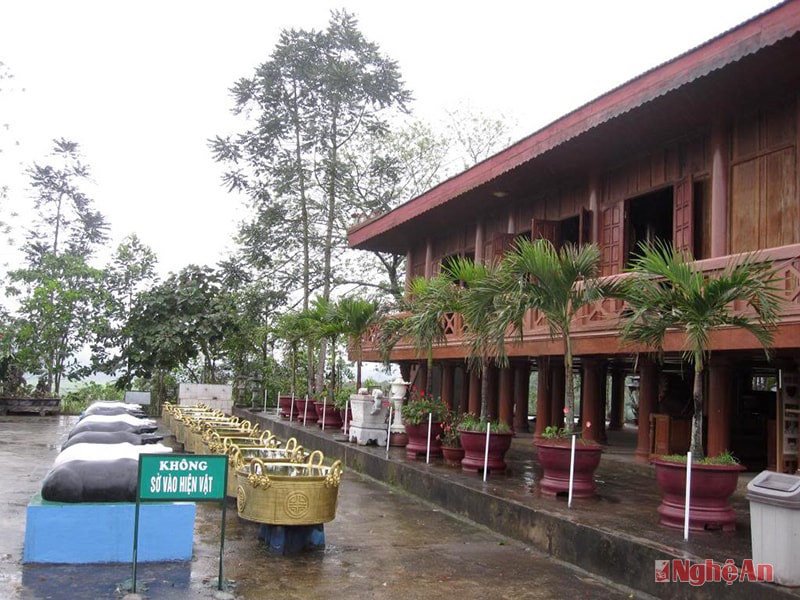 |
| The Nine-Chamber Temple. |
I've visited Que Phong many times, and each time I have to admit that this land of high mountain passes and deep ravines is strangely captivating! Except for hurried business trips related to programs and projects that brighten the prospects of the villages, if you travel at a leisurely pace, you can't forget to visit some of the famous landmarks that have become the "representative face" of this fascinating land. The swirling beauty of Sao Va Waterfall, Pa Tang Waterfall... the majestic beauty of the Pha Ca Tun mountain range throughout the four seasons, or the quiet stillness of the highland town at night all immerse the soul of the visitor in a world of intoxication. However, Que Phong's beauty is not just about dazzling display; its beauty also lies in the profound and mysterious legends that shimmer in the consciousness of the Thai ethnic people throughout the nine villages and ten hamlets, and which, since time immemorial, have subtly permeated the souls of those far from home.
I have wandered countless times through the Chau Kim region – a land that is part of the illustrious Muong Ton region, stopping to bathe in the vast Nam Giai river, lost in thought, reminiscing about the many whispered secrets of the past. Remembering a crackling fire, an ancient stilt house, the frosty nights of the mountains, fathers and sons, grandfathers and grandsons gathered together, breaking roasted cassava roots in half, whispering stories of old… The story goes that the Thai people have a sacred path – the path to heaven! The path to heaven is for spirits seeking to ascend to the upper realm, the starting point of their journey to the eternal realm with their ancestors. The path is not far from us, it is very close, right in the deep, dark Nine-Chamber Temple amidst the vast forest – the point connecting space and time in the cycle of reincarnation, of human existence. That mysterious, whispered story was later recorded in many official and unofficial histories, and further chronicled with important contemporary information: The Nine-Room Temple was built during the Ming Dynasty (1407-1427) on Pu Quai Mountain (Buffalo Mountain), in Chau Kim commune. After centuries of exposure to the elements, the temple, originally simple in architecture, was restored by the local people.
In the year of Dinh Mao (1927), the Prefect of Quy Chau, Mr. Sam Van Vien - a Thai man from the Muong Ton region - ordered the local people to go into the forest to exploit ironwood, haul it to Pieng Pan wharf (now in Chau Thang commune, Quy Chau district), and assemble it into rafts. These rafts were then transported along the Nam Giai River to Ta Tao wharf for the upgrading of the temple. Many village elders still remember that after the renovation, the temple had four rows of tall ironwood pillars resting on stone foundations, and the stairs were built of brick. In 1929, the villagers held a festival, which was only revived once in 1947. For a period of 59 years (1947-2006), almost a lifetime, the Nine-Room Temple Festival was completely interrupted, remaining only in the memories of the elderly. In 2004, the People's Committee of Que Phong district undertook the restoration and renovation, and in 2006, the temple was inaugurated and the festival was reopened with great fanfare...
Today, the majestic Nine-Chamber Temple stands atop Pu Quai mountain, surrounded by countless mystical legends. Even the temple's name, linked to the sacred number 9, evokes stories of divine power and the symbolic meaning of "nine lower realms." Many documents suggest that the Châu Kim - Mường Tôn region, where the Nine-Chamber Temple once stood, was the ancestral land of the Thái people of western Nghệ An province. While this remains a subject of debate, the most important thing is the spiritual orientation of each individual. Everywhere is homeland, the land of our ancestors, and perhaps simply showing reverence before symbols of history and tradition, and preserving these traditions in every aspect of daily life, is the most beautiful expression of gratitude!
Looking at the nation's official history, it becomes clear how the sacred ancestral land has instilled in future generations a tradition of unwavering patriotism and national defense. The sacred Châu Kim region shines brightly in the history of the land and people of this border region with its glorious battle relics. The Nghệ An Chronicle by the renowned figure Bùi Dương Lịch records the name Cầm Công – a chieftain in Mường Tôn who, along with his militia, joined the Lam Sơn rebel army, contributing significantly to the thunderous victory at Bồ Đằng, opening the way for the main army to advance from Thanh Hóa into Nghệ An. In the long history of national defense, the year 1884 remains a significant milestone, the time when the Nguyễn dynasty signed the Patenôtre Treaty, "accepting" French colonial protection in Vietnam. Unwilling to accept the loss of their country and enslavement, the people of the Phủ Quỳ region, and especially the people of Châu Kim, wholeheartedly responded to the Văn Thân – Cần Vương movement against the French colonialists and their feudal collaborators. Names like Lang Van Cang, also known as Quan Thu, took the lead, rallying the people to contribute resources and labor, persistently defending the Thanh Nga outpost (Chau Nga, Quy Chau) and bravely sacrificing their lives on their homeland.
Thoughts about a sacred land kept flowing... The land and people of Chau Kim, I thought, held nothing new to me. Yet, this return to Chau Kim gave me ample time to enjoy the simple pleasures of exploring this sacred land in the hearts of the Thai people. Furthermore, I took advantage of invitations from many elders to visit Khoang village – the ancestral home of the Nine-Room Temple. The elders of Khoang village, blessed by Heaven, are still very sharp-minded and knowledgeable! Elder Luong Quang Vinh, nearly 90 years old, said, “This age is a gift from Heaven!” – he drawled, raising both hands in a warm greeting, in the traditional manner of the people. Elder Vinh is now a respected village elder and, having once been an official of the Provincial Agricultural Committee, his eloquence and storytelling were impeccable.
The old man said that the village now has 69 households and 321 people, all of whom unanimously maintain a cultured and civilized way of life. There are no drug addicts or gamblers; they only open their rice wine jars on holidays and festivals. Husbands and wives, and children, live in harmony, and while their lives aren't necessarily prosperous, they are somewhat more stable than before. After rambling on about joyful stories, the old man's voice suddenly became serious as he spoke about the aspirations of the villagers. He explained that the people of Khoẳng village want to build their village into a "Resistance Village," or some other model to commemorate the victories and sacrifices of a generation of people in the national resistance against the American invasion. "The elders still remember the stories, but the younger generation has forgotten much. We want a commemorative plaque erected at the beginning of the village, at the historical sites, to serve as historical evidence and educate future generations," Elder Lương Quang Vinh confided thoughtfully.
And according to old man Vinh's memory, I searched through documents and records about the heroic fighting of the people of Khoang village (Chau Kim) in the indomitable resistance war of the country. So many sons and daughters of the village took up arms and went to the battlefield, while the rear guard provided rice and grain to feed the troops. It's impossible to recount all the blood and sacrifices, staining the red flag that fluttered on the day of complete victory. In particular, there was an event that directly impacted every inch of land and every stream in Khoang village, leaving a strong mark on the minds of many generations of villagers, and fortunately, I found it stored in the Report of the Que Phong District Party Committee in 1969 (File 23, page 4): On the evening of July 20, 1967, the Que Phong District Party Committee was carrying out preparations for the 3rd Party Congress. But before the Congress could take place as planned, a fierce bombing raid by American planes struck, catching the people of Khoang village off guard. 27 houses were completely burned down, 2 people died and many were seriously injured. Luong Van Binh, the then head of the Chau Kim commune militia, sacrificed his life while braving danger to help rescue people and protect the property of the villagers...
Old Man Vinh led me to the bank of the Nam Giai River, pointing towards the middle of the stream. There, massive rocks, easily weighing tens of tons, stood towering across the water, their surfaces cracked with large fissures. “Those are the remnants of American bombs from years ago. I remember clearly, flares illuminated the area, bombs and rockets exploded with deafening roars. Our villagers hurriedly gathered their belongings, protecting the resistance materials and supplies, while helping each other take shelter in the tunnels and trenches surrounding the village,” Old Man Vinh recounted, his voice trembling. In Khoang village now, many new stilt houses stand amidst the old wooden ones, so, understandably, the ravages of time have buried many of the traces of the resistance. Besides the large rocks in the middle of the Nam Giai River, only an A-shaped tunnel remains, just outside the dense bamboo grove. Looking up from here, one can still faintly see the silhouette of the Nine-Chamber Temple, and the lush green forest of Pu Quai peak bordering the sky of Chau Kim - Muong Ton, creating an unusually mystical atmosphere. It turns out that, despite countless changes over time, the sacred Pu Quai peak still radiates the love and respect for ancestors and homeland throughout the traditions of the Thai people. Greetings, Elder Vinh, greetings to Khoang village, greetings to Chau Kim, I – a stranger from afar – will carry with me the sacred and lingering echoes of the gongs from the Nine-Chamber Temple in my heart!
Text and photos:Phuong Chi