

We need to reach a consensus to maximize our practical role.
(Baonghean) - On February 23, the United Nations Security Council opened a discussion session on the theme "Maintaining International Peace and Security: Reflecting on History, Reaffirming a Strong Commitment to the Purposes and Principles of the UN Charter." In light of recent disagreements within the Security Council, this session provided an opportunity for member states to reaffirm their commitment to the principles of the UN Charter, while also serving as a forum for mutual listening and constructive engagement, contributing to the strength of the United Nations in general and the Security Council in particular.
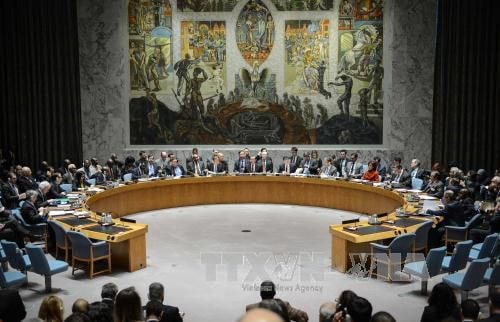 |
| A plenary session of the United Nations Security Council on the theme "Maintaining international peace and security" on February 23. Source: THX/VNA |
During this discussion, the Russian Foreign Minister stated that "the UN Security Council needs to exercise its authority properly and truly become an effective and influential tool for maintaining peace and security, instead of becoming an arena for propaganda, in which the UN risks being sidelined from important international issues." It is clear that division is not a new problem for the UN Security Council, but it has been a topic of much discussion in recent years, especially during the turbulent year of 2014. In the Ukrainian crisis alone, the UN Security Council held dozens of meetings without achieving any positive results. This is clearly a problem that member states need to reflect upon. The Ukrainian crisis has created deep divisions between Russia and Western countries, pushing East-West relations to their lowest point since the end of the Cold War.
With its five permanent members possessing veto power—Britain, France, the United States, Russia, and China—the United Nations Security Council is the most powerful body on the planet, primarily responsible for maintaining international peace and security. Looking back at history, the former Soviet Union and present-day Russia have often held differing positions on most international issues compared to Britain, France, and the United States. However, there have been instances where the Security Council has reached a unified stance, such as peacekeeping in some African and Middle Eastern countries, or preventing epidemics. Nevertheless, today, with the world no longer divided into two poles as during the Cold War, the member states of the Security Council have yet to truly reach significant consensus on resolving global issues.
UN Secretary-General Ban Ki-moon affirmed that "collective security is a core objective of the United Nations," while emphasizing that preventing armed conflict is central to the organization's charter. Therefore, continuing the mission of maintaining international peace and security effectively is essential for the Security Council to live up to its role. After all, no resolution can be passed if a permanent member among the UK, France, the US, Russia, or China casts a veto.
Overall, divisions and disagreements will continue to exist within the United Nations in general and the Security Council in particular. However, how to bridge these conflicts and disagreements is a matter that nearly 200 UN members need to consider. 2015 marks the 70th anniversary of the founding of this largest multilateral organization globally, and countries need to seriously reflect on the common cause in peacebuilding, peacebuilding, empowering women, and mitigating the risks of natural disasters. Nations need to work together to uphold the values of the UN Charter, with the members of the Security Council playing a leading role. Only then will the world reduce wars and conflicts, build peace, and work together to address current common problems, such as preventing natural disasters and epidemics and tackling global climate change.
Nguyen Cao Bien