

When vegetables are as cheap as straw?
(Baonghean) - From mid-2014 to the present, many types of commercial vegetables on the market have experienced a "price drop," with prices at times being so low they were practically given away. This situation is posing a challenge for management agencies, businesses, and vegetable growers in planning, planting, preserving, and processing clean vegetables.
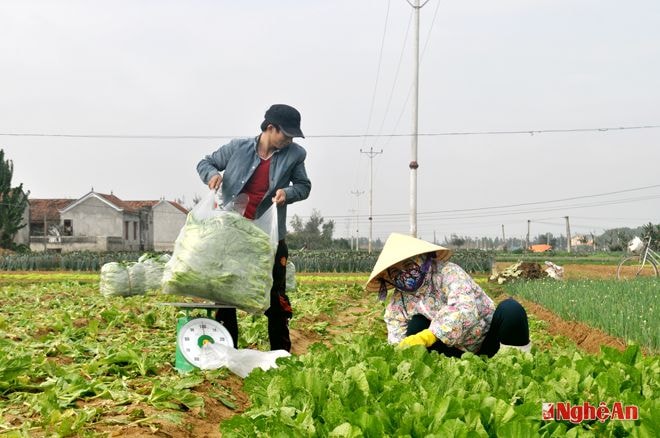 |
| Vegetable production in Quynh Luong commune (Quynh Luu district). |
The paradox of clean vegetables
Standing beside her overripe cabbage field, only suitable for pickling, Ms. Ho Thi Hoa from Hamlet 7, Quynh Luong Commune, Quynh Luu District, couldn't hide her frustration. She should have harvested the cabbage long ago, but due to the low price, she kept delaying, hoping for a price increase. In the end, she had to harvest the old cabbage to sell for pickling, at a price still only 500-1,000 VND/kg, whereas during peak seasons, the price could reach 4,000-5,000 VND/kg. "Take the cabbage home to eat, I'll give it to you for free. I even took it to Vinh market, but even a big bag like that only fetched 10,000 VND. But I still have to scrape together some of the cost," Ms. Hoa shared. In the neighboring field, Mr. Nguyen Van Hoang's family (Hamlet 8) was in a similar situation, lamenting, "Now, vegetables are as cheap as straw!" With 5 acres of land, he grows all kinds of vegetables, from tomatoes and cabbage to kohlrabi...
If tomatoes were priced at 10,000-12,000 VND/kg close to Tet (Lunar New Year), now they only fetch 2,500-3,000 VND/kg at the wholesale market. Currently, in this famous vegetable-growing region, kohlrabi is only around 2,000 VND/kg, cabbage is only about 500 VND/head, and Chinese cabbage is priced from 500-1,000 VND/kg. Compared to previous seasons and the days leading up to Tet, vegetable prices have dropped to only 1/3, or even 1/5, of their previous prices. With low prices and difficult sales, many vegetable plots are old and turning yellow. Households that raise livestock are using them as animal feed, while others are using them as fertilizer – a typical cycle of a vegetable crop...
Notably, this is not the first time vegetable growers in Quynh Luong, as well as other vegetable-growing areas in the province, have faced this situation. Many harvests have resulted in vegetables being given away for free, or even left unharvested. The irony is that although the growers commit to growing and caring for their vegetables according to clean farming practices, an increasing number of people in towns and cities – areas without land for growing vegetables – are finding ways to obtain "clean" vegetables grown by themselves for their families' daily needs.
For several years now, in her house facing the street, Mrs. Tran Thi Chi from Hung Dung ward, Vinh City, has been utilizing every available space to grow organic vegetables in styrofoam containers. She even ordered several stainless steel racks to place the containers on. Growing seasonal vegetables, along with supplies from relatives in her hometown, her family almost never buys vegetables from the market.
According to Ms. Chi, "Nowadays, going to the market is impossible. Whether it's raining or sunny, the vegetables are always fresh and green, but it's hard to tell the difference between clean and 'dirty' vegetables. There are a few places selling 'clean' vegetables, supposedly certified as safe, but the prices are a bit high. Moreover, many places use the label 'clean' to deceive consumers, so it's impossible to feel secure." This is the general sentiment of many consumers today. It's not difficult to find styrofoam containers used for growing vegetables in homes, or makeshift vegetable plots in narrow alleyways right next to the streets. Because of the reality of many vegetable growing areas not meeting food safety and hygiene standards, many consumers have turned their backs on locally produced vegetables.
The directions...
Following the establishment of the Phu Luong Cooperative, the leaders of Quynh Luong commune harbored the ambition to transform the commune's specialized vegetable farming area into the largest safe vegetable production zone in the province. With 20 members cultivating nearly 4 hectares, the cooperative produces tens of tons of clean vegetables daily. The products are sold under contract to several large supermarkets such as Metro Vinh, BigC Vinh, Metro Hanoi, and BigC Hanoi. Vegetable growers receive training on safe vegetable cultivation techniques at least twice a year, ensuring that the vegetables are produced according to guaranteed technical procedures. In particular, farmers must strictly adhere to regulations requiring them to stop spraying pesticides at least 10 days before harvesting to ensure food safety and hygiene. Having started operations in 2003, the Phu Luong Cooperative's approach was considered a novel, effective, and necessary direction to meet the growing demands of the market and consumers.
However, after more than 10 years of operation, starting from this winter season, the cooperative has stopped supplying vegetables to supermarkets and only sells to distributors who distribute them to Vinh, Thanh Hoa, and Da Nang. According to the cooperative's chairman, Mr. Ho Lam Thong: "Every day, the cooperative produces about 2,000 tons of safe vegetables, but only about 0.5 - 1 ton is consumed by supermarkets. The quantity is too small, resulting in losses due to transportation costs. Moreover, producing safe vegetables that meet the strict requirements of product quality inspection, providing consumers with clean products, also means that vegetable growers have to work harder in the planting and care stages. Yet, the purchase price of vegetables is almost always lower than the market price, and even when it's higher, the difference is negligible."
Concerned about the issue of selling safe vegetables to local people, Mr. Ho Nguyen Tuan, Vice Chairman of the People's Committee of Quynh Luong commune, shared: “From the Phu Luong Cooperative model, the commune has expanded the production of safe vegetables throughout the entire commune. Currently, all 8 hamlets have areas producing safe vegetables. However, people are mostly left to fend for themselves in terms of planning, caring for, and finding markets, with prices and markets being unstable. Meanwhile, consumers in the market still cannot distinguish between safely produced vegetables and those that do not meet safety standards, leading to difficulties and losses for safe vegetable producers. We regularly educate and encourage people to persistently adhere to safe production processes to build and maintain the Quynh Luong vegetable brand and hope for opportunities to expand the market, especially to increase consumer awareness and preference for clean vegetable products...”
Safe vegetables are fresh vegetables whose levels of chemical, biological, and physical substances are below the permitted standards, ensuring safety for consumers and the environment. With an improving standard of living, but with the increasing health risks from unsafe food products, the demand for safe vegetables in the market is growing. However, not everyone is lucky enough to buy clean vegetables at the market. This stems from the fact that many vegetable growers overuse growth stimulants, fertilizers, and pesticides to increase yield and shorten growing time, bypassing clean farming practices. This reality occurs in most vegetable-growing regions, thus increasing consumer concerns about unsafe vegetables.
It's noteworthy that in many localities, even without programs or projects implementing safe vegetable production (VietGAP), people are very conscious of producing clean products to supply the market. Breaking off a cucumber and eating it right in the field, Mrs. Tran Thi Toan from Hong village, Thanh Linh commune, Thanh Chuong district, said: Her family has two plots of land for growing vegetables, growing whatever is in season – sometimes cucumbers, sometimes green squash – but for many years, it has become a habit. Her family, like other households in the village, is always conscious of producing clean produce. Because of this, during peak vegetable seasons, while many other places struggle to sell their vegetables, the produce here is always sought after by traders from Nam Dan and Do Luong, who buy directly from the fields, and the prices remain stable. Similarly, in Nghi An commune (Vinh City), which has specialized in growing clean vegetables for many years, with good quality, delicious, and clean vegetables, the prices here are often higher than market prices. Along with traditional vegetable production methods, the people of Nghi An also firmly grasp and utilize scientific and technological advancements in clean vegetable cultivation, such as composting organic fertilizer into bio-organic fertilizer, treating the soil with lime powder and organic fertilizer before sowing seeds, and only watering the vegetables throughout the growth process.
What is the path to safe vegetables?
Mr. Nguyen Van Lap, Deputy Director of the Department of Agriculture and Rural Development, said: Along with the province's overall plan, localities also need specific plans based on market demand to avoid uncontrolled production, which leads to periods of oversupply and difficulties for farmers. In addition, the province needs strong policies and mechanisms to encourage businesses to invest in building processing facilities for fruits and vegetables in the area. Currently, Nghe An has over 2,000 hectares of vegetable production annually, yielding hundreds of thousands of tons, but no businesses have yet invested in building processing facilities or implemented effective and reasonable post-harvest preservation methods.
These factors lead to significant disadvantages for farmers growing safe vegetables. Finding a stable market requires the involvement of local authorities and businesses, helping farmers escape their current state of self-reliance. Furthermore, to promote the development of safe vegetable production and expand the area under cultivation to meet market and consumer demand, management agencies need comprehensive and specific solutions from production to consumption. Specialized agencies such as agricultural extension, plant protection, quality control, and food safety and hygiene must directly guide the development of safe vegetable production models according to proper procedures. Simultaneously, a strategy and system of competitive retail outlets for promoting, introducing, and selling the products need to be developed. Safe vegetable products must be closely monitored, directed, supervised, and tested for quality by specialized agencies such as the Plant Protection Sub-department, the Measurement and Quality Control Sub-department, and the Food Safety and Hygiene Sub-department, and then certified. In particular, consumers also need to improve their knowledge in choosing and using vegetables from reputable sources with proper labeling to boycott unregulated vegetables and support clean produce... Only then can vegetable growers escape the vicious cycle of "bumper harvest, low prices"...
Phu Huong