

Youthful energy under Phu Xai Lai Leng
(Baonghean) - The towering Phu Xai Lai Leng peak bears the footprints of countless young men from Nghe An who trekked through forests and crossed waterfalls to conquer the vast mountains, building shelters and establishing their lives. The Na Ngoi Youth Village (now the Nghe An Youth Volunteer Team 10) is not only a home for young people but also actively supports the people in the mountainous areas in changing their production methods, escaping poverty, and stabilizing their lives.
(Baonghean) - The towering Phu Xai Lai Leng peak bears the footprints of countless young men from Nghe An who trekked through forests and crossed waterfalls to conquer the vast mountains, building shelters and establishing their lives. The Na Ngoi Youth Village (now the Nghe An Youth Volunteer Team 10) is not only a home for young people but also actively supports the people in the mountainous areas in changing their production methods, escaping poverty, and stabilizing their lives.
Set up a tent and start a new life.
The highest peak in North Central Vietnam, on the majestic Truong Son mountain range, is Phu Xai Lai Leng, perpetually shrouded in clouds. Above 2,000 meters, not a single human footprint can be found. Naturally, it was impossible to send troops to the summit, as the mountain peak was incredibly high and the climate extremely harsh. “It’s freezing cold up there. The primeval forest is so old and dense that even cooking rice doesn’t get it right; the water only heats up to 80 degrees Celsius at most. You can’t survive up there for long!” said Nguyen Trong Canh. From the 8th Youth Volunteer Brigade for Economic Development, stationed in Huoi Tu (Ky Son district, a remote area of Nghe An province), Nguyen Trong Canh selected six of his most outstanding members and led them to Na Ngoi, below the peak of Phu Xai Lai Leng. The land where the headquarters of the Na Ngoi Youth Settlement Village, later the 10th Youth Volunteer Brigade for Economic Development, was located was a valley.
In those early days of pioneering and clearing land, there were countless difficulties. With just a few kilograms of rice, some salt, a bundle of dried fish, and a few worn-out, stained clothes, the "leader" and his team members began their journey to conquer the vast mountains. Three main tasks were set: going down to each village to persuade the Hmong and Thai people to work together to establish youth villages; building a central area; and quickly bringing intensive farming techniques for crops suitable to the highland soil to the mountain people. Nguyen Trong Canh recounted: "Na Ngoi commune has 19 villages, with over 4,000 inhabitants, of which more than 80% are Hmong. The population is sparse, scattered over a large area; some villages require a day's journey climbing mountains and crossing streams to reach. We went to each family, persuading each person to give up land and support the construction of the youth village." After months of persistent "negotiations," Nguyen Trong Canh's team finally received 20 hectares of land in the Ka Tren valley from the Hmong people in Na Ngoi commune to expand their business.
Beneath the majestic and treacherous peak of Phu Xai Lai Leng, a thatched hut with bamboo walls sprang up. “Night after night, lying in the forest listening to the wind blowing from all directions, thinking about the arduous journey ahead, there were times I couldn’t help but sigh. If we hadn’t had the willpower and the team hadn’t been united, it would have been very difficult to complete the mission!” – recounted “leader” Nguyen Trong Canh. Seven members of the Youth Volunteer Team went to open up land in the border region; each from a different hometown, but united in heart and mind. Among the seven, three were Hmong youths: Denh Ba Mai, Tong Ba Tenh, and Xong Ba Xa. They played a core role in contacting and mobilizing the villagers to support the establishment of a new village. Denh Ba Tenh (born in 1984) was a model member transferred from the Huoi Tu Youth Volunteer Team for Economic Development to Na Ngoi. Whatever the difficult task, this Hmong young man volunteered to take it on.
Nguyen Trong Canh confided, "To get the villagers to follow and support me, I have to show them that what I'm doing is effective; I can't just talk!" In the remote mountains, where did it all begin? In 2008, after stabilizing the team and securing a foothold, Nguyen Trong Canh discussed with the Command Board of the Nghe An Youth Volunteer Force for Economic Development the application of experience from the model of the 8th Huoi Tu Brigade, immediately bringing plant varieties to Na Ngoi for cultivation. In a short time, the Ka Tren valley was overflowing with various kinds of vegetables. Pumpkins, corn, kohlrabi, cabbage – every row was straight and lush green. The first harvest was successful, and Nguyen Trong Canh ordered his team members to bring vegetable seeds into the village, going to each household to guide the villagers on how to plant, care for, and harvest. Working for the people was like working for his own family. The diligence and thoughtfulness of each member of the Na Ngoi Youth Settlement Village have left a positive impression on the Mong and Thai communities in the mountainous Ky Son district, earning their trust, admiration, and emulation.
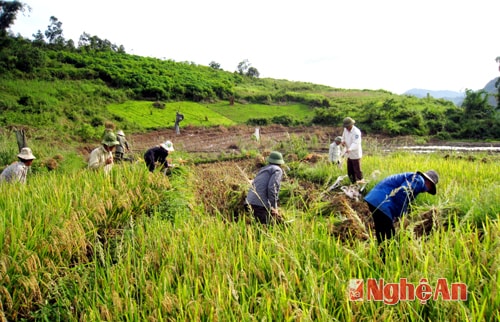 |
| Rice harvest in Ka Trên valley (Na Ngoi commune, Kỳ Sơn district). |
It's no coincidence that the Nghe An Youth Volunteer Force Command chose Nguyen Trong Canh, former Chairman of the Nam Xuan Agricultural Cooperative (Nam Dan district), as the leader and the first person to sow the seeds for the Na Ngoi Youth Settlement Village. Born in 1966, known for his energy and willingness to think outside the box and take action, Nguyen Trong Canh once stirred up the rural areas of Nam Dan with his movement to grow "super cucumbers" and... raise cats. Faced with the rampant rat infestation that destroyed crops, the Cooperative Chairman launched the "every household raises cats" campaign. He enthusiastically encouraged households to raise cats, persuading villages to pass resolutions to raise cats to protect crops and food supplies. The Nam Xuan Cooperative subsidized each cat brought to the commune at 50,000 VND. In just a few months, the entire Nam Xuan commune, comprising 1,200 households, had raised 1,250 cats. Cats appeared throughout the villages, spilling out into the fields, resulting in a rat-free countryside and bountiful harvests. This determination was also applied by Nguyen Trong Canh in the movement to grow "super cucumbers," bringing high economic benefits and improving the lives of many people in Nam Xuan during the years 1999-2000. The high-yielding cucumber variety, originating from Thailand, suited the soil of Nam Dan, providing each household with tens of millions of dong per crop. It was then widely cultivated in many communes and for a time was considered the main crop in the fields. Recalling this economic model, Mr. Nguyen Trong Canh smiled: "Back then, people called this type of cucumber 'ghost cucumber' because the next day, after harvesting, the fields were full of fruit. No pesticides were used; this cucumber variety is just like that. Farmers earning tens of millions of dong each season from growing cucumbers was a great success, especially more than a decade ago!"
Reproducing plants and animals
Salmon and lilies, two specialties of the Na Ngoi Youth Settlement Village, are just a few examples of the tireless and creative labor of the Youth Volunteer Teams in this remote border region. Although Na Ngoi has undergone a quiet yet spectacular transformation, with its people and Youth Settlement Team members gradually escaping poverty through their own hard work, sweat, and tears, the salmon and lilies still hold a compelling mystery. Why can the salmon climb to the very top of the mountain pass to reproduce? And how can lilies, a seemingly finicky flower, bloom so profusely in this remote, isolated place?
Nguyen Trong Canh said: “The climate in Na Ngoi is cold all year round, as cold as Sapa and Da Lat. The Ka Tren valley is a thousand meters high, but the soil is fertile and suitable for lilies. This flower is easy to grow, but arranging the planting season so that the flowers bloom exactly during the Lunar New Year is not simple. We spent thousands of kilometers traveling to Da Lat to select seeds, learn how to plant and care for them, and then brought them back to Ky Son. In 2009, we planted 5,000 plants as a trial. The first harvest was successful, making all the team members excited, and since then, we have planted lilies every year for Tet. This year, 2014, we planted over 20,000 plants.” Every Tet holiday, Ky Son lilies bloom profusely, filling the streets. Although the salmon project still faces challenges in terms of market access and the production is modest, only a few tons per year, both of these specialties are a great success in terms of morale. "Nothing is impossible/ Only a lack of perseverance is to be feared." The persistence, perseverance, and youthful enthusiasm are the strength that enables these young members to overcome all difficulties and hardships, conquer the vast mountains, and continue writing the glorious history of the Youth Volunteer Force.
Na Ngoi is one of the communes with the largest area of terraced rice paddies in Ky Son district, with over 400 hectares. The Mong and Thai people in the villages of Ka Tren, Na Cang, Phu Kha, etc., only planted one crop per year during the summer-autumn season, using old, low-yield varieties, toiling all year on the fields just to barely make ends meet. “We set a goal of converting to two crops per year, introducing new rice varieties to the people. When the villagers' stomachs are full, they will listen and follow our advice!” explained Nguyen Trong Canh. Initially, the team members experimented on areas of 5 to 10 hectares, then expanded to the entire commune. Each Youth Volunteer team member was assigned to go to individual households, guiding farmers on how to sow seedlings, transplant rice, fertilize, and use pesticides. All the rice seeds, fertilizers, and pesticides were provided by the Na Ngoi Youth Village. In a short period, 400 hectares of terraced rice fields throughout the commune were converted to a two-crop system, increasing the yield per hectare to 6 tons per crop, resulting in full granaries for every household. Seeing this successful approach, at the end of 2013, Ky Son district selected Na Ngoi to hold a field workshop and decided to replicate the unit's rice cultivation model throughout the entire district.
Snow Shan tea, the main crop, has been widely planted by the youth union members throughout the villages, covering barren land and hills. Within five years, Na Ngoi has planted 170 hectares of Snow Shan tea, with an average yield of 3-4 tons per hectare. Like other crops, with support from the Central Youth Union and Nghe An province, the unit provides seedlings free of charge to each producing household, and supports each hectare of tea with 5 million VND. The villagers only contribute their labor for cultivation, and the unit guarantees the purchase of the harvested product. The unit has also invested 200 million VND in installing and operating a Snow Shan tea processing plant. Below the peak of Phu Xai Lai Xeng, the tea gardens of the Mong and Thai people are lush and green, contributing to improving the lives of the villagers. For example, the families of Lau Va Menh, Lau Chong Po, Xong Ba Re, Xong Ba Sao, etc., each cultivate 2 to 3 hectares of Snow Shan tea.
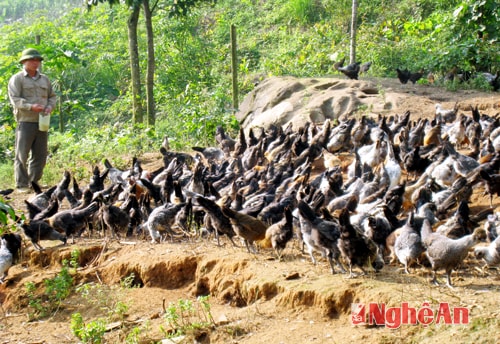 |
| Black chicken, a specialty of the Youth Volunteer Brigade - Economic Development Unit 10 (transformed from Na Ngoi Youth Settlement Village). |
Black chickens, a type of chicken with black bones and black meat, have become a nutritious delicacy in Ky Son. From a valuable breed already present in the village, crossbreeding with a black chicken breed brought back from a gene conservation center in Hanoi by youth group members has led to a boom in Na Ngoi. Building coops and farms, the youth group members selected the largest and healthiest chickens for breeding, expanding the scale of black chicken farming to over 3,000 birds. Lau Va Menh (Ka Tren village), Xong Ba Co (Na Cang village), Mua Ba Xong (Phu Kha village)... each household raises between 100 and 250 black chickens, earning tens of millions of dong per year. Besides black chickens, Tuyet Shan tea, various vegetables and food crops, the Na Ngoi Youth Village also encouraged villagers to grow winter squash and ginger. The harvested fresh ginger has helped many villagers escape poverty and become wealthy. For example, during the 2014 ginger harvest, Mr. Lau Va Menh's family earned about 200 million VND (20 tons of ginger); Lau Xai Ky, Lau Nhia Bi, Xong Ba Sao... each household earned about 100 million VND from growing ginger.
The growth and development of the Na Ngoi Youth Settlement Village, now the Nghe An Youth Volunteer Brigade - Economic Development Unit 10, has not only created a socio-economic model, but through practical actions, the Youth Volunteers have helped the villagers escape poverty and stabilize their lives. As he saw us off, "leader" Nguyen Trong Canh said: "There are things the Youth Volunteers have accomplished that cannot be measured!"
| The Na Ngoi Youth Settlement Village project in Nghe An province was approved by Decision No. 388-QD/TUDTN dated October 31, 2008, of the Central Committee of the Vietnam Youth Union; construction began in March 2009. The village center is located over 70 km from Muong Xen district town, Ky Son district, and nearly 300 km from Vinh City. |
Feature story:Quang Long