
Lesson 2: Choosing a Way Out of Poverty
(Baonghean) - In life, each household has its own circumstances, so families have different ways to escape poverty. With the attention and support of the state, many people have risen out of poverty through diligence, hard work, and creativity in labor and production... Many localities also have concerns about how to make support for poor households more effective.
(Baonghean) - In life, each household has its own circumstances, so families have different ways to escape poverty. With the attention and support of the state, many people have risen out of poverty through diligence, hard work, and creativity in labor and production... Many localities also have concerns about how to make support for poor households more effective.
| RELATED NEWS |
|---|
Huu Kiem commune has the lowest poverty rate in Ky Son district (33.7%), while the district's average poverty rate is over 60%. Sharing his experience in achieving rapid poverty reduction, Mr. Kha Van Quyen, Chairman of the Commune People's Committee, said: "Every year, before the government's poverty alleviation program, the commune categorizes poor households into four groups: those who are lazy, sick, lacking capital, and lacking scientific and technical knowledge. Only then do we identify households to support, prioritizing those lacking capital, scientific and technical knowledge, and those who are sick. Doing so ensures that the government's support funds are used effectively. Over the years, many exemplary cases of people rising out of poverty have emerged in the commune, most notably some households of the Khmu and Thai ethnic minorities in remote areas..."
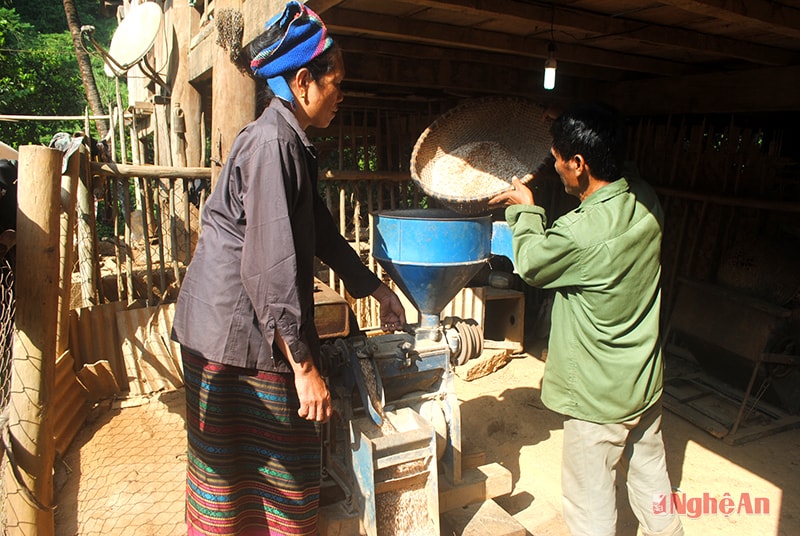 |
| Mr. and Mrs. Lu Van May in Dinh Son 1 village, Huu Kiem commune (Ky Son district) mill rice to serve the villagers. |
Following a small dirt road beside the stream, we arrived at Dinh Son 1, a particularly disadvantaged village in Huu Kiem commune, home to 96 Khmu ethnic minority households. At this time, the Dinh Son 1 village management board was gathered at the community cultural center to classify households in the village, preparing for the 2015 poverty assessment. Village head Luong Xuan Hien confided: "Although it's a particularly disadvantaged village, with 68 out of 96 households classified as poor, among those who have escaped poverty, some have risen from nothing, without any government assistance..." Then, Mr. Hien enthusiastically led us to the house of Mr. Lu Van May.
During our conversation, Mr. and Mrs. May shared that they got married in 1986. Both families were poor, so their married life was difficult, like many other families in the village. With their diligence and hard work, Mrs. Luyen – Mr. May's wife – actively cultivated the fields and raised pigs, while Mr. May, being skilled and a mason, took on any construction work needed in the village. After many years of saving, in 1991, they built a wooden house, replacing the hut their parents had built for them when they started their own family. With a stable place to live, they moved to a land half a day's walk from their home to develop their economy through livestock farming. There, Mr. May dug two ponds for fish farming and grazed cattle on the hillside.
Because they didn't have enough money to invest all at once, Mr. and Mrs. May bought two breeding female buffaloes. During the breeding process, they raised each calf as soon as it was born. Around the fish pond, they planted bananas and cassava, using the leaves as fish feed. In 1992, they sold one large buffalo and bought a rice milling machine to serve the villagers. For the past 10 years, Mr. May has switched from raising buffaloes to raising cattle. Each time he sells a large cow, he buys two more calves, and the herd has grown larger. Every day, the husband mills rice at home while the wife tends the cattle and raises fish in the field. During the harvest season, the couple works together to harvest corn and rice. Families who come to mill rice usually pay with money, rice, or bran, which Mr. May accepts. From that, the family has been able to raise additional pigs for breeding and meat.
For the family of Ms. Vi Thi Thanh, a Thai ethnic minority in Hom village, Huu Kiem commune, they also have their own way of doing business to escape poverty. While it's called "unique," it's really just about diligence and hard work, nothing more than a few hectares of farmland and livestock and poultry farming. Ms. Thanh happily says: "When people in the highlands first move out on their own, everyone is poor. But we can't just stay poor and rely on the government forever." Unlike other households in the village who leave to work elsewhere, "spending whatever money they earn," in 2010, she and her husband took on additional farmland near the Nam Mo River to set up a farm for raising broiler chickens and goats. At that time, they received 50 chicks from the government. With the chicks, she started a large flock and had broiler chickens to sell on the market. Ms. Thanh shared: "Raising chickens here isn't easy either. To ensure the chickens grow quickly and don't get diseases, we never use river water for them to drink, to prevent people upstream from throwing dead chickens due to disease into the river." After years of struggling to find a way to make a living, in 2012, Ms. Thanh's family finally escaped poverty. Regarding her experience in escaping poverty, Ms. Thanh concluded: "It's the same for any family; whether you're poor or not depends on yourself. You have to work hard and produce to have something to eat and save."
Currently, over 51% of households in Tuong Duong district are still living in poverty. The poorest areas are mainly concentrated in the communes surrounding the Ban Ve hydroelectric reservoir. The communes of Huu Khuong, Nhon Mai, and Mai Son each have poverty rates exceeding 80%. These areas face many obstacles to socio-economic development, making poverty alleviation difficult for the local population. However, in the outlying areas, the poverty alleviation movement is quite active. Some villages have seen a surge in residents voluntarily withdrawing from the poverty list, notably Quang Thinh village in Tam Dinh commune.
In Quang Thinh, village head Vi Vo Tuan said that the recent upland rice harvest could be considered a bumper crop, and the villagers were delighted. The average yield was about 50 quintals/hectare. With rice now available, the villagers feel more secure and motivated to work, thus gradually pushing back poverty. Of the 193 households in the village, 93 are still poor. It seems that the number of poor households in Quang Thinh village is not small. However, compared to previous years, the number of poor households in the village has decreased significantly. In 2014, the village reduced the number of poor households by 20, exceeding the target set by the commune. In 2015, the village aims to reduce the number of poor households by another 20 or so.
Mr. Tuan shared: "During the review of poor households, democracy is prioritized. Gathering the opinions of the majority of the people is the fairest approach. Each poor household in the village is assessed to see how their economic situation has been over the past period. Afterward, the final decision on whether a household is considered poor is made by the people themselves. Thanks to this method, many households have voluntarily requested to be removed from the list of poor households. The family of Mr. Xen Cong Nghia is one such example. Two years ago, his family was in difficult circumstances. Thanks to the government's poverty alleviation policy, he was able to buy a buffalo. Unfortunately, the buffalo died from disease, so he decided to leave his hometown to work as a laborer at a company in Thai Binh. After working and saving up some capital, he returned home and, together with his wife, developed their household economy. The first thing this 27-year-old man did was propose to the village that he be removed from the list of poor households." Mr. Nghia said: "Once I voluntarily applied to be classified as a poor household, I had to put all my effort into achieving my goal." With capital, he bought piglets to raise. After selling several batches of pigs, his capital grew, and he planned to build a pig farm in the area near the Săng Lẻ forest, combining it with planting perennial trees, digging a pond for fish farming, and raising cattle. Currently, he has 20 pigs and 10 cows in his barn. In early 2014, he opened a general store to increase his income...
In the village, there is also the family of Ms. Le Thi Phoi, who also registered to be removed from the list of poor households in 2015. Like Mr. Xen Cong Nghia, this single mother also wants to use the removal from the list of poor households as motivation to overcome difficulties. Mr. Tuan shared: In the coming time, the village will prioritize newly escaped-from-poverty families to implement economic development models deployed by the district and commune, in order to encourage those who have escaped poverty to have favorable opportunities to escape poverty sustainably.
In Tam Thai commune (Tuong Duong district), many households have risen out of poverty through their own efforts. Currently, this area is one of the three communes with the lowest poverty rate in the district, at just over 16%. Mr. Vi Viet Kieu, Chairman of the People's Committee of Tam Thai commune, said: In 2014, officials and civil servants at agencies and units located in the commune supported 8 households to escape poverty, each household receiving livestock worth 10 million VND. Before handing over the livestock, commune and village officials visited the households to understand their economic capabilities, labor resources, and natural conditions to select suitable breeds. This approach helps people use capital more effectively in economic development, thereby accelerating the reduction of poverty in the commune.
Mr. Kha Van Thang, residing in Tan Hop village, is one of the households in Tam Thai commune that will receive poverty alleviation support in 2015. After business setbacks and an accident in 2013, he had to sell his house and garden land. Following a poverty assessment at the end of last year, he was included in the list of impoverished households. After a year of hard work, he has created his own capital to develop livestock farming and has begun to generate income. Mr. Thang said that his family is striving to improve their business and hopes to rebuild their house in about two or three years. As a hardworking and proactive individual, he hopes to be removed from the list of impoverished households in the coming years.
In recent years, poverty reduction has been a top priority for all levels of government in Tuong Duong district. Besides government support for particularly disadvantaged areas, since 2013, the district government has also implemented a policy where each agency or unit located within the district supports 1-2 households to escape poverty. This support is raised from officials and civil servants throughout the district. The District People's Committee directly supports two households in each of the two communes of Thach Giam and Luong Minh, with each household receiving over 10 million VND to purchase livestock.
Mr. Kha Dinh Phe, Head of the Labor, War Invalids and Social Affairs Department of Tuong Duong District, said: "Previously, each agency under the district committee had to support a number of poor households, but some departments had very few staff, and the amount of money raised was not much. Therefore, in 2014, the entire block of agencies under the committee only supported 4 households to escape poverty. This measure will be more effective in helping people escape poverty..."
The households that have risen out of poverty, as mentioned, are just a few of the shining examples of those who have escaped poverty in the mountainous districts, and deserve attention and encouragement. Besides that, there are still many households that, despite meeting the criteria for escaping poverty, still harbor a mentality of dependence and seek every way to benefit from poverty alleviation policies, which is met with public disapproval.
Text and photos:X.Hoang - V.Choong