
Teaching Korean: Opportunities and Challenges
(Baonghean) - Currently, with the increasing number of South Korean investment projects in Nghe An province, the South Korean labor export market is expanding, leading to a surge in demand for Korean language learning. Therefore, teaching Korean in Nghe An is a promising profession!
(Baonghean) - Currently, with the increasing number of South Korean investment projects in Nghe An province, the South Korean labor export market is expanding, leading to a surge in demand for Korean language learning. Therefore, teaching Korean in Nghe An is a promising profession!
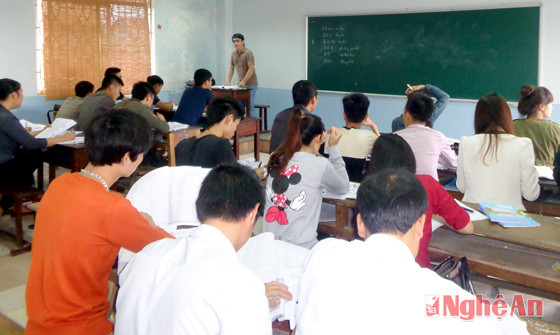 |
| Korean language class at the Vietnam-Korea Vocational College of Technology (Vinh City). |
Where there is demand, there is supply.
The Vietnam-Korea Industrial Technical Vocational College (referred to as the Vietnam-Korea College) officially introduced Korean language instruction in 1999. However, it wasn't until recent years, when South Korea became one of Vietnam's leading economic partners, that the demand for learning Korean surged, making teaching Korean a highly sought-after profession, offering significant job opportunities and high incomes. Korean language teachers sometimes earned 20-25 million VND per month. Currently, in Nghe An province, besides the Vietnam-Korea College, several other institutions such as the No. 4 Vocational College of the Ministry of National Defense (Nghi Phu, Vinh City) and the Job Placement Center (Department of Labor, Invalids and Social Affairs) also offer Korean language courses.
Ms. Nguyen Thi Thu Hoai, from Trung Do ward (Vinh City), a graduate with a Bachelor's degree in Korean Language (Hanoi University of Foreign Languages) and a Korean language teacher at the Vietnam-Korea School, said that the school currently has 4 permanent Korean language teachers. Due to the high demand for Korean language classes, the 4 official teachers are insufficient, so the school has had to contract up to 20 additional teachers to teach Korean. In addition, the school also collaborates with 15 Korean volunteers who are always ready to meet the Korean language learning needs of students.
The target audience for Korean language classes is quite diverse: full-time college and vocational school students studying Korean as a compulsory foreign language; and individuals seeking employment in South Korea. According to the Employment Permit System (EPS) for Vietnamese workers under fixed-term contracts in South Korea, these workers must pass the Korean language proficiency test for overseas employment (ESP-TOPIK) to be accepted. Therefore, the demand for Korean language learning from these groups is very high. At one point, the Vietnam-Korea School had 1,500 prospective workers registered for Korean language classes. The school had to organize more than 40 classes, teaching continuously in three shifts per day. The third group consists of those receiving advanced Korean language training as part of an orientation program for those who have passed the ESP-TOPIK and are about to depart for South Korea. In 2014, the Vietnam-Korea School was one of only two centers nationwide selected to organize orientation training courses. Therefore, in June and July 2014, nearly 1000 students from across the country participated in these courses. The fourth target group consists of managers from Korean-invested enterprises who need to use Korean in their work. Currently, there are 8 Korean-owned businesses operating in Nghe An, and a significant number of their managers have a need to learn Korean. Another group includes those wishing to study in Korea, a number that has increased considerably in recent years. Additionally, some students attend Korean language classes simply because they love Korean culture or songs; others learn Korean to "marry into a foreign country."
The methods of teaching Korean are quite diverse. Besides attending classes at Korean language centers, students can take supplementary classes with teachers at home, or, if they have the means, they can opt for private tutoring at home. Mr. Ho Van Giap – Manager of the Vinh University Tutoring Center – said: “Since 2010, the center has added Korean language instruction to its curriculum, and the number of students has steadily increased. In 2014, the center had about 10 students per month, mostly young people who wanted to study abroad in Korea.”n Nation".
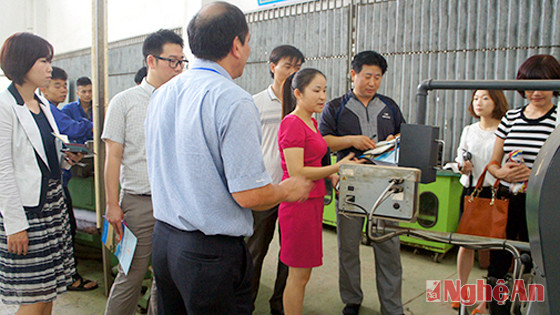 |
| A Korean language teacher acts as an interpreter for the KOICA (South Korea) delegation in the practical training room at the Vietnam-Korea Vocational College of Technology. |
Opportunities and challenges
According to Ms. Nguyen Thi Thu Hoai, graduates in teaching the Korean language currently have many job opportunities. Many graduates choose to work in the offices of Korean companies. Korean businesses in Nghe An often include a phrase in their recruitment announcements that "those fluent in Korean are preferred." In addition, the Korean language teachers at the Vietnam-Korea School are frequently invited to act as interpreters whenever Korean delegations visit and work in Nghe An. Working trips by diplomatic delegations, Korean delegations, and delegations from sister provinces (such as Gyeonggi Province and Nam Yangju City); as well as Korean business delegations and companies from other regions visiting Nghe An, frequently contact Korean language teachers for interpretation services. On average, each day of interpreting earns them at least 100 USD. The starting salary for a Korean interpreter at Korean companies is around 300-400 USD/month, increasing by 100 USD annually, and the current average income for a Korean interpreter is approximately 600-800 USD/month. Ms. Hoai also added that, compared to Latin-based languages, Korean is easier to learn, with spelling and syllable blending similar to Vietnamese; Korean has a large vocabulary of Sino-Korean words, so many people can communicate fluently with Koreans after just one year of study.
Besides the factors mentioned above, teaching Korean in the province also has many other favorable conditions for development. Currently, South Korea has the largest number of investment projects in Nghe An. To date, there are 11 active investment projects with a registered capital of 60.97 million USD, employing over 10,000 local workers. Typical examples include the Hitech BSE Vietnam Electronics Co., Ltd., established in Nam Cam Industrial Park, with a total investment of 30 million USD and a production capacity of 250 million products per year; and the Haivina Kim Lien garment factory (Nam Dan) with a total investment of 5 million USD, specializing in the production and processing of sports gloves and industrial gloves with a production capacity of 3.5 million pairs per year. The leather and textile manufacturing plant of Prex Vinh Co., Ltd., with an investment of US$11.6 million, specializes in producing textile products, swimwear, leather products, and clothing accessories, with an output of 3 million products per year; the ready-made garment and clothing manufacturing plant invested by Nam Sung Vina Co., Ltd. in Thap Hong Ky Industrial Cluster (Dien Chau), with a total investment of US$7 million, has an output of 9,480,000 products per year.
Korean businesses in Nghe An have established a Korean Business Club to support and exchange experiences with each other during the investment process in Nghe An. Meanwhile, at the Vietnam-Korea School, out of the total $6 million that the Korea International Cooperation Agency (KOICA) will invest in the school in the coming period, in addition to the cost of building workshops and purchasing equipment, $1.4 million will be allocated to opening training courses for nearly 60 school administrators, teachers, and experts in Korea. Currently, the Vietnam-Korea School also has a contract with Yangsan University (Korea) to teach and award supplementary Korean language certificates. This is a favorable condition to promote economic cooperation between Vietnam and Korea, opening up many opportunities for the development of Korean language teaching.
However, teaching Korean currently faces many challenges. Before 2011, the demand for learning Korean for overseas employment in the province was very high, leading to a situation where "supply did not meet demand." However, from December 2011 to December 2013, South Korea temporarily suspended Korean language proficiency tests to limit the acceptance of Vietnamese workers. This was due to the highest number of Vietnamese workers residing illegally in South Korea among the 15 countries whose citizens were working under fixed-term contracts. Therefore, Korean language teaching in the province was quite sluggish during that period. Earlier this year, when the ESP program, which sends Vietnamese workers to South Korea, resumed, the demand for learning Korean among this group increased. However, most people who want to work abroad and attend Korean language classes tend to choose large, high-quality centers. Therefore, some small-scale Korean language centers are currently experiencing a severe shortage of students. At the Provincial Job Placement Center, according to Mr. Le Van Thanh – Deputy Head of the Training Department: “Before 2012, the Center’s Korean language classes attracted 50-60 students each year. In recent years, the number has only been a little over a dozen students per year.”
To date, we are still not free from the risk of losing the South Korean labor market, as the rate of Vietnamese workers residing illegally in South Korea remains high. According to Mr. Le Huy Vinh, a specialist in the Labor and Employment Department (Department of Labor, War Invalids and Social Affairs), the current rate of Vietnamese workers residing illegally in South Korea is 36.6%; in Nghe An province alone, it is over 48%. Meanwhile, according to the terms of the agreement, the EPS program will only be resumed when the rate of Vietnamese workers residing illegally in South Korea falls below 30% by December 2014.
According to Mr. Dang Cao Thang, Deputy Director of the Department of Labor, War Invalids and Social Affairs, in order to reduce the rate of Vietnamese workers residing illegally in South Korea, facilitate the continued implementation of the EPS program, and also facilitate the teaching of Korean in Vietnam in general and Nghe An in particular, in the coming time, we must vigorously implement measures to encourage illegally residing workers to return home. In the long term, we need to raise awareness among migrant workers to avoid illegal residency. This responsibility primarily rests with Korean language teachers. They must both teach Korean and simultaneously raise awareness about law enforcement in the workplace in accordance with the contract. In addition, families and society also need to actively participate in educating and encouraging migrant workers not to be greedy and to avoid sacrificing opportunities for others for their own illegal gains.
Minh Quân – Đức Dương