

Ancient interpretations of solar eclipses.
Thousands of years ago, people may not have considered solar eclipses a natural phenomenon, even viewing them as a sign of the impending apocalypse.
Vikings
The Vikings believed that Ragnarok (the end times) originated from two wolves, Skoll and Hati, wanting to devour the Moon and the Sun. Skoll pursued the Sun while Hati hunted the Moon. When one of the celestial bodies fell into their hands, a solar eclipse would occur. On Earth, humans had to rescue either the Sun or the Moon by making noise to drive away the wolves.
Ancient Egypt
Although sun worship was widespread in ancient Egypt, little is known about their beliefs surrounding eclipses, as there is almost no mention of solar eclipses.
Because the sun played a prominent role in society at the time, many experts consider solar eclipses to be a very frightening phenomenon. According to one theory, the ancient Egyptians greatly feared them and considered them an omen.
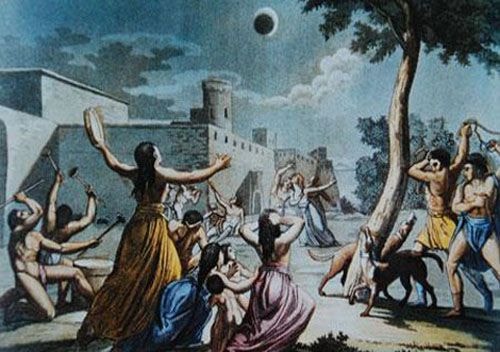 |
| Thousands of years ago, people believed solar eclipses were ominous signs, a harbinger of destruction. (Image: history.cultural-china.com) |
Mayan civilization
In 2013, researchers discovered evidence suggesting that the Maya may have accurately predicted solar eclipses.
Astronomical almanacs from the 11th or 12th century predicted an eclipse would occur on July 11, 1991. The eclipse was called chi' ibal kin, or "eating the sun." However, what they believed or understood about solar eclipses remains unclear to this day. Their writings were destroyed in the 1600s.
Indian mythology
In mythology, the serpent Rahu (or Kala Rau) was beheaded by the god Vishnu for drinking the gods' wine. Rahu wanted to drink the sacred wine to achieve immortality and disguised himself as a woman to carry out this plan. After being beheaded, he flew into the sky, swallowed the sun, absorbed its light, and caused solar eclipses.
Ancient Greece
In 2008, researchers stated that the phenomenon of a total solar eclipse may have been mentioned in the epic poem Odyssey: "The sun disappeared from the heavens, and a demonic haze began to cover the world." The ancient Greeks believed that a total solar eclipse was an ominous sign, indicating the gods' anger and the imminent arrival of a period of disaster and destruction.
China
In China, solar eclipses are also considered bad omens. For the ancient Chinese, this phenomenon occurred when a dragon devoured the sun. To prevent this from happening, they would sing, beat drums, use firecrackers or gunpowder to drive the dragon away.
Predicting solar eclipses was the task of astrologers. According to historical records, in 2134 BC, two astrologers were beheaded for failing to fulfill their duty.
Modern era
Total solar eclipses have occurred four times in Britain over the past century and have never been considered the beginning of the apocalypse. However, those who believe in this theory still think that the obscuration should be seen as a warning sign of the arrival of an omnipotent force.
Some believe this is a message from God to the whole world. According to Jewish tradition, it is a warning to non-Jews and European countries to take note.
According to VnExpress.