

Key milestones in Cuba-US relations
The relationship between the United States and Cuba has been intertwined for many years. Since 1960, the U.S. has maintained an economic embargo against Cuba. Here are some key milestones in the relationship between the two countries:
| RELATED NEWS |
|---|
1898: The United States declared war on Spain.
1898: The United States defeated Spain. Spain relinquished all claims of sovereignty over Cuba and ceded the island to the United States.
1902: Cuba became an independent nation, with Tomas Estrada Palma becoming its president. However, the Platt Amendment kept the island under American protection and granted the United States the right to intervene in Cuban affairs.
1906-1909: Estrada resigned and the United States occupied Cuba after a rebellion led by Jose Miguel Gomez.
1909: Jose Miguel Gomez became president after elections supervised by the United States, but his image was quickly tarnished by corruption.
1912: American forces returned to Cuba to assist in suppressing Black protests against apartheid.
1933: Gerardo Machado was overthrown in a coup led by Fulgencio Batista.
1934: The United States lifted its right to interfere in Cuba's internal affairs, reviewed Cuba's sugar quotas, and changed tariffs in a way that benefited Cuba.
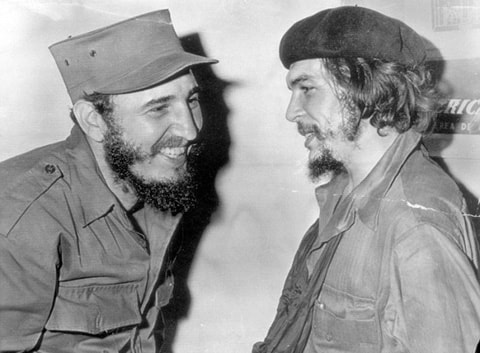 |
| Fidel Castro (left) and Che Guevara (photo: AP) |
1953: Fidel Castro led an unsuccessful uprising to overthrow the Batista regime.
1956: From Mexico, Castro landed in eastern Cuba and descended into the Sierra Maestra mountains. There, with the support of Che Guevara, he launched a guerrilla war.
1958: The US withdrew military aid to Batista.
1959: Castro led a guerrilla army of 9,000 members into Havana, forcing dictator Batista to flee. Castro became prime minister.
April 1959: Castro met with U.S. Vice President Richard Nixon during an unofficial visit to Washington. Nixon later wrote that the U.S. had no choice but to try to steer this left-wing leader in the "right" direction.
1960: All American businesses in Cuba were nationalized without compensation. The U.S. severed diplomatic relations with Havana and imposed a trade embargo in response to reforms undertaken by Castro.
1961: The US backed an invasion by Cuban exiles at the Bay of Pigs. Castro declared Cuba a socialist state and began allying himself with the Soviet Union.
1961: The CIA began planning the assassination of Castro as part of Operation Mongoose. Between 1961 and 1963, at least five assassination plots against the Cuban leader were drawn up.
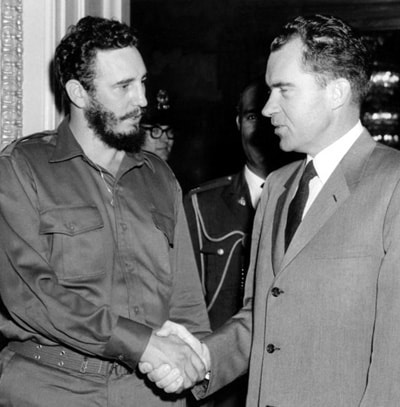 |
| Fidel shakes hands with Nixon during his visit to Washington in 1959 (photo: UPI) |
1962: The Cuban Missile Crisis erupted when Castro, fearing a US invasion, agreed to allow the Soviet Union to deploy nuclear missiles on the Caribbean island nation. The US released photographs of Soviet nuclear missile caches on Cuban territory, creating a crisis that brought the two superpowers, the US and the Soviet Union, to the brink of nuclear war.
The issue was later resolved when the Soviet Union agreed to dismantle the missiles in exchange for the United States withdrawing its nuclear missiles from Türkiye.
1980: Approximately 125,000 Cubans fled to the United States when Castro temporarily lifted travel restrictions.
1993: The U.S. tightened its embargo against Cuba, which at the time began implementing a number of market reforms aimed at stemming its economic decline. These reforms included legalizing the U.S. dollar, converting many state-owned farms into semi-autonomous cooperatives, and legalizing small-scale private businesses.
1994: Cuba signed an agreement with the United States under which the U.S. agreed to accept 20,000 Cuban citizens annually in exchange for Cuba blocking the flow of immigrants to the U.S.
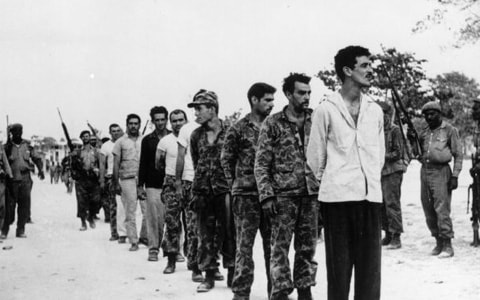 |
| Cuban exile soldiers captured by Cuban authorities in 1961 (photo: Three Lions) |
1996: The U.S. trade embargo against Cuba was extended in duration in response to Cuba shooting down two U.S. planes piloted by Cuban exiles in Miami.
1998: The U.S. eased restrictions on remittances sent to relatives by Cuban Americans.
November 1999: Elian Gonzalez was rescued off the coast of Florida after a boat carrying his mother, stepfather, and others attempting to flee to the United States capsized. Cuban exiles in Miami launched a major campaign to prevent Elian from returning to his father in Cuba and to keep him with relatives in Miami.
June 2000: Elian was allowed to reunite with his father in Cuba after a protracted legal battle.
Tháng 6/2001: Năm người Cuba bị kết án ở Miami và phải chịu mức án nhiều năm tù vì tội làm gián điệp cho chính phủ Cuba. Trường hợp 5 người Cuba này đã trở thành lời kêu gọi tập hợp lực lượng của chính quyền Havana.
Tháng 11/2001: Mỹ xuất khẩu thực phẩm sang Cuba lần đầu tiên trong hơn 40 năm sau khi chính phủ Cuba yêu cầu giúp họ khắc phục hậu quả của bão Michelle.
Tháng 1/2002: Các tù nhân bị Mỹ bắt giữ trong chiến tranh ở Afghanistan đã được đưa bằng máy bay tới cảng Guatanamo để thẩm vấn với tư cách là nghi phạm al-Qaeda.
Tháng 5/2002: Thứ trưởng Ngoại giao Mỹ John Bolton đã tố cáo Cuba đang cố gắng phát triển vũ khí sinh học, đưa quốc gia này vào danh sách của Washington về các nước thuộc “trục ma quỷ”.
Tháng 5/2002: Cựu Tổng thống Mỹ Jimmy Carter có chuyến thăm thiện chí lịch sử tới Cuba. Chuyến viếng thăm bao gồm việc đến thăm các trung tâm khoa học nhằm đáp ứng lại các cáo buộc của Mỹ về vũ khí sinh học.
Tháng 10/2003: Tổng thống Mỹ George Bush công bố các giải pháp mới nhằm đẩy nhanh việc chấm dứt chế độ XHCN ở Cuba, bao gồm việc thắt chặt cấm vận thương mại đối với hòn đảo này, thẳng tay với các vụ chuyển tiền mặt bất hợp pháp, và một chiến dịch tuyên truyền mạnh hơn nữa nhằm vào Cuba. Mỹ đã tạo ra một cơ quan mới có tên Ủy ban Trợ giúp cho một nước Cuba tự do.
Tháng 8/2006: Tổng thống Mỹ George W Bush, trong các bình luận đầu tiên sau khi Chủ tịch Cuba Castro trải qua phẫu thuật và trao quyền cho em trai Raul, hối thúc người Cuba hãy nỗ lực theo hướng “dân chủ hóa”.
Tháng 12/2006: Phái đoàn lớn nhất của Quốc hội Mỹ tới thăm Cuba kể từ cách mạng 1959. Jeff Flake, một nghị sĩ Cộng hòa dẫn đầu phái đoàn, cho biết ông muốn mở ra “một kỷ nguyên mới trong quan hệ Mỹ-Cuba”.
Tháng 7/2007: Quyền lãnh đạo Raul Castro bắn tín hiệu cho rằng ông có thể đón chào mối quan hệ ấm dần lên với Mỹ. Ông đề nghị tham gia vào hội đàm, nhưng chỉ là sau khi cuộc bầu cử tổng thống Mỹ 2008 được tổ chức.
Tháng 2/2008: Raul Castro chính thức đảm nhận chức vụ Chủ tịch nước Cuba. Washington kêu gọi bầu cử tự do và công bằng, đồng thời tuyên bố lệnh cấm vận của mình sẽ tiếp tục.
November 2008: Barack Obama was elected President of the United States.
December 2008: A new poll showed that a majority of Cuban Americans living in Miami wanted an end to the embargo against Cuba.
April 2009: President Obama lifted restrictions on family travel and remittances to Cuba.
December 2009: American citizen Alan Gross was arrested in Cuba on charges of spying for Washington.
November 2010: The Ballet Theatre visited Cuba for the first time in 50 years – the latest in a series of cultural exchanges.
October 2011: Cuban spy Rene Gonzalez was released from a Florida prison. Gonzalez was a member of the Cuban "Five" group – who were sentenced to years in prison in 2001 in the U.S. after being convicted of espionage. Havana has repeatedly called for their release.
December 2011: The U.S. once again called for the release of Alan Gross, an American serving a 15-year prison sentence in Cuba for bringing internet equipment into the country. Cuba's refusal to release him had frozen bilateral relations for months.
September 2012: Cuba indicated its willingness to negotiate with Washington on finding a solution to the Gross case.
December 2014: President Obama announced the restoration of diplomatic relations with Cuba.
According to VOV