

Actively responding to climate change
(Baonghean) - According to forecasts, Nghe An is one of the localities located in a special region heavily affected by climate change and sea level rise. These challenges require the involvement and action of all levels, sectors, and every citizen to ensure sustainable development and stable livelihoods. This is also the message launched by the Ministry of Natural Resources and Environment on World Meteorological Day 2015 with the theme "Climate - Awareness and Action".
The weather is becoming increasingly extreme.
Climate change is the extreme change in weather patterns. The most obvious manifestations of climate change are global warming, rising sea levels, saltwater intrusion into inland areas, and unpredictable changes in heatwaves, storms, and natural disasters. In recent years, these extreme weather events have occurred continuously, directly impacting humans and other life forms in the environment.
In Nghi Tien commune, a coastal commune in Nghi Loc district with 6.3 km of coastline, according to many elderly residents, sea levels have risen higher in recent years, especially during high tides or storms. This is threatening the production and lives of the people. In particular, saltwater intrusion is becoming increasingly evident.
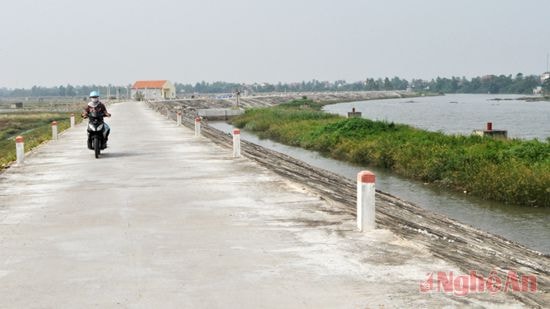 |
| The saltwater intrusion prevention dike, which runs through the coastal communes of Dien Bich, Dien Van, and Dien Ngoc in Dien Chau district, was built to cope with rising sea levels and saltwater intrusion. |
Mr. Tran Cong Oanh, Chairman of the People's Committee of Nghi Tien commune, said: Because Nghi Tien commune is located at the end of the freshwater source and the beginning of the saltwater source, when the water level in the Cam River drops low during the summer-autumn crop season, saltwater intrusion from the sea with salinity levels exceeding permissible limits makes production impossible. Of the commune's total 230 hectares of cultivated land, 150 hectares are affected by saltwater intrusion, with some years being productive and others not, including 40 hectares of aquaculture that are precarious.
In Nghi Tien commune, climate change not only affects agricultural production but also impacts those who work in the fishing industry. Mr. Luu Dinh Tuan, from Hamlet 2, shared: “We don't have the resources to fish far offshore, so we only fish near the shore. But in recent years, the amount of seafood near the shore has also decreased, causing many difficulties for fishermen like us.” Scientists explain this by saying that rising sea temperatures are damaging the marine ecosystem, and coral reefs, home to many marine species, are deteriorating.
According to Mr. Nguyen Duc Tho, Head of the District's Agriculture Department, saltwater intrusion deep inland is not only occurring in Nghi Tien commune but also in most communes along the coast of Nghi Loc district, such as Nghi Quang, Nghi Yen, Nghi Thiet, and Phuc Tho. In these communes, due to high salinity levels in the fields, some agricultural land is left fallow, especially during the summer-autumn crop season, including 80 hectares in Nghi Quang, 70 hectares in Nghi Thiet, and 50 hectares in Nghi Yen.
Investigations along the 82 km coastline of Nghe An province reveal that saltwater intrusion is occurring in several communes including Quynh Luong, Son Hai, Quynh Nghia, Tien Thuy, Quynh Thuan, and Quynh Long (Quynh Luu district); and Dien Thanh, Dien Trung, Dien Hung, Dien Kim, Dien Bich, and Dien Hai (Dien Chau district). The increase in saltwater intrusion is not limited to coastal areas; according to the Nghe An Irrigation Sub-Department, in 2010, saltwater intrusion, also known as salinity encroachment, extended almost to Nghi Van commune (Nghi Loc district) on the Cam River. Also in 2010, on the Lam River, salinity encroachment extended as far as Hung Xuan commune (Hung Nguyen district).
While coastal areas are clearly showing signs of rising sea levels and saltwater intrusion, the western region of Nghe An province is increasingly experiencing warmer weather and longer periods of hot weather. At times, temperatures in the districts of Quy Chau, Tuong Duong, and Thai Hoa have reached 40-43 degrees Celsius. This region has also experienced severe cold spells and unusual rainfall, causing flash floods and landslides.
Mr. Tang Van An, Head of the Forecasting Department of the North Central Meteorological and Hydrological Station, said: "Monitoring weather patterns over the past 10 years in the North Central region in general and Nghe An in particular shows that extreme weather phenomena are occurring more frequently. Although the number of storms per year has not changed, their intensity has increased significantly, including super typhoons. Rainfall is not prolonged but is more intense. While previously rainfall reached about 300mm over 2-3 days, recently, 300mm of rain has reached within just 3 hours. This has led to flash floods and landslides in mountainous areas. Furthermore, the number of hot days has increased, reflecting the rising temperature trend, causing droughts and shortages of freshwater for production and daily life across a wide area of the province..."
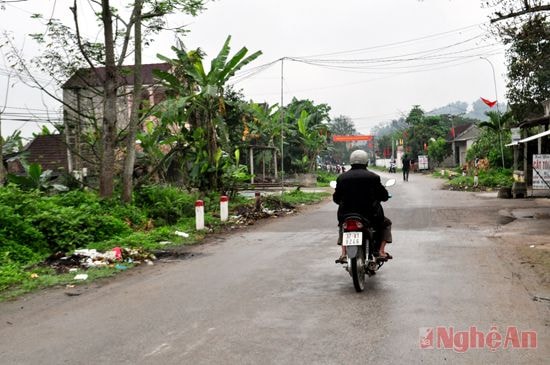 |
| We need to raise awareness about environmental protection and address the problem of indiscriminate waste dumping. |
Proactive response measures
Climate change is threatening life, requiring us to act to adapt and proactively respond effectively. Based on the Action Plan for Responding to Climate Change in Nghe An province, 2011-2015, with a view to 2020, approved by the Provincial People's Committee under Decision No. 1395/QD-UBND.DC dated April 27, 2011, in recent years, various sectors and levels in the province have proactively developed plans to integrate climate change response into their respective programs and plans for implementation. Priority activities have focused on repairing and upgrading river and sea dikes, reservoirs, dams, and sluices for preventing saltwater intrusion and preserving freshwater.
According to Mr. Nguyen Truong Thanh, Deputy Head of the Provincial Irrigation Department, Nghe An is the first province in the country to issue a program ensuring reservoir safety, which includes statistics and assessments of the reservoir and dam situation, and outlines a roadmap for upgrading and repairing them to serve production and daily life for the people. From 2012 to 2014, the agricultural sector implemented maintenance and repair of 224 reservoir and dam projects with a total cost of nearly 90 billion VND. Along with that, the canal reinforcement program continues to be promoted; several programs to prevent saltwater intrusion and retain freshwater have been implemented on the Cam River and procedures are underway to implement them on the Lam River, ensuring water storage for production and daily life for the people and limiting saltwater intrusion deep inland.
In recent years, the agricultural sector and localities have proactively transformed the structure of crops and livestock according to seasons, researching and developing, and applying new technologies in agriculture. Changes in weather patterns have necessitated adjustments to cropping seasons and structures to adapt. In recent years, due to low rainfall and intense heat, many areas previously planted with sesame and summer-autumn vegetables have been converted to corn and various types of beans. The area planted with summer-autumn rice has also decreased, while the area planted with autumn rice has increased; at the same time, early planting of winter crops has been organized, and short-term crops have been introduced to mitigate flooding. Also related to the agricultural sector, reforestation efforts have been intensified, including mangrove reforestation. In the last five years, the province has planted an average of 15,000 hectares of new forest annually, contributing to raising the province's forest cover to 54.6% by the end of 2014.
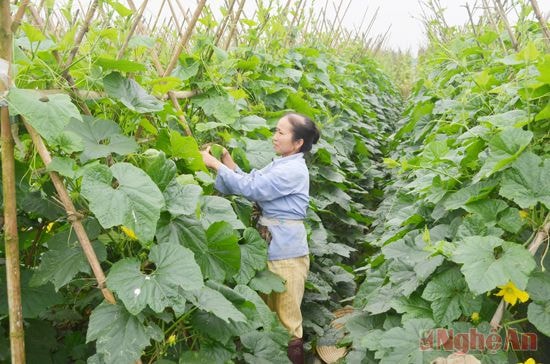 |
| Thanh Chuong district has introduced the cultivation of green squash on land previously used for two rice crops, helping to overcome drought conditions. |
In the industrial sector, the province is promoting the implementation of the national target program on energy saving and efficiency to mitigate greenhouse gas emissions.
According to Mr. Hoang Van Dien, Deputy Director of the Nghe An Industrial Promotion and Development Consulting Center, the implementation of the Government and the Provincial People's Committee's energy saving program, along with the dissemination of information and the implementation of various energy-saving models in households, agencies, units, schools, and businesses, has been given attention by all levels, sectors, and localities. As a result, the awareness of energy saving and efficient energy use among the people and agencies, units, and businesses has increasingly improved.
In the electricity sector alone, according to a report by Nghe An Power Company, the province saved more than 42 million kWh of electricity in 2014, achieving 103% of the target set by the Northern Power Corporation. Simultaneously, national target programs on environmental remediation and improvement, national target programs on climate change adaptation, and action plans to improve the efficiency of management, protection, and integrated use of resources and the environment in a sustainable manner, as well as disaster prevention and mitigation, were implemented by all levels and sectors.
Mr. Nguyen Ngoc Vo, Deputy Director of the Department of Natural Resources and Environment, affirmed: The Party and State's guidelines and policies on responding to climate change have been gradually concretized into policies and guidelines at the provincial level, becoming tasks and targets in the leadership and management process of Party committees, government agencies, departments, branches, mass organizations, and socio-political organizations. Community awareness of climate change is increasingly enhanced, investment in climate change response is gradually improving; and climate change factors are gradually being integrated into the strategies, plans, and programs of all sectors and levels.
However, there are still limitations regarding investment resources for climate change adaptation, which are insufficient to meet requirements. While policies on climate change adaptation are fundamentally appropriate and comprehensive, implementation remains challenging due to its novelty and far-reaching impact on all aspects of socio-economic life. Furthermore, awareness of climate change among various sectors, levels of government, and the general public remains limited. Proactive action in responding to climate change within communities is still lacking. Actions to prevent and mitigate climate change are both short-term and long-term, complex, and involve all sectors, levels of government, and every individual. Therefore, all levels of government, sectors, localities, and every citizen need to continue implementing solutions and plans with concrete and practical actions to enhance capacity and ability to respond to climate change, contributing to disaster prevention and mitigation, ensuring sustainable development, and protecting people's lives.
Minh Chi