

Building and promoting brands: A solution for sustainable development of traditional craft villages!
(Baonghean) - In recent years, traditional craft villages in our province have been restored. However, these villages have not yet built their own brands, or have not been enthusiastic about building brands, leading to difficulties in finding markets and increasing production value.
(Baonghean) - In recent years, traditional craft villages in our province have been restored. However, these villages have not yet built their own brands, or have not been enthusiastic about building brands, leading to difficulties in finding markets and increasing production value.
Recognized as a traditional craft village by the Provincial People's Committee since 2011, Thanh Luong blacksmith village (Thanh Chuong district) currently has 30 professional production households and 40 seasonal households. For a long time, the blacksmiths' workshops operated intermittently, struggling to sell their products. The reason was that consumers were overwhelmed by the influx of imported knives and scissors with attractive designs, bright white colors, and rust-resistant properties. Thanh Luong blacksmithing is known for its high-quality products, but to this day, the lives of those working in the craft remain just enough to make ends meet, unable to achieve prosperity or wealth. Because the main products are still agricultural tools, the scale of household production is small, and production is based on orders from wholesalers, leading to price manipulation; the designs and styles are limited and lack competitiveness, thus failing to penetrate the high-end household goods market. Meanwhile, agricultural production is gradually becoming mechanized… Therefore, the blacksmithing craft in Thanh Luong is being passed down quietly, without a strategy for building a brand or promoting products, and is at risk of disappearing.
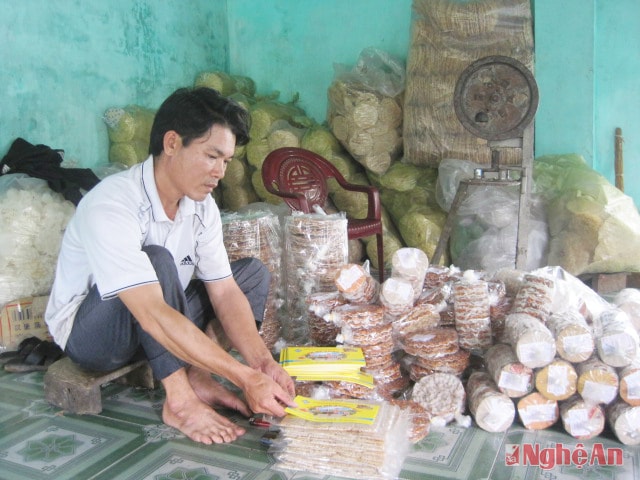 |
| Confectionery production in Xuan Bac and Dong Ha villages (Dien Van commune - Dien Chau district). |
With a history spanning hundreds of years and having weathered many ups and downs, the craftsmen of Phu Nghia village, Quynh Nghia commune (Quynh Luu district), specializing in both domestic and fine art woodworking, have been contributing to preserving the cultural values passed down from their ancestors. With their skillful hands, they create exquisite wooden products such as antique wooden beds, tea cabinets, and various types of tables and chairs in both Asian and European styles. To meet customer demand, in recent years, Phu Nghia craftsmen have shifted towards producing domestic goods such as doors, wooden ceilings, and staircases, while also incorporating handicrafts (mother-of-pearl inlay) into their production. The products of this village are comparable in design and quality to those of renowned woodworking villages like Dong Ky in Bac Ninh and Van Diem in Thuong Tin, yet their market price is only 70-80% of similar products from these famous villages. According to Mr. Ho Van Minh, the owner of a woodworking factory in Hamlet 1, Quynh Nghia, this is because the products of the craft village have not yet found a stable market and have not yet built their own brand; production in the craft village is currently small-scale, carried out by individual households, with each person working independently.
To date, 126 craft villages in the province have been recognized by the Provincial People's Committee. In addition, there are 285 craft villages recognized by the People's Committees of the districts. From 1995 to the present, nearly 400 products in the province have been registered with trademarks, but the number of products from craft villages and small-scale industries remains low; the number of craft villages that have built their own brands can be counted on the fingers of one hand. Furthermore, many businesses, although they have built brands, lack a marketing strategy, resulting in products not reaching consumers widely. Especially when expanding to markets outside the province or internationally, craft village products lack branding and are therefore not highly valued. Consequently, many valuable items are sold on the open market or exported through intermediaries under a different brand, resulting in generally low revenue for the craft villages.
According to Mr. Nguyen Hong Phong, Director of the Center for Industrial Promotion and Development Consulting (Department of Industry and Trade), there are many reasons why craft villages are not enthusiastic about building brands. The main reason is the mentality of relying on long-standing traditions, with many people already knowing about their products; coupled with the manual production style, mostly individual business operations, low cohesion among households in the craft village, and few craft villages have representatives to act as intermediaries for purchasing products, trading with outside parties, and legal representatives for the craft village. From this indifference to branding, many people believe that the craft village is a shared asset, and no one has boldly taken the initiative to register a brand.
Among the craft villages in our province, the Cừa tile-making village (Nghĩa Hoàn commune - Tân Kỳ district) is considered to be quite proactive in building a brand for its local products. The Cừa tile-making village production, business, and service cooperative has registered trademarks for its satellite units, and Cừa tiles have been granted trademark protection by the Intellectual Property Office on April 10, 2007. To proactively protect the product's reputation, the cooperative has promptly implemented solutions to inform a large number of customers through its dealer network, or directly through the cooperative's hotline for accurate advice on prices, designs, sizes, etc., helping customers avoid counterfeit goods and identify genuine Cừa tiles. To date, Cừa tiles are strongly consumed in the markets of Nghệ An, Hà Tĩnh, and Quảng Bình provinces, and have also reached markets such as Hanoi, Hải Phòng, Thanh Hóa, and Ho Chi Minh City. Ho Chi Minh City and the provinces of Xieng Khouang and Khammouane (in neighboring Laos)... Each year, the village's revenue reaches over 110 billion VND; creating jobs for about 1,000 local workers, with an income of about 3-4 million VND/month. Currently, the village has dozens of brick and tile kiln owners achieving revenues of 600-800 million VND/year.
Over the years, many functional agencies have supported and encouraged craft villages and businesses in building brands and promoting their products. Since 2009, the Provincial People's Committee has issued Decision No. 10/2009/QD-UBND on mechanisms and policies to encourage and support organizations and individuals in technological innovation and research and application of scientific and technological advancements to enhance the competitiveness of goods in Nghe An. Accordingly, it provides support of 2 million VND for domestic trademark/design registration and 10 million VND for international registration. Specifically, from the beginning of 2014 to the present, using industrial promotion funds, the Industrial Promotion Center has developed 64 projects with a budget of 3,990,700,000 VND. These projects mainly focus on: supporting the construction of technical demonstration models and technology transfer; Supporting businesses and organizations participating in trade fairs and exhibitions, developing markets, and promoting brands for some of the province's advantageous products such as tea, textiles, rattan and bamboo weaving, fish sauce, brocade weaving... For example, Van Phan Aquatic Products Joint Stock Company, with support from provincial and national industrial promotion funds, participated in numerous booths at most trade fairs and exhibitions in Vinh City from 2002 to 2012, as well as several fairs in Hanoi, Ho Chi Minh City, Da Nang, and Can Tho… Brand building and market development have helped the company's products reach most domestic markets and are also very popular in the Lao market. Notably, for the first time in 2012, the company exported 1,800 liters of fish sauce to the Malaysian market.
In early 2014, Duc Phong Co., Ltd., a manufacturer of export-quality rattan and bamboo products, received a grant of 92,700,000 VND to participate in the Ambiente International Fair in Germany. According to Mr. Thai Dai Phong, the company's director: “The EU market is very demanding regarding quality, environmental factors, consumer health, and especially design, which plays a significant role, accounting for 30-50% of the success of orders entering this market. Therefore, we always research and introduce new collections annually, with unique designs, combining various raw materials on a single product, and most importantly, designing products according to consumer needs...”
At the aforementioned trade fair, the company's rattan and bamboo products were highly praised for their design and quality, and many inquiries were made seeking further collaboration. Duc Phong's development of new product designs is approached through various channels, including participation in international trade fairs and seeking support from the professional design team of the Vietnam Handicraft and Gift Export Association, aiming to find designs that suit the company's product characteristics and market consumer trends.
Clearly, branding and product promotion have been effective in boosting the sustainable development of craft villages. In reality, many craft villages have products of guaranteed quality and attractive designs, but lack effective promotion to build consumer trust and encourage usage. This area requires craft villages, business owners, and production and trading establishments to clearly understand that government support is only encouraging; the fundamental issue is that craft villages must leverage their own inherent strengths for sustainability. Therefore, promoting branding, trade promotion, and participation in exhibitions and trade fairs to advertise products should be considered a crucial step, even a decisive factor in the survival and development of craft villages in the context of economic integration.
Text and photos:Ngoc Anh