

Opening up avenues for training high-quality human resources.
(Baonghean) - During the past term, thanks to the efforts of vocational training institutions and localities, vocational training in the province has seen positive changes, contributing to a rapid increase in the percentage of trained workers. Many vocational training institutions have effectively implemented orientation, targeted training, and linked training with job placement; thereby creating a direction for training high-quality human resources.
Positive change
Nghe An province has a large population of over 3 million people, including nearly 1.8 million workers. On average, approximately 30,000 people reach working age annually to join the province's workforce. The 17th Provincial Party Congress for the 2011-2015 term set specific targets and tasks to promote vocational training and job creation, aiming to create jobs for an average of 35,000-40,000 people annually; reduce the urban unemployment rate to 2.85%; and increase the percentage of trained workers to 55% (of which vocational training accounts for 48%).
Mr. Dang Cao Thang, Deputy Director of the Department of Labor, War Invalids and Social Affairs, said: “Compared to the period 2006-2010, the number of vocational training institutions has not increased significantly, but the scale and quality of vocational training have improved considerably from 2011 to the present.” Currently, the province has 64 vocational training institutions, including 6 vocational colleges (1 private), 9 vocational secondary schools, 24 vocational training centers (8 private), and 25 institutions involved in vocational training (13 private). Among the provinces in the North Central region, Nghe An has the highest number of vocational training institutions (accounting for 29.2% of the entire region). The network of vocational training institutions is evenly distributed; to date, all districts, cities, and towns have vocational training institutions. In the province's key economic zones, there are vocational training centers for technical workers, such as: in the Northwest mountainous region, there is the Western Economic and Technical Vocational College in Thai Hoa town; in the Southwest mountainous region, there is the Ethnic Minority Boarding Vocational College in Con Cuong district; in the North of the province, there is the North Nghe An Economic and Technical Vocational College in Quynh Luu district...
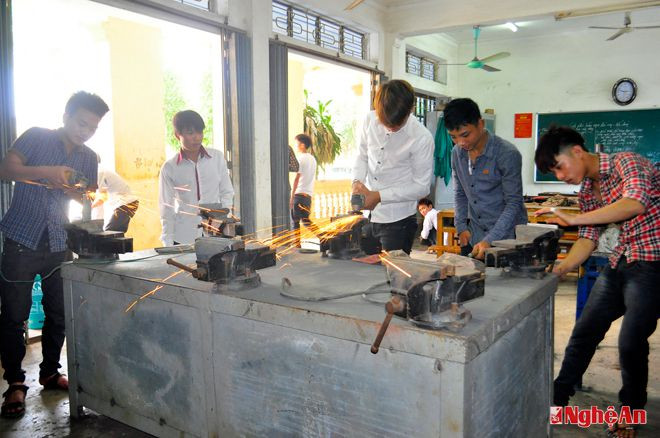 |
| Practical training in mechanical engineering at the North Nghe An Economic and Technical Vocational College. |
Over the years, Nghe An has been one of the provinces receiving significant support from the national target program on vocational training. Regional and district-level vocational secondary schools have been approved and implemented investment projects to strengthen their infrastructure with investments totaling tens of billions of VND. Notably, thanks to leveraging international relations, the Vietnam-Korea Industrial Technical College continued to receive phase 3 support from the Korean government with a grant of 6 million USD at the end of 2014. In addition, Nghe An was approved by the Ministry of Labour, Invalids and Social Affairs to have 13 schools with 42 key vocational fields prioritized for investment (compared to only 38 schools with 93 prioritized vocational fields across all six provinces in the North Central region).
These resources have helped vocational training institutions in the province upgrade their facilities and equipment, and expand their training scale. As a result, the number of workers receiving vocational training has increased significantly, especially those with technical skills (from vocational secondary level upwards). It is estimated that during the period 2011-2015, vocational training institutions in the province enrolled 405,417 people (achieving 101.35% of the plan for the 2011-2015 period), including 21,320 people in vocational colleges, 38,970 people in vocational secondary schools, and 345,127 people in basic vocational training and short-term training (under 3 months). Annually, the graduation rate for vocational secondary and college students is over 95%, with nearly 30% achieving good or excellent grades. Some vocational training programs initially meet the economic and social development needs of the province and the demand for skilled labor from other provinces as well as for labor export, such as: Mechanical Engineering, Automotive Technology, Industrial Electronics, Welding, Mechatronics, Industrial Electricity, Refrigeration and Air Conditioning Technology, Food Processing, Hotel Management, Restaurant Management, and Handicrafts...
Furthermore, at national vocational skills competitions, teacher training conferences, and competitions for self-made vocational training equipment, the Nghe An delegation has always been highly appreciated by the Ministry of Labour, Invalids and Social Affairs. For example, at the 8th National Vocational Skills Competition in Hanoi in 2014, the Nghe An delegation was one of 10 delegations nationwide to receive a Certificate of Merit from the Minister of Labour, Invalids and Social Affairs (including 1 First Prize, 2 Third Prizes, and 5 Consolation Prizes); in particular, one contestant who won First Prize was selected by the Ministry of Labour, Invalids and Social Affairs, the General Department of Vocational Training, and Vikotex of South Korea to study and train in South Korea, and participated in the Vietnamese team at the 10th ASEAN Skills Competition in 2014, winning a Silver Medal.
These results have contributed to the successful implementation of the objectives of the Resolution of the 16th Provincial Party Congress on human resource training. After 4 years of implementing the resolution, the percentage of trained workers in the province has increased from 40% in 2010 to 52% in 2014, and the percentage of workers with vocational training has increased from 33% in 2010 to 46% in 2014. It is estimated that in 2015, the percentage of trained workers will reach 55%, of which 48% will have vocational training, achieving the target set by the congress resolution.
Besides expanding the scale of training, a prominent achievement in vocational training during the 2011-2015 period was the job placement of graduates. From 2011 to the present, the number of students with elementary, intermediate, and college-level qualifications who found and were placed in regular employment annually reached 85-87%, an increase of more than 10% compared to the 2006-2010 period. 1,573 businesses have recruited 55,971 workers from vocational training institutions in Nghe An. In particular, during the training process, some vocational training institutions have effectively implemented orientation programs, linking training with the labor needs of society and connecting vocational training with post-training employment, such as: the Vietnam-Korea Technical and Industrial Vocational College, the Nghe An Tourism and Trade Vocational College, and the North Nghe An Economic and Technical Vocational College…
Mr. Nguyen Duy Nam, Principal of the Vietnam-Korea Technical and Industrial Vocational College, said that since its establishment in 1997, the school has trained over 11,000 students in long-term vocational courses, more than 2,000 students in short-term vocational courses, 7,000 workers in Korean language training, and provided orientation education for over 4,000 workers for export. Of those, over 8,000 students have graduated, with 90% finding employment, including 2,500 working in South Korea, Japan, Taiwan, Malaysia, and other countries. Meanwhile, Nghe An Vocational College of Tourism and Commerce has its own approach to job placement for students. Every year, the school organizes a tripartite agreement between businesses, employees, and the school. Through this agreement, high-achieving students are accepted for internships at large hotels and tourism companies both domestically and internationally. During this time, they receive a salary equivalent to that of a full-time employee, earning between 10 and 15 million VND per month. This provides them with an opportunity to prove themselves and easily find employment after graduation.
Besides the province's key vocational schools, localities have also made many efforts to coordinate with vocational training centers and businesses in vocational training and job placement. Mr. Ho Ngoc Dung, Vice Chairman of the People's Committee of Quynh Luu district, said: “From 2011 to the present, the district has coordinated with vocational schools such as the Industrial and Handicraft Vocational College, the North Nghe An Economic and Technical Vocational College, and businesses in rattan weaving, carpentry, mechanics, and livestock farming… in the district to organize vocational training linked to practical needs to exploit the potential and strengths of the locality. In addition, we have coordinated with large companies such as Canon Vietnam Co., Ltd. and Nissay Company to organize vocational training consultations in clusters of communes and towns; creating conditions for laborers after vocational training to access loan sources to develop their economy and establish themselves right in their homeland.” Thanks to these efforts, from 2011 to 2014, the total number of trained workers in Quynh Luu district was over 21,000, and more than 10,000 workers found new jobs.
New prospects
According to the Project "Development of High-Quality Human Resource Training Facilities in Nghe An Province until 2020," approved by Decision 6980/QD-UBND.VX dated December 12, 2014, of the Provincial People's Committee, by 2020, the demand for skilled labor with vocational training (from elementary to college level) will be 1,202,849 people, accounting for 84.4%. With this demand, from now until 2020, the province needs to provide vocational training to an average of over 85,000 people annually, including over 16,000 people at the intermediate vocational level or higher, to raise the vocational training rate to 61% by 2020. In addition, the overseas labor market has many promising prospects in the coming years. Along with traditional labor markets for Nghe An province such as Malaysia, Taiwan, and the Middle East, the Ministry of Labor, Invalids and Social Affairs will continue to negotiate, sign, and implement cooperation agreements with many other countries such as Thailand, Angola, Cyprus, Laos, Russia, Belarus, and Germany...
In particular, with the formation of the ASEAN Economic Community in 2015, the number of Vietnamese workers going to work abroad is projected to increase. It is easy to see that most of the foreign labor markets that have expanded or opened since 2015 are high-income markets with stringent requirements regarding professional skills, expertise, and discipline from workers. Therefore, to send more workers abroad, vocational training in the province needs to undergo significant improvements in quality.
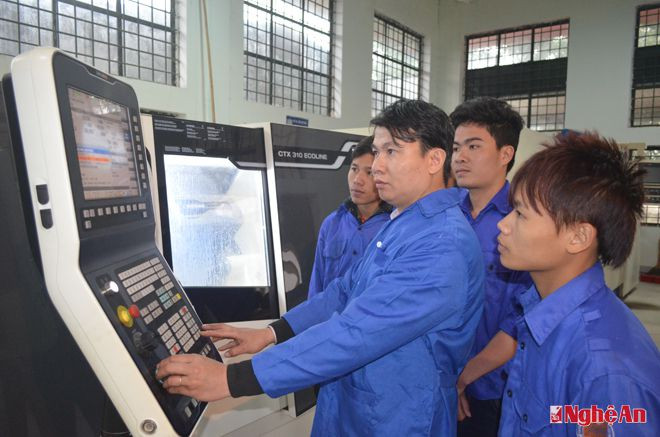 |
| Practical session for students of the Faculty of Mechanical Engineering, Vinh University of Technology and Education. Photo: MQ |
According to Mr. Nguyen Bang Toan, Director of the Department of Labor, War Invalids and Social Affairs, the period from 2015 to 2020 will basically maintain the number of vocational training institutions and those participating in vocational training. The plan is to establish only 2 new vocational colleges and 1 vocational secondary school, and focus on upgrading 2 vocational colleges to technical universities, 4 vocational secondary schools to vocational colleges, and upgrading 3 vocational training centers to vocational secondary schools. Regarding vocational training, in the coming period, the province will continue to implement Decision No. 854/QD-BLDTBXH of the Ministry of Labor, Invalids and Social Affairs dated June 6, 2013, on approving key vocational fields and schools selected for key vocational fields for the period 2011-2015 and orientation to 2020. In particular, the province has 13 schools with 42 vocational fields selected and approved by the Ministry of Labor, Invalids and Social Affairs for investment in key vocational fields such as: hotel management, tourism guiding, welding, industrial electronics, industrial electricity, metal cutting, agricultural machinery engineering, livestock and poultry farming, veterinary medicine, plant protection, etc.
In the coming period, the province will innovate and strengthen the work of disseminating information, providing career counseling and job placement services, and raising awareness among all segments of the population about the importance of vocational training for the province's socio-economic development. Simultaneously, it will improve the mechanisms, policies, and state management of vocational training, especially policies for trainees, trained workers, and businesses participating in vocational training. Vocational schools, for their part, need to focus on improving training quality rather than quantity; they should be more proactive in gathering recruitment information from businesses to establish specialized training partnerships. Annually, schools should conduct labor supply and demand surveys to determine the workforce's needs by occupation and skill level, in order to meet the demands of the labor market and, in particular, to implement training that aligns with the needs of businesses.
Minh Quan