

Van Mon Morning
(Baonghean) - Every time I visit Tam Hop commune (Tuong Duong district), I often pass by a small village that, viewed from above, looks like a beautiful landscape painting. That's Van Mon village, nestled in the valley beside the Cha Lap stream. Many times, traveling from Xop Nam village, the center of the commune, to Huoi Son and Pha Lom villages, looking down at the Van Mon basin, with its houses clustered together like a small town, I've longed to stop there someday...
It wasn't until the beginning of the Year of the Goat (2015) that I had the opportunity to visit this small village when the Chairman of the People's Committee of Tam Hop Commune invited me to "visit his home." The Chairman, Vi Canh Toan, is also a resident of Van Mon village. After traveling nearly twenty kilometers along a bumpy, rocky road from National Highway 7 to Tam Hop, my spirits sank when I encountered the smooth concrete road leading down to the village. However, after only a few hundred meters, just as I reached the first house in the Van Mon basin, the concrete road suddenly ended abruptly. The commune chairman explained that this was a new rural road section in Van Mon village. Because the village is far from the center, infrastructure development has faced considerable difficulties.
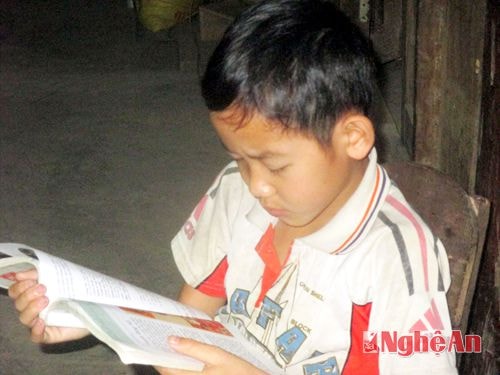 |
| Review your lessons before going to school. |
As the day drew to a close, a group of young men gathered around the village's only billiard table for "entertainment." Another group played volleyball near the village's community center. As the sun set, the small village nestled in the valley looked both familiar and unfamiliar. Stilt houses mingled with houses built on the ground, their style resembling both Hmong architecture and the traditional houses of Vietnamese villages. The houses were built close together. It was rare to find a house with an adjacent garden...
Mr. Vi Canh Toan explained the name of the village: The Cha Lap stream flows through the end of the village, forming a deep, round pool of water. In the Thai language, Vang Mon means "round pool of water." The village was established in the 1970s when the district government moved the Quy Mo cooperative from the old commune center to this location. People from Tem and Huoi Nhap villages, located at the headwaters of the Cha Lap stream, moved in to live and formed what is now Vang Mon village.
During the feudal era, the people of Tem village lived near a hill not far from the present-day village. The village leader was the "Chau Hua," a high-ranking official in the Lao Buddhist community during the feudal period. The village was peaceful until one year when an epidemic broke out. Many people died, and some left for other villages. At this time, the "Chau Hua" ordered the village to be moved closer to the stream. From then on, the villagers lived in peace. Until the seizure of power, the "Chau Hua" returned to being an ordinary villager. Some time later, he moved elsewhere to live and passed away…
My footsteps led me to the house of Village Head Ha Van Nghe. He is 35 years old and owns one of the largest wooden stilt houses in the village. He proudly says, "Vang Mon has always been known as the village of studious people in the commune." Many have become district and commune officials, teachers, and doctors. For a long time, Van Mon led the entire commune in the learning movement. “Currently, Van Mon village still has 9 students studying at Tam Hop Commune Secondary School. Some others attend the district's boarding school, and one is a university student. These are positive contributors to the learning movement, but the majority of young people in the village have left school early to pursue their livelihoods. Some have gone to industrial zones in the South and North, others to work as construction workers on hydroelectric projects. Some have risked their lives to illegally cross into China with acquaintances to work in small factories and workshops, hoping to earn a higher income. After Tet (Lunar New Year), the village becomes deserted again. Only a few remain at home to help their families with farming…”
I left the village headman Ha Van Nghe's house just as night fell. While waiting for the chairman's son to cast his net for stream fish for dinner, I took the opportunity to wander around the village. It was completely dark, and from a small house next to the chairman's residence came the sound of hammering and chiseling. Curious, I went over. A woman in her 40s was hammering and chiseling, making a cabinet. It was quite unusual, because for a long time, few women in the mountainous region were skilled in carpentry. She introduced herself as Lo Thi Hue, originally from Con Cuong district, and had been married and living in Van Mon village for 15 years. She recounted her early days as a daughter-in-law. Back then, it took a whole day's walk from National Highway 7 to the village. There were slugs and leeches everywhere. After moving to her husband's house, she had to wake up early to pound rice and cook pig feed. After the Tet holiday, in February and March of the lunar calendar, she would start clearing the land for farming.
Back then, there were many wolves in the forest. Every now and then, we'd hear news of buffaloes and cows in the village being eaten by wolves. Yet, many nights, while her husband was busy training the militia, she had to stay in the forest alone. She'd curl up at night, listening to the roars of wild beasts. "If I survived the night without being eaten by a wolf or carried away by an orangutan, I knew I was still alive!" She learned carpentry from her husband, helping him make beds and cabinets to sell to people in the village and neighboring communities. They weren't rich, but they had enough to provide for their two children's education, one in middle school and the other in elementary school.
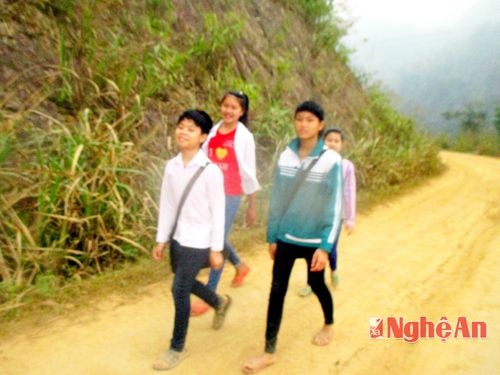 |
| Students from Van Mon village on their way to class. |
Yet, for this strong-willed woman, songs and music are indispensable. For 15 years since marrying into the Van Mon village, Ms. Hue has led the village's performing arts group. She believes that after working tirelessly in the fields and forests year-round, there must be time for fun. During holidays and festivals, Ms. Hue and the other women in the village's performing arts group practice and perform in exchange programs with other villages and border guards.
The village chairman's son returned with baskets full of freshwater fish. Our dinner was late as everyone waited to enjoy the freshwater fish from Chà Lạp stream. The meal today consisted entirely of local specialties: fried freshwater fish, several other stream fish stewed with lemongrass, and a soup made from wild palm trees. It had been a long time since I had been able to immerse myself in such a unique flavor of the mountains and forests of western Nghe An province.
Tonight, sleep came to me very gently. The village chairman's house was next to the Chà Lạp stream, the babbling sound lulling me to sleep. The shouts of the children calling each other to school woke me up. It was still pitch dark. I threw off the blanket and got up, grabbing my camera to capture the moment the students of Văng Môn village went to school in the thick fog. The village is only 4 km from the school, so the students of Văng Môn village do not receive the boarding school benefits. Saying goodbye to the children and returning to the village, I gazed for a long time at the small footprints imprinted on the dusty ground along the path. There was one barefoot footprint with tiny toes gripping tightly to the ground. I remembered what Huệ had said last night: "The girls here, at thirteen or fourteen, are already old enough to fall in love and get married. But I encourage my niece to study hard if she hopes to escape poverty."
We left Van Mon village at dawn. From above, the houses appeared like a forest of mushrooms in a full spectrum of green, red, and yellow. The sun, like a giant ripe loquat, had just risen above the distant mountain range…
Huu Vi