

Thanh Lien: Building a home incinerator.
(Baonghean) - Over the past two years, Thanh Lien commune, Thanh Chuong district, has been promoting and encouraging residents to dispose of waste at home by building makeshift incinerators. The incinerators are designed simply and cost little, so they have been well-received and implemented by the local people…
In Thanh Lien commune, as you travel through the fields, you occasionally see vertical cement pipes along the edges of the fields, plots, or rural roads. At schools, the commune's People's Committee office, and village cultural centers, you'll find these containers built in hidden corners. These are the makeshift waste incinerators constructed by various organizations.
Mr. Phan Bá Ngọc, Chairman of the People's Committee of the commune, said: "Among the 19 criteria for building new rural areas, the criterion on environment and household waste treatment is very difficult to implement for many reasons. According to regulations, if a centralized waste collection and treatment point is built for the commune, it must be 3 km away from residential areas and far from water sources. Therefore, for a semi-mountainous area like Thanh Liên, there is no suitable location. This reality makes environmental management in the locality very difficult. In this seemingly insurmountable situation, through the media, some localities nationwide have encouraged people to build waste incinerators on a family and group-household scale, bringing high efficiency in environmental protection. In early 2013, the Party Committee and local government issued a policy to build waste incinerators from the fields to units, agencies, and families." First, the commune prioritizes building incinerators in fields and at school premises, health stations, and commune People's Committee offices. If proven effective, these facilities will be extended to individual households. In the fields, after each harvest, a large amount of agricultural waste is generated. However, due to low awareness among the people, waste is often carelessly discarded after the use of pesticides or other farming tools, affecting the water environment and even causing people to step on hard objects when wading through the fields.
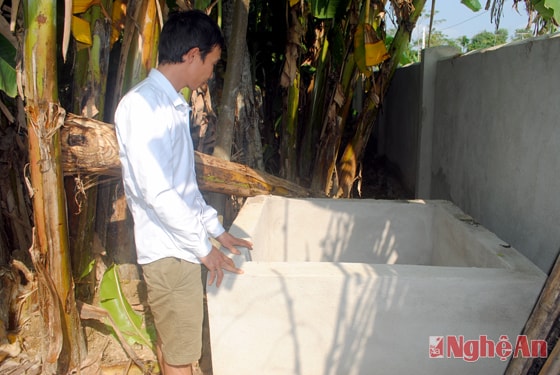 |
| The garbage incinerator of Mr. Tran Van Hoa's family, Hamlet 8, Lien Chau. |
After the installation of incinerators in the fields, residents voluntarily collected waste in one place, resulting in clean fields. Following this, the commune intensified its efforts to encourage residents to invest in building incinerators at home, with each household building one. Families who registered to build an incinerator received a subsidy of 50,000 VND from the commune. Each incinerator was designed with two compartments: one for waste requiring disposal, and another for recyclable plastic and aluminum bottles and containers for sale as scrap. The incineration compartment was designed to be about 1 square meter in size, with a raised edge about 30 cm from the bottom to support a steel mesh. The steel mesh used was 6mm diameter steel, and after incineration, the ash fell to the bottom of the incinerator. The incinerator was also covered with corrugated iron to protect against rainwater. In a short time, hundreds of households in the commune voluntarily registered to build incinerators in their gardens. To date, the entire commune has built 1,113 incinerators, accounting for over 50% of the households in the commune.
Visiting the home of Mr. Tran Van Hoa in Hamlet 8, Lien Chau, we saw a small incinerator in the corner of his garden. Although not yet completed, it was ready for use. Mr. Hoa explained: "The families around here have all built incinerators, and seeing the practical benefits, I decided to build one too. The incinerator was originally designed with two compartments, but my family used sacks to hold recyclable waste such as beer cans and plastic bottles to sell to scrap dealers. This incinerator is built as a square, 1 meter in diameter, 80 cm high, and about 30 cm from the bottom, with a raised edge to hold a steel mesh. A layer of corrugated iron is placed on top to prevent rainwater from entering. The cost to build this incinerator only required 50 kg of cement, 150 bricks, some sand, and one day's labor." Mr. Hoa's wife said that every day when she came home from the market, she saw countless plastic bags containing food. Before, they were just thrown around carelessly, and dogs and cats would drag them everywhere. Every time she went into the garden, she'd see bags of garbage, creating unsanitary conditions and environmental pollution. Now, with the incinerator, all kinds of combustible waste, like plastic bags, eggshells, and toilet paper, are put in there, and when there's a lot, they burn it.
Using a home incinerator is very simple. When people have trash, they just put it in the incinerator, including plastic bags, rubber, and other solid waste. When the incinerator is full, they just need to add some firewood or dry leaves under the wire mesh, light it, and the trash will slowly burn away. By burning it this way, types of waste that are difficult to decompose in the natural environment, such as plastic bags, rubber tires, shoe soles, etc., are burned to ashes. The biggest advantage of a home incinerator is that elderly people and children can clean up their own homes and neighborhoods without much time or effort, fostering a sense of shared environmental protection…
Mr. Phan Bá Ngọc added: "The benefit after the commune launched the movement to build household incinerators is that the sense of responsibility of each citizen regarding environmental protection has been raised, thereby significantly reducing the indiscriminate dumping of waste in alleys and public places. Thanh Liên commune strives to have 100% of households with household incinerators by the end of 2015. To achieve this goal, the commune recently requested the district to provide funding to further encourage the remaining households to build incinerators."
Video clip of a garbage incinerator at a house in Thanh Lien (Thanh Chuong):
Xuan Hoang