

Chu Van An Street: A subtle charm
(Baonghean) - Chu Van An Street is considered one of the "fickle" streets in Vinh City; quite long, with winding entrances and turns, making it confusing for strangers... but it possesses a subtle charm amidst the bustling city...
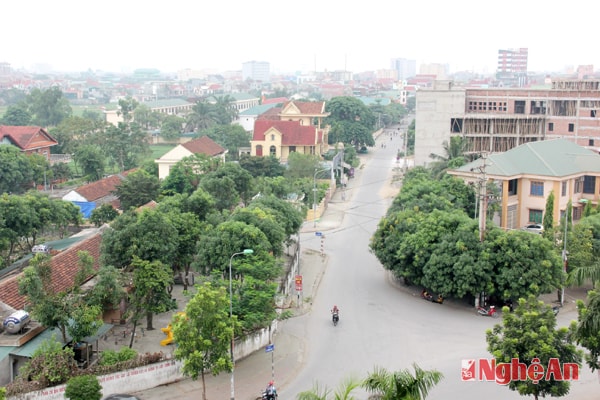 |
| Chu Van An Street. |
Imagine Chu Van An Street as a three-branched tree, each branch a wide, open path. One branch turns from Le Loi Street, another from Ly Thuong Kiet Street, right near Thanh An - Saigon General Hospital, and yet another from Nguyen Dinh Chieu Street. Many city residents know this street and complain about the inconvenience of its length and width, with its many winding turns, making it difficult for inattentive drivers to find their way. Before discussing scientifically planned house numbering schemes or getting angry if you speed and miss an exit, let's pause our daily hustle and bustle and take a moment to admire the charm of the streetscape. We'll see that Chu Van An Street is actually quite charming, both tranquil and lively...
On autumn days, leisurely strolling along Le Loi Street, reaching the bustling traffic lights before the Cua Bac market, and turning onto the other side, you immediately encounter one of the entrances to Chu Van An Street. A headache from the noisy car horns on the main road, stepping inside is like entering another world, clearly seeing the gentle rhythm of autumn's golden hues swaying in the old banyan trees and beside the glass railings of the new high-rise buildings, filling your heart with a warm and familiar feeling. Chu Van An Street wasn't newly formed after recent construction and renovation projects; its predecessor was a familiar inner-city road for the city's residents, serving as a "connecting link" between the two main thoroughfares of Le Loi and Ly Thuong Kiet. Initially, the road was like a thin silk ribbon draped between the two main thoroughfares, discreetly occupying a small area between rows of closely packed houses. Later, as the urban space expanded, Chu Van An Street was upgraded, becoming wider, more spacious, and more modern, while still retaining its charm and tranquility in the heart of the city.
 |
| Le Loi Primary School - one of three schools on Chu Van An Street. |
Midway down Chu Van An street, there's a small, unassuming tea shop under the shade of a mango tree. The shop utilizes a section of the clean, block-paved sidewalk, placing a simple, long wooden bench and propping up a makeshift tarp to provide shade and protection from rain. A few packets of candy jingling in a faded plastic box, a proudly tilted pipe on the table, a pot of green tea and carefully brewed herbal tea (nhac tran) wrapped in layers of cotton, and it's become a familiar stop for many travelers. The owner, naturally contributing to this rustic, old-fashioned scene, is an elderly man nearing seventy. He's originally from the North, having migrated to Nghe An with his parents during the resistance against the French. His voice remains steady and serious, typical of a meticulous Northerner, but his personality has long since become "wooden." Ask whatever you like, and if you're interested, he'll answer wittily. If not, then excuse me, I'll offer you another cup of sweet herbal tea. As for the past, it's better to remember those who are about to pass away. Sitting here, even though the conversation with the shopkeeper is interrupted, I enjoy the leisurely, cool breeze, gazing at the sky, the land, the houses, the streets, and the passing traffic. Sitting here, I immerse myself in the thoughts of hundreds of years ago, when Chu Văn An, the "Teacher of all ages," with his high moral character and profound wisdom, became the exemplary teacher for all generations…
Kudos to the urban planners for associating this charming street with the name of a renowned figure in the field of education. Chu Van An Street, as if perfectly harmonious, is home to three schools: the Nghe An Road Company's kindergarten, bustling with children's arrivals and departures; Le Loi Primary School, vibrant with the innocent colors of its uniforms; and Le Loi Secondary School, pristine with the white uniforms of its students. These three schools, with easily thousands of students and numerous parents dropping off and picking up their children before and after school, are remarkably free from the clutter and disorder of makeshift stalls and the unsightly buying and selling outside the school gates. Street vendors neatly arrange their morning and afternoon snacks in their yards, and their advertising signs are thoughtfully and thoughtfully displayed, contributing to the street's aesthetic appeal. Throughout the four seasons, the subtlety and civility of the city's inhabitants have given this inner-city street a confident and dignified appearance.
Chu Van An Street is also one of the rare streets in Vinh City with sidewalks running along both sides. This meticulous construction gives the street an elegant beauty, attracting travelers from near and far. Houses on both sides of the street are set back, making way for the gentle blossoms of banyan, tamarind, and mango trees in the sunny season. This yielding has brought unexpected benefits; for a long time, residents have lived in a cool, airy atmosphere, free from the stuffiness and dust of other city streets. Therefore, even though residents live right next to the Vinh Bus Station (which is often known for its noise and commotion), they still enjoy a peaceful and tranquil space.
Speaking of Chu Van An Street, although it lacks a distinctive culinary scene, a bustling commercial hub, and even fewer grandiose buildings and the formality of office buildings, it still deserves to be remembered as an important inner-city route in the harmonious development of this young city. The street retains its unique character, while also incorporating the vibrant energy of modern civilization. This quiet yet powerful character deserves to be recognized as a lasting and influential feature of a corner of Vinh City.
| Chu Văn An (also known as Chu An) was from Văn village, Quang Liệt commune, now Thanh Liệt, Thanh Trì district, Hanoi (his mother's hometown). According to the supplementary edition of the Dang Khoa Hoc Bo Di, at the age of 14, he passed the Thai Hoc Sinh examination (equivalent to a doctorate) but did not pursue an official career. He opened a school in a field in Huynh Cung village, adjacent to Văn village. Chu Văn An's talent and virtue reached the King's ears. Tran Minh Tong (1300 - 1357) invited him to be the director of the Quoc Tu Giam (like a vice-director of a university) and to teach the crown prince. Crown Prince Vuong was only about 5-6 years old at the time, so he mainly taught at the Quoc Tu Giam. At the age of 10, Crown Prince Vuong ascended the throne (Tran Hieu Tong). After Vuong's death, Du Tong (1336 - 1369) succeeded him at the age of 8. Minh Tong remained the retired emperor until his death in 1457, after which the government collapsed. Du Tong became depraved, spending his days gambling and drinking. Chu Văn An repeatedly advised against the Emperor's rule, but to no avail. He submitted a petition requesting the execution of seven treacherous officials. Emperor Dụ Tông refused to listen. He then returned his official robes and hat, resigned from his position, and returned to his hometown. Chu Văn An stayed at home for a short time, then traveled around. Upon reaching Chí Linh, Hải Dương, he found the scenery beautiful and built a house on Phoenix Mountain, in Kiệt Đắc village. He adopted the pseudonym Tiều Ấn and opened a school, living a simple life. Chu Văn An died around the end of November 1370, at the age of 78 (according to Đại Việt sử ký toàn thư). |
Text and photos:Phuong Chi