
World in the past week: Many challenges remain!
(Baonghean) - March 18th marked the one-year anniversary of Crimea's annexation by Russia, an event considered to have opened a new chapter in a multipolar world. The consequences included an increasingly tense confrontation between Russia, the West, and the US; the election of Israeli Prime Minister Benjamin Netanyahu for a fourth term with hawkish foreign policy; and the spread of terrorist violence to Tunisia – a country previously considered peaceful in the "Black Continent" due to its absence from the anti-government protests orchestrated by the US and the West – all noteworthy events of the past week…
(Baonghean) - March 18th marked the one-year anniversary of Crimea's annexation by Russia, an event considered to have opened a new chapter in a multipolar world. The consequences included an increasingly tense confrontation between Russia, the West, and the US; the election of Israeli Prime Minister Benjamin Netanyahu for a fourth term with hawkish foreign policy; and the spread of terrorist violence to Tunisia – a country previously considered peaceful in the "Black Continent" due to its absence from the anti-government protests orchestrated by the US and the West – all noteworthy events of the past week…
The annexation of Crimea - gains and losses.
To date, one year after the Crimean Peninsula returned to Mother Russia following a referendum held by 2 million residents, which triggered an unprecedentedly tense confrontation between Russia and Western countries and the United States since the Cold War.
The sanctions were continuously imposed to put pressure on each other, and the Russians suffered the consequences. However, according to observers, the cost of reclaiming Crimea compared to the sanctions was "acceptable."
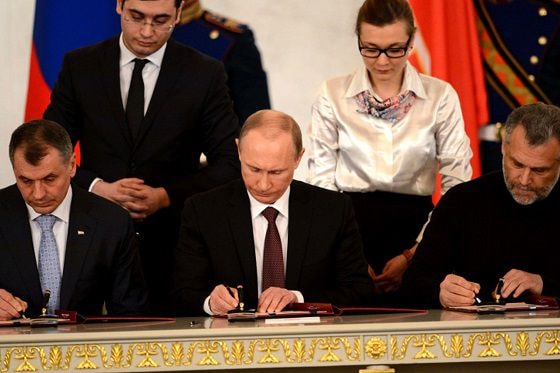 |
| President Putin (center) at the signing ceremony of the treaty annexing Crimea to Russia on March 18, 2014. Photo: Getty Images AP |
Crimea is a historical part of Russia. During the Great Patriotic War, the peninsula was a target for Nazi Germany's conquest, and it also witnessed the great battle in which the Soviet Red Army crushed Hitler's powerful forces, serving as a springboard for expanding liberated areas and making a significant contribution to the liberation of Ukraine and much of Europe.
On February 19, 1954, the Presidium of the Supreme Soviet of the USSR issued a decree ceding Crimea to the Ukrainian Soviet Socialist Republic. This transfer was seen as a "gift" commemorating the 300th anniversary of Ukraine's integration into Russia. More than just a part of Ukraine's history, Crimea is an extremely important geopolitical and geostrategic location, controlling the maritime security of countries bordering the Black Sea. It is also home to the Russian Black Sea Fleet, housing over 70% of its weapons and military equipment.
The Ukrainian crisis, culminating in the Maidan events that overthrew the government of President Viktor Yanukovych, orchestrated by the US, has led to the risk that this strategically important location will fall under NATO control.
If so, this would pose an immeasurable threat to Russia's security. Meanwhile, the majority of the peninsula's inhabitants are Russian, and they dislike the West and the United States, so they always harbor the desire to return to their "old home" in their motherland, Russia. And so, after the referendum on March 16, 2014, in accordance with the wishes of the people of Crimea, Russia welcomed the peninsula with open arms.
By taking over Crimea, Russia not only brought a better life to the "distant children" but also secured a geopolitical and geostrategic position to ensure national security against external threats, specifically NATO.
For many years, the North Atlantic Treaty Organization (NATO) has viewed Russia as an adversary and has consistently sought to expand its territory into post-Soviet countries in order to contain Russia, especially in the defense sector.
Even though the Cold War is over, there are always differences in perspective between Russia and NATO, especially in resolving issues and hotspots around the world.
While NATO, led by the US, consistently maintains a hardline stance, using military force to impose its will, Russia holds the opposite view.
Thus, Moscow's acquisition of Crimea is seen as a painful blow to NATO's ambitions to contain Russia, thereby increasing Russia's influence on the international stage.
Some observers even argued that this marked the end of a unipolar world where weaker nations were always oppressed and exploited. However, every medal has two sides, and the dark side of the Crimea medal was a series of blockades, isolation, and sanctions that plunged the Russian economy into a severe crisis, at times even bringing it to the brink of bankruptcy.
The ruble depreciated, and Western investors, unwilling to take risks, rushed to withdraw capital from the market, making life extremely difficult for the people due to rising inflation and soaring prices… And on the first anniversary of Crimea becoming Russian territory, President V. Putin declared that Crimea would not be returned, despite Western sanctions that would certainly increase tensions between the two sides.
Nevertheless, from the perspective of strategic analysts, Russia's annexation of Crimea would still be a huge victory for Russia. It would not only enhance the country's ability to defend itself against threats but also solidify Russia's prestige on the international stage.
Benjamin Netanyahu's re-election: A new chapter in US-Israel relations.
For a long time, the United States and Israel have been known as two close and unshakeable allies, because everyone knows that both the US and Israel share common interests. That is, both the US and Israel are "enemies" of many Muslim countries in the Middle East.
While the US wants Israel as a bulwark to resolve conflicts should war break out with countries in the region, Israel also wants to rely on the US, hoping to become a regional power and impose its will…
It is noteworthy that in resolving some of the current tensions in the region, the leaders of the two countries hold completely opposite views. For example, regarding the Iranian nuclear issue, while the US, specifically President Barack Obama, quickly ended the confrontation with the Islamic nation; or regarding the Middle East peace process, which the White House has pursued peacefully and constructively, Prime Minister Benjamin Netanyahu has expressed opposing views.
| Benjamin Netanyahu re-elected (Image: Internet) |
During his tenure, Prime Minister Netanyahu consistently pursued a hardline foreign policy. The Middle East peace process continued to face obstacles. Israel continued its settlement construction in the West Bank and withheld Palestinian tax revenues, despite international opposition and the rejection of some Western European powers.
Just before the election, Israeli Prime Minister Benjamin Netanyahu asserted on March 16th that if he were elected, "there would be no Palestinian state." Furthermore, Netanyahu's administration has consistently made statements and taken actions that hinder negotiations on the Iranian nuclear issue.
Given his hardline and conservative stance, if successful in forming a coalition government, the Israeli Prime Minister will undoubtedly be determined to pursue the foreign policies he has been implementing recently, even if it means facing opposition from the international community.
This completely eroded the patience of those at the White House. After preliminary results favored incumbent Prime Minister Benjamin Netanyahu, US officials repeatedly sent messages aimed at "managing" the hawkish leader of Israel. These messages included the possibility of withdrawing the diplomatic "protection" that Washington had provided to Israel at the United Nations for decades.
Remember how, in the past, whenever the United Nations voted to pass a bill against Israel, the US always used its veto power as a shield for the Jewish state. The question is, why would Benjamin Netanyahu take such a risk? Surely, in his calculations, the Prime Minister believed that the Americans would not abandon Israel. Having built a powerful traditional ally in the Middle East, the US would be foolish to turn its back on them.
But remember, at the present time, the image of the US in the eyes of Middle Eastern countries cannot be worse than the image left by the State of Israel. If the P5+1 (which includes the US) satisfactorily resolves the Iranian nuclear issue, it would also mean that America's biggest "enemy" would no longer exist. Therefore, if the US continues to pursue a hardline hawkish approach, relations between the US and Israel will further deteriorate, and the US will have every reason to cease cooperation with this Jewish state.
The shadow of ISIS has landed in Tunisia.
As a country not immune to the influence of the "Arab Spring" movement orchestrated by the West, which caused countless instabilities in the Middle East and North Africa, first the collapse of the dictatorial capitalist regime of Hosni Mubarak in Egypt, followed by Libya, Syria, and others...
Initially, it was thought that the "Arab Spring" would usher in a new era in the region's politics. However, once the movement ended, the consequences were political and economic instability, civil wars, and the rise of terrorist organizations…
In Tunisia's case, the country appears to have ended the "Arab Spring" no worse than it began. This Sunni Muslim nation of 11 million people avoided civil war and managed to create democratic institutions that have so far mediated between competing factions and ideologies. The formula for Tunisia's relative success seems simple: Limit foreign intervention, steer clear of sectarian politics, and encourage compromise from all sides.
 |
| Internet image |
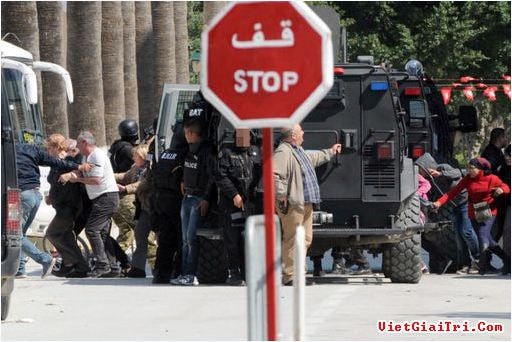
However, after the March 17 terrorist attack that killed 22 people in what was considered the most stable country in the Middle East and North Africa, it became clear that the consequences of the "Arab Spring" had begun.
With its economy heavily reliant on tourism, the Islamic State's claim of responsibility and its designation of the attack as "the first drop of rain" is a red alert for the country. Particularly concerning is that the attack occurred near the Tunisian Parliament building – a heavily guarded area where members of parliament were debating a counter-terrorism law.
Thus, the shadow of IS has infiltrated Tunisia, posing a significant challenge to the coalition fighting the Islamic State, as it not only fails to narrow the organization's influence but also allows it to expand and grow.
Canh Nam