

Child inventor
(Baonghean) - “We hope that solar energy, a clean natural energy source, will be exploited to serve human life more effectively,” that was the idea behind the science project “Exploiting solar energy using an external combustion engine” by two students, Dau Van Thuan and Nguyen Ngoc Chinh (9B class, Dien Hai Secondary School, Dien Chau), which excellently won second prize at the national science and technology competition for secondary school students in the 2014-2015 school year.
Dau Van Thuan shared: “In my hometown, the power grid hasn't reached the fields yet, so people still struggle a lot. One time, while working in the fields, I saw my parents still having to strain their backs pulling power lines and waiting to operate the water pump under the scorching sun. Suddenly, I had the idea: 'Why not convert solar energy into electricity to power irrigation?'"
From that idea, Thuan shared it with his close friend and classmate, Nguyen Ngoc Chinh. The common ground between these two students was their passion for science. Thuan's family had a side business making household furniture, so the two often utilized tools from the workshop, such as wood and steel, to satisfy their hobby of tinkering, assembling, and designing models.
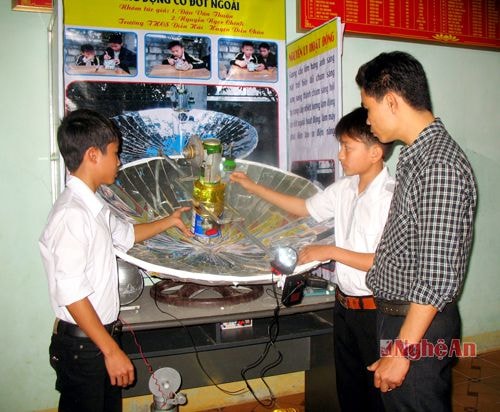 |
| Students Dau Van Thuan and Nguyen Ngoc Chinh presented their project "Harnessing solar energy using external combustion engines". |
When the school launched a science and technology innovation competition, the students enthusiastically participated. Their project, "Harnessing Solar Energy Using an External Combustion Engine," was based on the principle of light convergence. The model was designed with tools, including a concave mirror used to collect sunlight and transform the parallel beam of sunlight into a converging beam—meaning converting light energy into heat energy, which is then converted into mechanical energy to power the engine. However, the journey from idea to model was a challenging one for the two ninth-grade students.
To complete their project, Thuan and Chinh had to supplement their knowledge with physics documents and research on the internet, establishing the technical specifications for the model. It was a period of self-taught invention. After school, Thuan and Chinh would find time to search for recycled materials such as beer cans, milk cartons, plastic bags, and iron bars to cut and shape into engine parts like pistons, cylinders, and flywheels. “Some parts required precision to meet the model’s structural specifications, such as the round, flat flywheel made of iron. We spent a lot of time searching in repair shops and welding shops to find the right materials,” Thuan shared.
After obtaining the necessary materials, the two children diligently practiced assembling the model with their instructor. The most difficult part was making the concave mirror, with a diameter of over 1 meter. The steel rods had to be cut evenly and then bent into a circular shape to form the base; the acrylic sheet had to be cut into dozens of small, evenly sized fan-shaped pieces to be glued together to form the concave sphere, requiring meticulous attention to detail. There were dozens of attempts at cutting and shaping, but none met the requirements, so they had to start over. But perhaps the most memorable moment was when the model was finally completed and the teacher and students took it out for testing. Under the sunlight, the mirror focused the light but reflected it upwards; the heat-collecting position wasn't set correctly, so the concave mirror that the two students and their teacher had poured their hearts into for months was scorched.
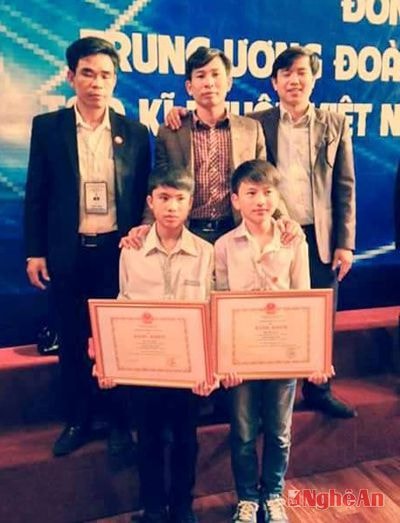 |
| Awarding prizes to the children. |
The teacher and students were once again racking their brains to find the errors and fix them. Having accompanied his two students for a long time, Mr. Nguyen Minh Dong was particularly impressed by their diligence, hard work, continuous learning, and creativity. After each failure, they were very determined and self-motivated to learn, find materials, and come up with their own solutions without giving up. While Thuan excelled in intelligence and problem-solving skills, Chinh was always persistent, meticulous, and precise down to the smallest detail. Thanks to this, they complemented each other to successfully develop their project.
After six months of hard work, the solar-powered external combustion engine model was completed. With outstanding advantages such as: harnessing an inexhaustible source of clean energy (a new direction in today's era, as natural resources are increasingly being depleted); contributing to environmental protection; using an external combustion engine that can achieve the highest efficiency compared to other types of thermal engines, reducing noise and emissions; the device is equipped with an accumulator to store electrical energy so that the machine can still operate when there is insufficient sunlight... thanks to these achievements, the project of these young scientists won second prize at the national science and technology competition for high school students in the 2014-2015 school year.
Their success in the recent competition is a great motivation for them to strive harder in their studies. It also conveys the simple wish of these two students from the coastal region: "We hope that in the future, the solar-powered external combustion engine model can be widely applied to power household appliances such as water pumps, drills, threshing machines, fans, etc., saving costs and effort, helping farmers with plowing and planting, or during their trips out to sea in rural areas, making a practical and useful contribution to the lives of people in places without electricity, such as islands and remote areas..."
Dinh Nguyet