

Dang Tat Street: The culinary highlight of Vinh City.
(Baonghean) - A close friend of mine, who had been away from home for a long time, just returned this early autumn. Before we could even catch up on stories of our time away, she grabbed my hand and asked, "Is there any street that sells sticky rice cakes, steamed rice rolls, and eel porridge in the style of Nghe An?" In Vinh City, these "Nghe An specialties" aren't rare, but perhaps only on Dang Tat Street can they all be found together to satisfy the cravings of those who miss their hometown.
Dang Tat Street is nearly a kilometer long, easily only about 3 meters wide. One end intersects with Dinh Cong Trang Street, the other cuts across Ngu Hai Street. This brief description reveals that the street is actually just a small alley; and small alleys always evoke a sense of familiarity and closeness. The street is lined with houses facing each other, selling a variety of breakfast and afternoon snacks. This shows that the people here are quick to adapt to the changing culinary demands of city dwellers.
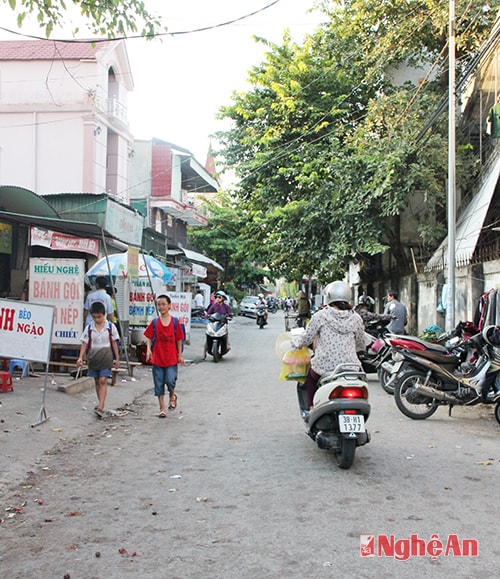 |
| Dang Tat Street. |
That being said, not everything on Dang Tat Street is outstanding. Some dishes are delicious, while others are only passable. Let's overlook the imperfections with affection for this charming street in the city. We'll only discuss the beautiful aspects, so that those far from home, like my dear friend, can retain in their memories the simple yet beloved cuisine of their homeland. Like the richly flavored steamed rice rolls, the delicately thin rice cakes, or the simple bowl of porridge that encapsulates a whole world of innocent childhood memories…
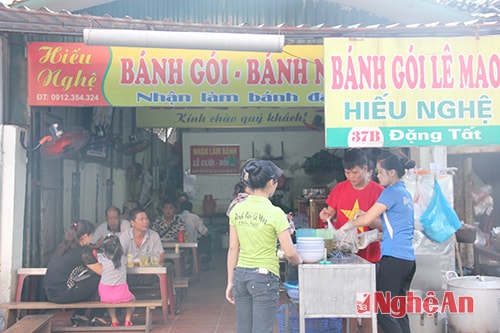 |
| The famous steamed rice cake stalls are located on Dang Tat Street. |
First up is the steamed rice cake (bánh gói). The steamed rice cakes on Dang Tat Street are considered the most "famous" in Vinh City. They are only sold in the afternoon – the rush hour when the streets are packed with people and vehicles, and even more crowded with customers from near and far. The stalls aren't fancy or luxurious, but clearly down-to-earth, from the slanted sign to the rows of old plastic tables and chairs that are rarely neatly arranged, as customers are arriving before they've even had a chance to greet the departing customers. Because it's so crowded, enjoying this rustic treat requires patience. It's okay if you're not used to it, but once you're, you won't mind the delay. Two large vats of steamed rice cakes simmer on the stove, opened and closed repeatedly. The vendor, wearing thick gloves, squints, leans, and quickly picks up a few strings of cakes with her nimble fingers. While waiting for my turn to be served, gazing at the hazy streets through the smoke from the pastries, contemplating the many interesting things in life that are fleetingly passing by, is also a pleasure that contributes to the blossoming of my love for food.
A brief digression about pastries and snacks is also intended to praise a street in the heart of the city that still retains the rustic charm of rural treats, a reminder of the footsteps of city dwellers. Near my house, there's an elderly woman, nearly eighty, who, at the urging of her children, migrated from the countryside to the city. But while the city might be appealing to some, for those who have already experienced a long and arduous life like her, it only means confinement and suffocation. What can one do? After living there for a while, she tried to find a way to pass the time. Every morning, she would wake up very early and make her way from her alley to Dang Tat Street. At first, everyone thought she was going for breakfast, as there were countless breakfast options on that street. Later, her grandchild, curious, followed her and discovered she was eating at a rice noodle shop at the beginning of the street. With just a small plate of rice cakes and a few thin slices of pork sausage, the old woman ate very quietly, but her conversations with the shop owner dragged on until the young customers rushed in for breakfast before school. Only then did she thoughtfully move to a small table in the corner, gazing intently at the shop owner's nimble hands stirring the batter, making the rice cakes, and spreading the leaves… It turned out she was missing her hometown, the bustling Sa Nam market with its lively stalls and rice cake vendors, a place connected to her youth and her life as a widow struggling to raise her children. On this small street, she found her memories, and the lively conversations of the shop owner and the ordinary customers here gave her a familiar feeling, like being back home.
Like many other streets in Vinh, Dang Tat Street possesses its own unique character. The street has few trees (a concern for many residents), so the feelings of spring, summer, autumn, and winter don't rush through as they do on tree-lined streets. However, the subtle changes in weather arrive in a unique way. Each season brings its own specialties, and the culinary offerings on Dang Tat Street are diverse and abundant! Regulars don't need to ask; they instinctively know when the weather turns slightly chilly and flock here to enjoy the fragrant shrimp pancakes. And when the weather is still hot, the light and refreshing rice noodle soup stall at the end of the street remains open to satisfy customers. Therefore, the soul of this small street, and what draws people from near and far, perhaps lies in its beloved culinary flavors, which, no matter where they go in the world, they will always fondly remember...
Text and photos:Phuong Chi
| Dang Tat (1357-1409) was born and raised in Ta Thien Loc village, Thien Loc district, Nghe An province, now Tung Loc commune, Can Loc district, Ha Tinh province. He passed the imperial examination during the Tran dynasty and was appointed prefect of Hoa Chau, now Hai Lang area, Quang Tri. Later, he moved to Thang Binh district, Quang Nam. In November 1407, Tran Ngoi, a member of the Tran royal family, declared himself emperor in Mo Do (Ninh Binh), becoming Gian Dinh Emperor, establishing the Later Tran dynasty and launching an uprising against the Ming army. Due to disagreements on strategy, Gian Dinh Emperor was displeased with Dang Tat. In March 1409, Emperor Gian Dinh stationed his troops on the banks of the Hoang Giang River, summoned two generals, and then ordered his soldiers to strangle Dang Tat to death. Dang Tat's remains were brought back by his sons and buried in The Vinh village, Sy Vang district, outside Hoa Chau (now Phu Mau commune, Phu Vang district, Thua Thien - Hue). His tomb is located on the southern bank of the Perfume River, about 3 km from Sinh ferry terminal and about 7 km from Hoa Chau citadel. The local people revere him as the tutelary deity of the region. Today, there are streets named after Dang Tat in Hanoi, Hue, Ho Chi Minh City, Da Nang, and other cities. |