

Go to Thai Hoc to drink "pork tea".
(Baonghean) - Recently, every time I travel on National Highway 48C, the section passing through Chau Thai commune, Quy Hop district, and see the sign: "Thai Hoc 5 km," I feel curious. For me, this name often brings to mind the Thai Hoc Temple at the Temple of Literature - National University (Hanoi), a familiar place for students of the University of Culture in the past... Driven by curiosity, I made a trip to Thai Hoc in the famous Muong Choong region of northwestern Nghe An...
Previously, this stretch of road had no signposts; it only appeared when the road from Chau Quang commune through Chau Thai to Chau Cuong (Quy Hop) was built. Then, one time, a contributor to Nghe An Newspaper, originally from Phu Quy, told me that if I had the time, I should visit Thai Hoc, a place that still preserves many old customs of the Thai community and is also the "origin" of the local specialty "Quy Hop pounded tea." Oh, in an era when we are concerned about the gradual loss of the cultural identity of ethnic minorities, a place like that would be wonderful!
Believing this, I decided to make a trip to Thai Hoc. Besides, the journey wasn't that far. The inter-communal road from Chau Quang to Chau Thai and Chau Cuong was already half completed. It reached Co and Pom villages in the Thai Hoc area. A leader of Chau Thai commune called Thai Hoc an "inner region," encompassing 10 hamlets and villages, whose inhabitants were mainly the Tay Thanh ethnic group.
Walking along the road, with the rice paddies ripening in the valleys below and the palm-covered hills and lush green trees above, I felt as if the day was truly peaceful. In just a few more days, the people of Thai Hoc will begin their new harvest, their granaries full of rice. For them, that's certainly a great joy! Here and there, the first rice paddies have ripened. The villagers are heading down to the fields to harvest. The rice is piled up and threshed right next to the main road. The oil-powered threshing machine hums, and the dust of straw carries the faint scent of freshly harvested rice in the early morning breeze.
It's not just a "cultural village" like elsewhere; here, each hamlet has a welcoming gate at its main entrance. So, without asking, I knew I'd just passed through the Dong Minh and Lien Minh hamlets... The houses along the main road seem modern and stylish, but turning into the second or third row of houses in the hamlets and villages is like stepping into an ancient space. Low, sturdy stilt houses are hidden beneath lush, evergreen gardens. Each house has a row of betel nut trees, some decades old, swaying in the breeze. In front of the stilt houses, people erect a small structure called a "cooling platform." It reminds me of my mother's rice-pounding shed in her hometown near Con Cuong. Before electrification, there was a small shed in front of the house with a round mortar called a "xoc" and a long mortar called a "loong." Now that it's electrified, the shed is nicer, perhaps a place to cool off on hot summer afternoons?
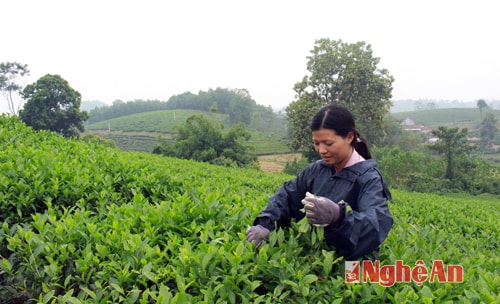 |
| Tea harvesting. Photo: Nguyen Khoa |
Before my feet even tired, I met a woman from the La ethnic group. She said, "If you want to take pictures of the tea plants, come to my hill. There are so many beautiful tea plants!" It was wonderful that the locals didn't mention how tea cultivation had lifted them out of poverty, but instead boasted about the beauty of their tea gardens. But I continued walking, because I had previously heard that the villages of Co and Noong On had the most tea plantations in the Thai Hoc area. These two villages, along with Pom, are now the main tea suppliers for almost the entire Quy Hop district.
Elder Vi Duc Thinh, also the Party branch secretary of Co village, owns a tea plantation of about one hectare. Knowing I was coming, he eagerly led me on a tour of the plantation. He also has a eucalyptus forest, a rice paddy, and a fish pond there; judging by the "ecological" layout, it's clear he's running a large-scale, profitable business. Yet, he modestly declined when I suggested calling it a farm...
Although it's called "going to the fields," motorbikes can reach the foot of the tea hills. Elder Vi Duc Thinh says that since he could walk and remember, he's seen people drinking pounded tea. It's also the most popular drink among the villagers. When friends and neighbors come to visit, the villagers pour them pounded tea; even visitors from afar are treated to this simple yet unique beverage. The preparation is very simple. Tea leaves are pounded in a mortar and then filtered through boiled and cooled water using a clean cloth or plastic mesh to separate the pulp. That's all there is to it. Now, even shops outside Quy Hop town or in the centers of some communes sell pounded tea. Even in Vinh City, you can see signs selling it. Apparently, people from "Vinh" import tea from the Thai Hoc region. Once, when he went to the city, Mr. Thinh tried the pounded tea made by people from the lowlands, but found it not to his liking. In urban areas, people grind tea leaves using vegetable or fruit grinders, which is faster and more convenient, and the tea is greener, but it's not as flavorful or aromatic as when ground in a mortar and pestle.
Thus, Thai Hoc tea has become known far and wide. The local people are happy. In fact, some households earn tens of millions of dong each year from selling tea. However, this is still not equal to the income of tea growers elsewhere who sell to factories and processing companies. Therefore, it seems that it is not yet worthy of being considered a specialty product. The main outlet for Thai Hoc tea is the morning market trips of the women in the villages. Prices fluctuate. Occasionally, traders from afar drive in to buy tea. Such occasions are rare, but thanks to them, the villagers can sell a considerable amount of tea at once. If they diligently go to the market, tea cultivation can provide a decent income, with each kilogram of tea selling for about 10,000 dong when the price is good. Perhaps that is why the people here have remained committed to this crop for so long, despite the lack of any targeted support for tea development in the area.
After walking through the tea plantations, we arrived at the acacia forest. I stopped under the shade of a tree to rest and regain my strength after a long climb up the slope, while listening to the story. Village elder Vi Duc Thinh explained that this acacia forest covers 7 hectares and is 5 years old. In about two more years, it will be ready for harvest. There have been ups and downs, but acacia trees remain a key crop in the entire Thai Hoc region. In many villages, tea and acacia trees have contributed to nearly a dozen students attending colleges and universities in the province and in the capital. Now that there's a paved road leading to the village, transporting the acacia is much easier.
Our "tour" was interrupted by a phone call from the Women's Association branch leader in Co village, summoning Party Secretary Thinh to a meeting. So I didn't get a chance to see the ripening rice fields and the "old farmer's" fish pond. Upon returning to the village, I found one household packed with members of the Co Village Women's Association. It turned out the village still lacked a community center. Not only Co village, but many other villages in the Thai Hoc area also lacked a public space for villagers to hold meetings...
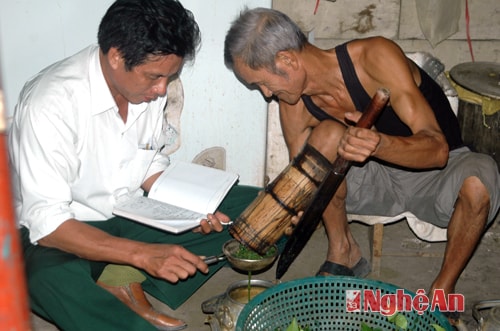 |
| Preparing "che dam" (a type of Vietnamese dessert). Photo: Thu Huong |
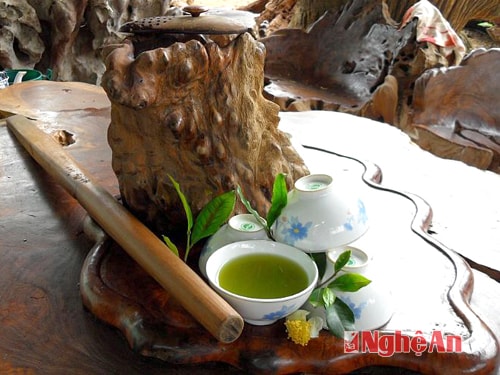 |
As the day drew to a close, I took the opportunity to visit Noong On village. Here, the villagers also cultivate a considerable amount of local tea. Pouring me a cup of brewed tea, the village head, Ha Van Chung, shared the difficulties faced by the villagers, explaining that their lives still largely depend on forest resources. Of the 54 households in the village, 26 are poor. On average, each household owns nearly 1 hectare of forest land; according to the head, this area is insufficient, yielding only about 1,400 acacia trees. Despite the road access to the village, the economic situation has not improved.
On the way back down south, I kept wondering: The average area of forest land allocated to each household in Co village (nearly 2 hectares per household) and Noong On village (1 hectare per household) is considerable, and each household also has nearly 1,000 square meters of paddy fields, yet there seems to be a lack of effective ways to utilize that land. I thought about the local tea plant, which the people here have been attached to for generations. If a stable market for it were guaranteed, perhaps it could be a crop that helps people escape poverty. Often, people still seek a path in something unfamiliar, while the key to success may lie in something simple and familiar. It's like the strong tea from Thai Hoc region, not only appealing because of its unique flavor, but also because of the charm of a specialty plant from a land with a name that evokes interesting associations.
Notes:Huu Vi