

Meeting the target for the percentage of communes with doctors.
(Baonghean) - The Resolution of the 17th Congress of the Nghe An Provincial Party Committee determined that, in order to effectively care for the people's health, it is necessary to focus on improving the quality of medical examination and treatment at primary healthcare facilities. Accordingly, the target set for the 2010-2015 term was to strive for 100% of commune and ward health stations in the plains and 90% of health stations in mountainous areas to have doctors working there. Through many decisive solutions and policies to attract human resources, the Nghe An Health sector has nearly achieved the goal set by the Congress Resolution.
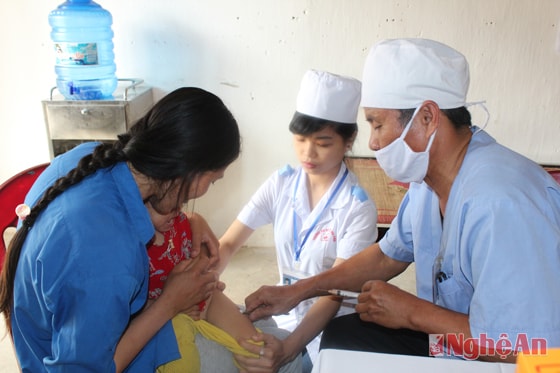 |
| Doctors treat patients at the Quỳnh Phương Commune Health Station, Quỳnh Lưu District. Photo: TS |
The Chau Khe Commune Health Station is located next to National Highway 7, offering much better transportation access than many other mountainous areas. However, the station still lacks a doctor. Medical examinations and treatment for local residents still rely on doctors from the Regional Polyclinic 1 of the Southwest General Hospital, located nearby. However, according to a decision by the Provincial People's Committee, this clinic will be dissolved from January 1, 2015. In a conversation with Ms. Lo Thi Gioi, the head of the Chau Khe Commune Health Station, it was learned that the restructuring of the Polyclinic is not a cause for concern, as two medical assistants will be sent to study to become doctors and will return to perform their duties in 2015. Sending local staff for training to become doctors is proving to be an effective solution to the severe shortage of doctors in Chau Khe commune in particular and Con Cuong district in general. Dr. La Van Lieu, Director of the Con Cuong District Health Center, said: To ensure the healthcare needs of the local people are met, the district has initially contracted two more retired doctors to work at two health stations. Currently, 7 out of 13 commune and town health stations have doctors working there. This number is expected to increase to 11 out of 13 units in 2015 when doctors complete their training courses and return to fill the gaps at the stations.
Similarly, in Anh Son district, after implementing Project 1816, the district's General Hospital has reinforced its medical staff with 3 doctors, and the Health Center has reinforced its staff with 2 doctors at the commune level, raising the number of communes and towns with doctors to 16 out of 21. Dr. Nguyen Thi Huong, Director of Anh Son District General Hospital, said: "It is expected that by 2015, all 21 communes and towns in the district will have doctors working there, once the medical assistants who have been sent for specialized training return..." Discussions with the leaders of the health centers in Que Phong and Quy Chau districts revealed that at this time, the communes in these districts already have a sufficient number of doctors. Dr. Hun Vi Truong, Director of the Quy Chau District Health Center, affirmed: "By the beginning of 2015, all health stations in the district will have 100% of their required doctors, with some communes having up to 2 doctors." Dr. Le Quang Trung, Deputy Director of the Que Phong District Health Center, revealed: To address the shortage of doctors, the Que Phong Health Department has requested permission from the Provincial Health Department to recruit medical assistants who are children of Que Phong residents for specialized training to become doctors. The Que Phong District Health Center currently has 10 doctors at the health stations, 5 doctors at the center, and 3 doctors currently deployed to reinforce medical services in the communes, not to mention several other medical assistants who are currently undergoing further training.
In Vinh City, the deployment of doctors to work at commune and ward health stations has been fully achieved and the target has been met for the past two years. While in 2010 – the first year of implementing the target set by the Provincial Party Congress Resolution – only about 70% of commune and ward health stations in the city had doctors, this number gradually increased to 80-90% in 2011 and reached 100% in 2012-2013…
The deployment of doctors to commune health stations has had a very positive effect on improving the quality of medical examination and treatment. Ms. Kim Thi Hong, from Khua village, Chau Ly commune, Quy Hop district, affirmed: “For the past two years, Chau Ly commune health station has had doctors from the Quy Hop District Health Center providing support, making medical examination and treatment in the commune much easier. People's health is increasingly better cared for, and common diseases in mountainous areas such as malaria and diarrhea have been pushed back. People are increasingly trusting in the local health services.” Mr. Luu Van Hieu, head of Hung Dao health station, happily announced: “Since the station received doctors, the number of patients coming for examination and treatment has increased rapidly. In the first six months of 2014 alone, the station provided medical examination and treatment for over 2,500 people and outpatient treatment for 840 patients, double the number before the doctors were deployed.” Medical officer Cao Thi Lan, Head of the Xa Luong Commune Health Station in Tuong Duong District, shared: “When the station has a doctor, more people come for examinations. Besides participating in examinations and diagnoses, the doctor also directs and guides the station on professional matters, record keeping, and implementing national target programs to achieve targets.”
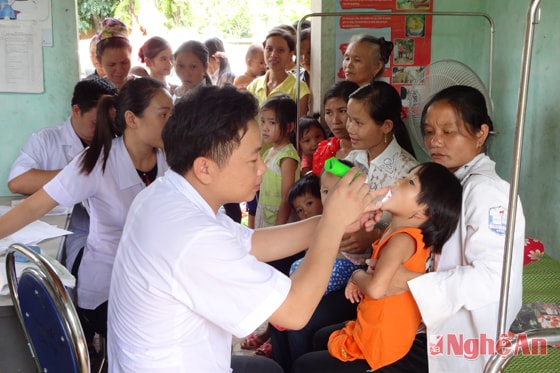 |
| Doctors from the Quy Chau Young Doctors Club provide medical examination and treatment in Chau Nga 1 commune. Photo: Nhu Trang |
To date, the percentage of communes with doctors working in the province is estimated at 88%, with 89.4% in the plains and 84.8% in the mountainous areas. To achieve this result, the Nghe An Health Department has implemented many effective leadership and guidance measures: From the beginning of the term, the Nghe An Health Department developed a plan for rotating doctors to communes according to the Ministry of Health's Project 1816 and the Provincial People's Committee's Decision 92 to ensure 100% of communes have doctors working there. Implementing this plan, over the past four years, the Health Department has sent nearly 500 doctors to work at 153 health stations. In addition, staff have been sent for specialized medical training; currently, 200 doctors from district and commune-level units are studying at medical universities nationwide. Not to mention the number of students enrolled in regular, selective, and preparatory university programs that have trained doctors since 2010-2011, with 100 students trained each year. The policy of contracting retired doctors to work at the clinic has also yielded good results…
With the number of doctors currently being sent for training, plus the actual number of doctors at the commune level totaling 287, the target set by the 17th Provincial Party Congress Resolution: "By 2015, 100% of commune-level health stations in the plains and 80-90% in mountainous areas will have doctors working there" is entirely achievable and even surpassable. However, from another perspective, this statistic is merely mechanical; the percentage of commune-level health stations with doctors currently faces many unsustainable factors, affecting the quality of medical examination and treatment for the people. The problem of doctors working at the commune level, once the difficulty in "quantity" is no longer a concern, will shift to a difficulty in "quality," as well as sustainability and uniformity. To address this issue, Nghe An province has recently implemented policies to improve working conditions and living standards for doctors working in communes and towns. Specifically, in 2013, the Provincial People's Committee invested in upgrading 32 health stations that lacked proper buildings and had poor infrastructure; in 2014, it invested in upgrading 40 health stations and upgrading equipment for 60 health stations; and in 2015, it invested in upgrading 40 health stations and upgrading equipment for 70 health stations. The total budget for these projects was 315.79 billion VND, of which 24.637 billion VND was for purchasing medical equipment. In December 2014, at its 13th session, the 16th Provincial People's Council issued a Resolution on specific policies to support the development of public health human resources in Nghe An province for the period 2014-2020. According to this resolution, doctors sent for further training, retired doctors working under contract at commune health stations, and doctors taking up positions in communes and towns will all receive higher support levels. It is believed that with this attention, the proportion and quality of doctors working at health stations will continue to improve.
Thanh Son