
Huoi Tu happily welcomes electricity.
(Baonghean) - The event of bringing the national power grid to the top of Huoi Dun mountain, Huoi Tu commune (Ky Son district) has illuminated a border region. With the arrival of electricity, the Mong people here feel warmer during the cold winter months…
(Baonghean) - The event of bringing the national power grid to the top of Huoi Dun mountain, Huoi Tu commune (Ky Son district) has illuminated a border region. With the arrival of electricity, the Mong people here feel warmer during the cold winter months…
Huồi Đun, in the Hmong language, means "gathering." The Hmong villages of Huồi Tụ commune are located around the Huồi Đun mountain range. When we arrived, the mountains and forests were shrouded in mist and clouds. The villagers, dressed in their Hmong traditional clothing, were bustling with excitement as they went to see the "electricity switch-on." The electricity switch-on ceremony was held at Huồi Tụ Secondary School. At 8 a.m., the thick mist still covered the houses in this area, which is over 2,000 meters above sea level. Suddenly, the lights blazed up in the corner of the village and at the school high above the mountains. The villagers clapped and cheered, their voices echoing through the mountains. Mr. Ly Chia Cu from Huoi Dun, visibly moved, said: “For generations, our people lived without electricity, facing many difficulties. At night, all family activities depended on the weak light of a mini-hydroelectric generator. During the hot season, the streams dried up, leaving insufficient water, and during the rainy season, the small hydroelectric plants were often swept away. We, the Mong people, are deeply grateful for the Party and the State's concern in bringing electricity to our homes.”
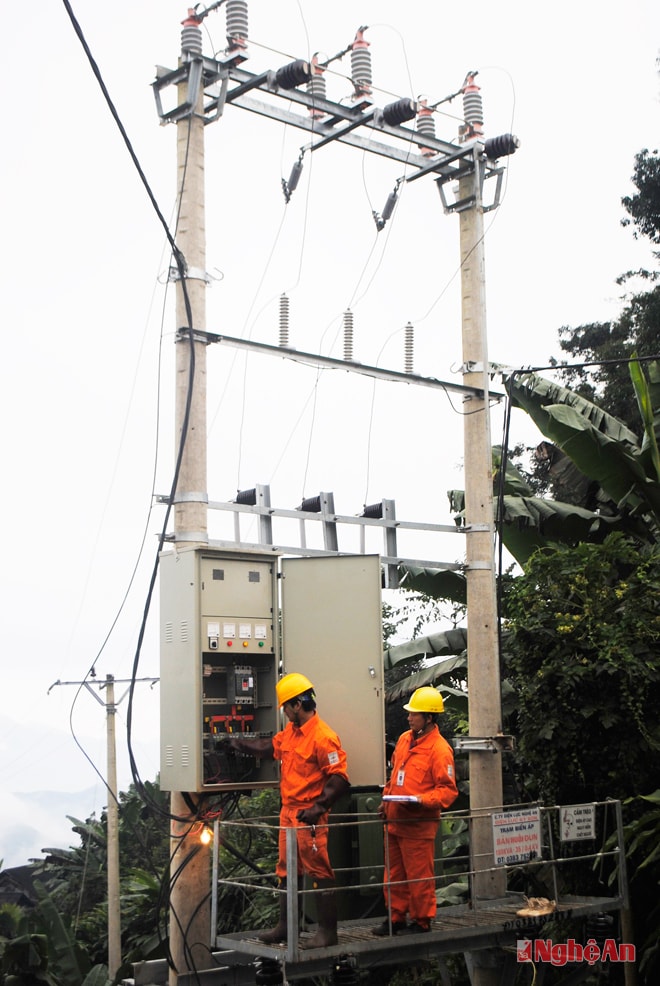 |
| Electricity has been switched on at Huồi Tụ - Kỳ Sơn. |
Upon hearing the news that electricity was coming soon, every family tried to buy electrical appliances. As a result, the village has seen the addition of many televisions, satellite dishes, and rice cookers in the past few days. Ly Y Mo's family could only afford two light bulbs due to their difficult circumstances, but Y Mo was overjoyed, her happiness difficult to express in words: "Tonight, my two children will be able to study in the light of electricity." Walking through the central village of Huoi Dun, we saw some villagers boldly investing in photocopiers, and restaurants had even purchased refrigerators... At Xong Pa Mua's motorbike repair shop, the national power grid was now providing light. The sound of the drill whirred, and Xong Pa Mua confided: "For a long time, I've been known for repairing motorbikes, but I haven't been able to apply equipment to make repairs more efficient. Now that we have electricity, I dare to buy machinery and equipment like drills, pumps, straightening machines, and welding machines..."
Sharing the joy of having electricity, teachers at junior high schools, primary schools, and kindergartens in the commune can now apply new teaching equipment and materials to improve the quality of education. According to Mr. Nguyen Quynh Luu, Principal of Huoi Tu Junior High School: “For a long time, without electricity, we teachers couldn't apply information technology to teaching, such as using electronic lesson plans or projectors… Not to mention, in the summer, the classrooms were hot and stuffy without fans. And in the winter, even though it was very cold, we had to open the doors because of the lack of light, which greatly affected teaching and learning. Now things are different; with electricity, it will be less difficult for teachers working in remote areas. Students can study in rooms with sufficient lighting and fans for use when it's hot. And teachers can prepare and print materials right at the school without having to trek through the forest to Muong Xen town as before…”
Now that electricity is available, the commune's People's Committee can operate more proactively. Commune officials can use the internet to exchange and search for information and documents, send emails, and effectively support their professional work. With electricity, the commune's health station can also more easily utilize diagnostic and treatment equipment for the people, saving them time and travel costs.
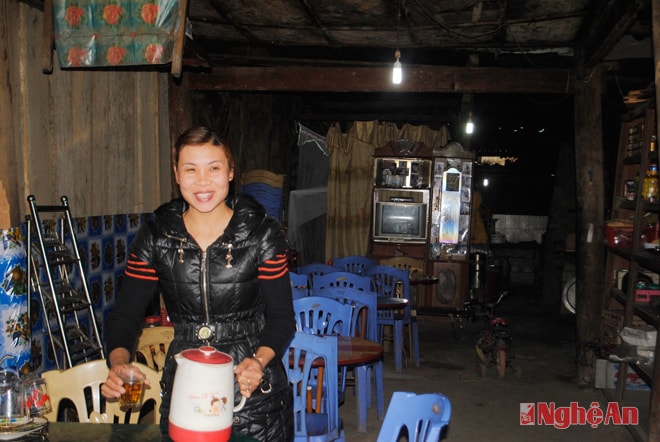 |
| The people of Huoi Tu (Ky Son) now have electricity for their daily lives. |
Huoi Tu is located more than 25 km from the center of Muong Xen town, but transportation remains difficult due to the numerous mountain passes. The lives of the Mong people here are particularly challenging, with the commune's poverty rate exceeding 80%. Therefore, with the arrival of electricity to the villages, the commune government and the people are hoping it will open up many new development opportunities. Mr. Ly Chia Chu, Chairman of the Huoi Tu Commune People's Committee, excitedly added: "Having electricity will change customs, impact and create dynamic economic practices for the people, contributing to the transformation of the economic structure and creating more jobs for people in various service industries, supporting livestock farming, and processing Shan Tuyet tea..."
Video clip about electricity in Huoi Tu:
It is known that the Huồi Tụ power grid system is connected to a contract from the Provincial Border Guard with 4 km of high-voltage power lines and one 180 kVA - 35/0.4 kV transformer station worth 5.5 billion VND, serving over 220 households in Huồi Tụ. Nghe An Power Company is striving to continue investing to provide electricity to the remaining over 400 households in the remote villages of the commune in the near future. From the beginning of 2014 to the present, two more communes in Ky Son district, Bao Nam and Huồi Tụ, have received national grid electricity. It is expected that in 2015, electricity will be supplied to Muong Tip and Na Loi communes, raising the number of communes with access to the national grid to 9 out of 21 communes and towns.
The investment required for power grid projects in mountainous and remote districts is two to three times higher than in the lowlands, due to the rugged terrain, steep slopes, ravines, streams, and sparse population. Some villages have received billions of dong in power grid investments, yet their monthly electricity bills are only a few hundred thousand dong. Therefore, continuing to extend electricity to remote and isolated communes still faces significant challenges in terms of investment resources. Currently, 16 communes in the province still lack access to the national power grid. The Nghe An Electricity Department is working diligently with local authorities to mobilize resources and bring electricity to these remote villages, contributing positively to poverty reduction and social security. A major concern for people in these mountainous areas is that most areas with electricity only reach the commune centers, while access to the national power grid remains a distant dream for those in remote and isolated regions with difficult terrain.
Van Truong