

Efficient biogas production
(Baonghean) - Exploiting biogas to serve economic development and improve living standards is one of the projects effectively implemented in Nghe An province. Since 2003, Nghe An has participated in the biogas project, and after 12 years, the program has brought many great results in terms of environment and economy for participating households, opening up a new direction in economic development associated with protecting the ecological environment.
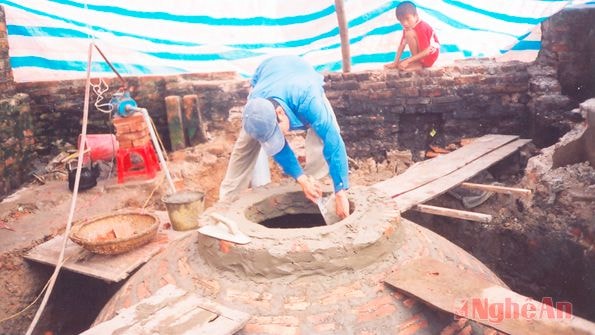 |
| Construction of a biogas tank in Dien Nguyen commune (Dien Chau district). |
Dien Nguyen commune, Dien Chau district, has a total herd of 840 buffaloes and cows, and 2,150 pigs. According to preliminary calculations, the average daily waste from buffaloes and cows is 15-20 kg/animal/day, and from pigs 1.5-2 kg/animal/day. This means over 20 tons of livestock manure are produced daily (not including poultry manure). Due to the large amount of livestock manure, many families accumulate and compost it before using it for farming, or dispose of it in village drainage ditches and canals, leading to environmental pollution and unsanitary conditions in residential areas. To help livestock farmers effectively address this situation, since 2003, Nghe An province has been selected to participate in the "Biogas Program for the Vietnamese Livestock Industry" project, led by the Department of Livestock under the Ministry of Agriculture and Rural Development, in collaboration with the Netherlands Development Cooperation Organization (SNV) and 41 provinces and cities nationwide. The project is expected to conclude at the end of 2015.
By the end of 2014, the province had organized 340 workshops and awareness campaigns for 9,121 potential households with a need to build biogas systems. Training on operation, maintenance, and use of biogas by-products was provided to 9,235 participating households. Therefore, awareness of developing livestock farming in conjunction with biogas system construction has been a major focus for the people in recent years, becoming a fundamental principle in developing livestock farming towards biosafety and sustainability. 8,651 biogas systems were constructed using the KT1 and KT2 model designs with fixed dome-shaped covers (from the Institute of Energy), a technology suitable for the scale of livestock farming and household economics, ensuring compliance with industry quality standards.
One of the most evident advantages of biogas technology is that it solves the pollution problem caused by livestock waste, reducing greenhouse gas emissions by 3-5 tons of CO2/year/storage; reusing and saving 3-4 million VND/year/storage on fuel costs by using biogas to replace firewood, coal, and other traditional fuels for daily life; and providing biogas by-products for agriculture, aquaculture, and many other benefits.
In addition, four demonstration sites using biogas technology were successfully implemented in Nghi Loc district for water heaters and generators, and eight experimental demonstration sites using waste residue and liquid waste were conducted in Yen Thanh and Dien Chau districts with 21 participating households on food crops, winter vegetables, and monosex tilapia farming. The results showed significantly higher yields and income compared to conventional production. Based on these practical results, Nghe An province was highly appreciated by the Central Biogas Project for its organization and implementation, and was recognized as a province with promising potential for sustainable biogas technology development in the future.
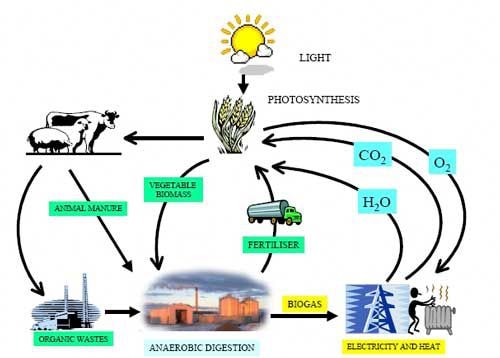 |
| Biogas production process. Photo: SSC |
Speaking with us, Mr. Nguyen Van Minh, from Hamlet 6, Dien Lien Commune (Dien Chau District), happily shared that before the biogas digester was built, the amount of livestock and poultry manure produced was enormous, and even using it as fertilizer for crops, there was still excess manure that had to be dumped into drains, causing foul odors and environmental pollution. Since the KSH project provided support, his family has been able to build a biogas digester, which has brought many practical benefits. The daily livestock manure is now completely channeled into the biogas digester, not only reducing environmental pollution and limiting flies, mosquitoes, and diseases among livestock and poultry, but more importantly, creating an abundant source of gas for cooking and lighting.
Nguyen Van Vinh, a veterinary officer and agricultural extension officer in the commune, said that since the KSH project was implemented, many livestock farmers in the commune have built biogas digesters, and many more families are continuing to build them. Livestock farming combined with biogas digester construction is an optimal solution to support and promote the development of livestock farming in a biosafety-oriented direction, preserving and protecting a clean environment in residential areas and rural communities, contributing to the protection of human health.
Nghe An province has a relatively large livestock and poultry population compared to other provinces nationwide, with a total of 296,241 buffaloes, 391,190 cows, 971,876 pigs, and nearly 18 million poultry (2014 data). Along with the development of livestock farming, addressing environmental pollution caused by livestock waste is a major concern for the people and society. Therefore, exploiting and utilizing biogas is the most optimal solution. Mr. Nguyen Xuan Dai, Head of the Agricultural Extension Station of Dien Chau district, further shared that currently, the entire district has built 1,774 biogas digesters using the built-in method. The District Agricultural Extension Station is continuing to direct and strengthen the dissemination of information and mobilization efforts among livestock farmers in the district to integrate livestock development with the construction of biogas digesters. This aims to reduce pollution caused by waste, reuse cheap and clean fuel sources, and create organic microbial fertilizers for crop cultivation (rice, corn, peanuts, vegetables, etc.), reducing the use of chemical fertilizers. This, in turn, reduces soil degradation, improves soil quality, and enhances crop productivity and quality. The program also contributes to freeing up women's labor in household chores, gradually improving the quality of life and rural civilization, and contributing to the overall construction of new rural areas.
The achievements of the biogas program over the years have demonstrated the multifaceted benefits of biogas technology. To ensure sustainable development and accelerate the construction of biogas facilities, guaranteeing the planned targets and quality, participating units need to continue strengthening and promoting communication through various channels, especially through training for farmers and using public address systems in communes to widely disseminate the benefits of biogas technology to all residents. Coordination with various departments, political and social organizations, and local authorities is crucial, particularly mobilizing agricultural extension officers at the commune and village levels to actively promote, implement, and encourage livestock farmers to participate. Prioritizing the quality of the facilities is essential to ensure reliability for the people. Simultaneously, timely maintenance, repair, and remediation are necessary in case of any facility failures. Strengthen the role of technicians in directing, inspecting, supervising, and accepting KSH projects during construction. Absolutely do not accept projects that do not meet standards and quality requirements. Complete documentation promptly to quickly transfer subsidy funds to eligible households.
In 2015, Nghe An province was again assigned the target of constructing 400 biogas digester structures by the project. The applied technological tunnel type was KT1 and KT2 tunnels (above-bridge type, fixed cover), built by a team of skilled and experienced construction workers from the project, who also guaranteed the quality of the construction. Each biogas digester structure, upon completion and meeting design and technical standards, received a financial support of 1,200,000 VND, regardless of size. 2015 also marked the end of the KSH project implemented in Nghe An. Given the significant practical benefits and effectiveness of KSH technology, livestock farmers should take advantage of the remaining project funding to participate in building KSH facilities. This will contribute to promoting livestock development, reducing environmental pollution, reusing clean energy, and providing nutrient-rich organic fertilizer for crops, gradually realizing the sustainable development of KSH technology in the future.
Cao Xuan Tuan
Deputy Director of the NA Biogas Project