
Ram Temple and the Fishing Festival
(Baonghean) - From Ben Thuy (Vinh City), following the rhythm of rowing upstream on the Lam River for a few kilometers, passing through prosperous villages along the riverbanks, you will reach a temple hidden under the shade of green trees – the Ram Temple, a famous architectural relic associated with the unique folk festivals of the people of Hung Nhan commune, Hung Nguyen district. The Ram Temple is situated on high ground, covering an area of 10,000 square meters, surrounded by ancient trees, creating an architectural space that is both vibrant and solemnly ancient.
(Baonghean) - From Ben Thuy (Vinh City), following the rhythm of rowing upstream on the Lam River for a few kilometers, passing through prosperous villages along the riverbanks, you will reach a temple hidden under the shade of green trees – the Ram Temple, a famous architectural relic associated with the unique folk festivals of the people of Hung Nhan commune, Hung Nguyen district. The Ram Temple is situated on high ground, covering an area of 10,000 square meters, surrounded by ancient trees, creating an architectural space that is both vibrant and solemnly ancient.
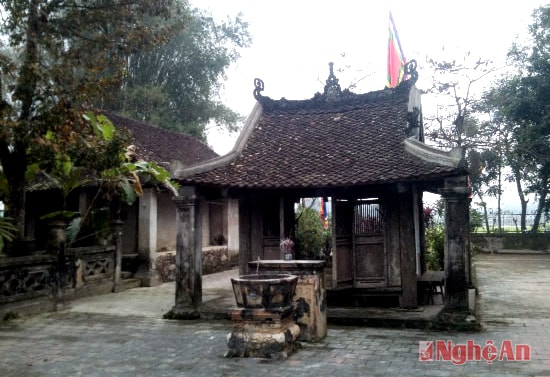 |
| Ram Temple relic |
The Rậm Temple consists of two buildings. The inner temple is built in the shape of the Chinese character "Tam" (three), comprising the Upper Hall, Middle Hall, and Lower Hall. It is dedicated to Dương Cảnh Thành Hoàng Thượng Đẳng Đại Vương Lê Lư (son of Lê Lai), who sacrificed himself to save Lê Lợi during the Lam Sơn Uprising. The outer temple is built in the shape of the Chinese character "Nhị" (two), dedicated to Nguyễn Quang Hợp, a native of the village. The two temple gates are formed by two pillars, each 5 meters high and 0.60 meters wide, consisting of many components such as bases, pillars, and finials, connected vertically.
The temples, elaborately carved with meticulous details and rich themes related to the folk life of a riverside village, such as fish leaping over the dragon gate, carp transforming into dragons, two dragons worshipping the moon, plum blossoms turning into dragons, a scholar returning home in triumph, scenes of plowing and farming, fishing and catching shrimp on the Lam River, fishing... All the carvings are magnificent works of art; the stories have been carved on wood by artisans with fluent, exquisite, and vivid lines depicting the life of a riverside village, most notably the fishing festival.
According to the elders, Do Nha village (Hung Nhan commune) was formerly a fishing village on the Lam River (known as a floating village), where people regularly went fishing up and down the river. Every three years, at the beginning of January, the villagers held a fishing festival, hoping for favorable weather, calm seas, and a bountiful catch of fish and shrimp. The fishing festival had two processions: the first from the inner Ram Temple and the second from the outer Ram Temple. Both processions started at the same time, converging at the Do Nha village communal house. The palanquins were placed on gilded dragon-shaped poles and decorated with magnificent colorful fabrics. Each palanquin was covered with a golden canopy, creating a majestic and solemn atmosphere. The eight-sided palanquin was carried by eight people, while the dragon palanquin was carried by four. The palanquin bearers had to be strong young men from the village, not in mourning, wearing colorful clothes, a tight belt, a crow's beak-shaped headscarf, and white shoes. Following the palanquin was a procession of soldiers carrying various wooden weapons painted in red and gold. Next came a folk music band, playing melodious folk tunes as they marched. Following them was a group of gongs and drums providing rhythm for the procession. Finally, people of all ages, from village elders and respected figures to young men and women, teenagers, and children, joined in. Upon arriving at the communal house, the procession was greeted with a resounding barrage of firecrackers, accompanied by the booming sounds of gongs and drums, adding to the festive and joyful atmosphere of the early spring days.
Before the ritual, the village organizes a boat trip to the middle of the Lam River to pay homage to the water god. The boat is cleaned thoroughly and features a three-tiered altar, a tray of tea, offerings of various fruits, incense, and a sacred flag in various colors (green, red, purple, and yellow) with a golden canopy. The priest reciting the prayers wears a long, flowing robe and white trousers, with a headscarf.
After the boat had paid its respects to the water god, it rowed back to the temple, and the ritual began. The offering tray faced east, the shaman sat facing west, and the offerings included incense, betel nuts, and wine. Village officials, in order of rank and position from highest to lowest, stood in neat robes and hats. After three rounds of gongs and drums, the musicians played the opening music. The ritual took place in a solemn and respectful atmosphere. Following the usual ceremonies, the eulogy for the fish god was read. Next came the lowering of the boat: Young fishermen gathered on both sides of the boat, pushing it into the river while singing.
"This boat has a low rudder and a high bow."
Out there are plenty of fish, in there is peace.
The boat returned with its hold full of fish.
Hitting the upper body is also an option.
There were also many attacks in the lower region.
A fortunate encounter leads to a peaceful transition.
"May the River God show his compassion and protect us..."
After the fishing prayer ceremony, the boat race on the river and the dry-land rowing game in front of the village communal house begin. For every boat competing on the river, there are as many teams in the dry-land rowing game in the communal house. Usually, there are 8 teams representing 8 fishing groups. Each team has one rowing boat and a dry-land rowing group. The dry-land rowing group consists of 10 young men and 10 young women, all unmarried. The village communal house is bustling with cheers, flags flutter on the riverbank, and everyone's faces are radiant. On the race course, drums beat, flags wave, and the helmsmen steer the boats. On both banks of the river, villagers stand watching and cheering, waving flags and holding umbrellas, their shouts echoing along the river.
After the boat and rowing competitions ended, they divided themselves up to sing call-and-response songs to the music that lasted all night.
"Come here and ask her honestly, girl,"
Is it suitable for weaving sieves from young bamboo leaves?
Answering and asking, asking and answering, and so the human connection intertwines, unwilling to break free...
Tran Huu Duc
(Vinh City)