

Hoanh Son Village, a source of cultural heritage.
(Baonghean) - With the Lam River flowing in front and the Thien Nhan mountain range shielding it from behind, Hoanh Son village (Khanh Son commune, Nam Dan district) is not only famous for its picturesque landscape and numerous ancient structures dating back hundreds of years, but also for being a land of outstanding people and a place that has produced many scholars who have brought glory to the land of learning. The village has Ngang Mountain, hence its name Hoanh Son…
| RELATED NEWS |
|---|
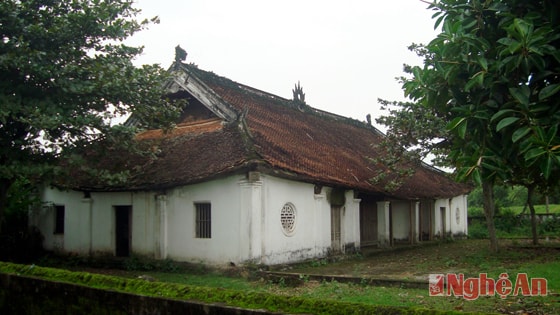 |
| Hoanh Son Temple - Khanh Son commune, Nam Dan district. |
The village has Hoành Sơn communal house (Ngang village communal house) – one of the four famous communal houses in the Nam Hoa region, mentioned in the folk song "First is the Tam Thanh ceremonial gate / Second is the Yên Quỳnh scenery / Third is the Nam Hoa communal house". The communal house was initiated by the Marquis Đặng Thạc in the 23rd year of the Cảnh Hưng era, during the reign of King Lê Hiển Tông (1763), dedicated to Uy Minh Vương Lý Nhật Quang, the Four Holy Mothers, and the Buddha. This is one of the largest communal houses in Central Vietnam, comprising a courtyard, a main hall, and a rear sanctuary, reflecting the architectural style of the 17th and 18th centuries. The seven-bay main hall and one rear sanctuary stand firmly on 36 massive lim wood columns, surrounded by walls, a brick courtyard, and a yin-yang tiled roof. Each section of the communal house displays a different artistic style, both majestic and intimate, vibrant and graceful, affirming the masterful talent of 18th-century carving and sculpting.
Hoanh Son communal house is a place of worship, a meeting place, and a venue for village celebrations and festivals. For 251 years, Hoanh Son communal house has been a witness to countless historical events. Here, the French imprisoned and tortured many revolutionary fighters. The flags of the Party and the Viet Minh Front flew atop the banyan and kapok trees in front of the communal house during the revolutionary days. During the resistance war, the communal house served as the workplace of the local Resistance Committee and a place to store food and supplies. Despite suffering significant damage from fierce wars and historical floods, Hoanh Son communal house has endured the test of time and was recognized by the State as a National Historical and Cultural Monument in 1980.
According to the elders, the old Hoành Sơn village also had many temples and pagodas dedicated to gods and Buddhas: Sắc Sơn Temple, Làng Bắc Temple… The Ngang Pagoda on Hốc Mountain, nestled under the shade of ancient pine trees, had five bays and two gables, with a triple-arched gate and many Buddha statues. Beyond the Nam Trung dike, to the left of the communal house was the majestic Cả Temple, and to the right was the bustling Ngang Market… Over time, the Ngang Pagoda has been reduced to a small tower, and the old statues have been moved to the village communal house for worship. The Cả Temple is no longer on the alluvial plain, the Ngang Market has moved downstream, and now beyond the Nam Trung dike, only a vast expanse of green corn and sweet potatoes remains.
Hoành Sơn village is the birthplace of many illustrious scholars and mandarins whose names are recorded in history: Nguyễn Thiện Chương, Nguyễn Đức Đạt, Tạ Quang Bửu… Today, in the middle of the village, near the Lòn rice field, stands the imposing Hoành Sơn Confucian temple, which locals informally call the "House of the Saints," dedicated to Confucius and other revered sages. Beneath the two pathways are four stone steles, inscribed with Chinese characters on both sides, placed symmetrically across an open courtyard, recording the names of nearly 20 outstanding sons of the village who passed the highest and intermediate levels of classical Chinese studies (equivalent to Hoàng Giáp, Thám Hoa, Tiến Sỹ, Cử Nhân…). Every year, this place used to host the annual ceremonies honoring Confucianism and the village's tradition of scholarly pursuit.
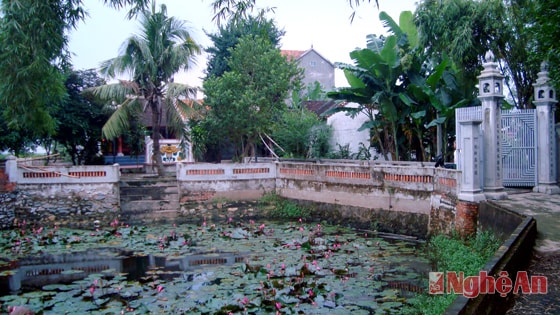 |
| The Nguyen Thien Chuong family church. |
Hoành Sơn village is home to dozens of clans, including famous ones like the Nguyễn Thiện, Nguyễn Đức, Chu, and Tạ clans, with many virtuous and talented individuals worthy of scholarly achievements. Many families have produced scholars, with the patriarch passing the exams, the son passing, the grandson passing, and the whole family passing; generations of the village have gradually continued the ancient tradition of "exchanging tattered clothes for embroidered silks / Exchanging worn hats for calligraphy bestowed by the King." Along the Nam Trung dike is the Nguyễn Thiện clan's ancestral temple, famous for Nguyễn Thiện Chương (1451-1520), who served as a judge, supervisor of the Imperial Censorate, and Right Minister of the Ministry of Justice; he also participated in compiling the Hồng Đức Code – the most perfect legal code in Vietnam during the feudal era; the temple still houses four imperial decrees from various dynasties. In the middle of the village is the Nguyễn Đức clan's ancestral temple, famous for Nguyễn Đức Đạt (1825-1887), who held the title of Thám hoa (third-place winner in the imperial examinations), served as a judge and inspector in various provinces, and was the Head of Education in Nghệ An; later, he returned to his hometown and opened the Nam Sơn school. He was a renowned scholar with many outstanding students. His teaching materials and writings are timeless masterpieces. Among them, "Nam Son Tung Thoai" stands out, comprising 32 chapters discussing virtue, scholarship, and contemporary legal systems. Currently, both his temples and tombs are recognized as provincial-level historical and cultural relics.
Through countless vicissitudes, Mount Hoành still stands tall, and the Lam River continues to deposit fertile alluvial soil, enriching the land of Nam Hoa. The village's traditions, forged over generations, are preserved and developed by descendants, shining ever brighter. Visiting Hoành Sơn to see the stone stele and admire the ancient village temple, one feels a surge of pride, as if walking amidst a thousand-year-old cultural heritage!
Huy Thu