

Lang Vac Village: A milestone in the formation of the Vietnamese nation.
(Baonghean) - Lang Vac (Nghia Hoa commune, now Thai Hoa town, Nghia Dan district) is an archaeological site belonging to the Dong Son culture, discovered in 1972. To date, 43 years have passed, almost half a century. From a remote village, Lang Vac has become famous among archaeologists both domestically and internationally. The Lang Vac archaeological site has been honored as a National Historical Monument, and the annual Lang Vac Festival attracts local residents and is a highlight of tourism for the entire district and Nghe An province.
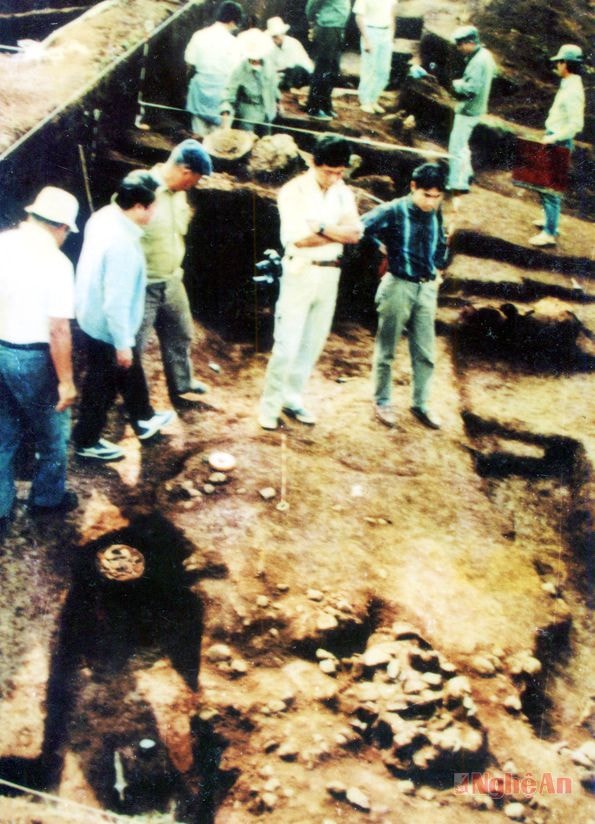 |
| Excavation site at Lang Vac archaeological site - 1990. Archival photo. |
Since its discovery, Lang Vac has attracted special attention from scientists both domestically and internationally, due to the discovery of beautiful Dong Son bronze drums buried underground, along with many other bronze artifacts. At that time, the area was under American bombing campaign. Undeterred by the dangers, two researchers from the Institute of Archaeology cycled all the way from Hanoi to Lang Vac to conduct their research. Now, one of those two archaeologists has passed away.
Less than a year later, in 1973, the Institute of Archaeology organized the first systematic excavation, and the results were very promising. They found a rather impressive burial site containing bronze drums, which were funerary objects buried with the deceased. Alongside these were many daggers with handles shaped like human figures, pairs of snakes biting elephant feet, pairs of snakes biting tiger feet, and numerous bracelets and anklets adorned with many bronze bells. To this day, no other ancient burial site in Vietnam has a greater number of bronze drums and bronze artifacts, and in such a beautiful way.
In 1981, the Lang Vac burial site was excavated again. The excavation yielded even more valuable artifacts, attracting the attention of many foreign scientists, especially Japanese archaeologists.
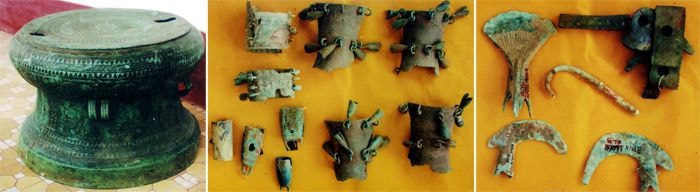 |
| Some artifacts were unearthed at the Lang Vac archaeological site. (Photo: Archival image) |
In 1990 and 1991, a large-scale excavation at the Lang Vac site was conducted by Vietnamese and Japanese archaeologists. This was the first international cooperation program between the Vietnam Institute of Archaeology and Sophia University, University of Tokyo, Japan. This collaborative excavation yielded new insights into the significance of this archaeological site. Numerous burial mounds, along with many beautiful bronze artifacts, glass objects, and agate jewelry, were discovered. Lang Vac once again gained fame, this time known to many foreign archaeologists. A highly regarded book about Lang Vac, a collaborative Japan-Vietnam project entitled "The Lang Vac Site," was published in English in Tokyo, Japan, in 2004.
Also in the 1990s, when antiques became valuable and many antique collectors emerged, the fame of Lang Vac Village inadvertently made it a focal point for numerous excavations. Many valuable artifacts from Lang Vac were transported to Hanoi and Ho Chi Minh City through various means. Scientists were then exposed to many unique artifacts unearthed from Lang Vac Village, with a touch of regret about the spontaneous nature of these archaeological excavations.
The Lang Vac archaeological site is valuable and rare not only because it has contributed to our tangible heritage a series of unique bronze drums and exquisitely beautiful decorative artifacts, but also because it has helped scientists to sketch a picture of contemporary history, which is extremely significant for the history of our country and the Vietnamese nation.
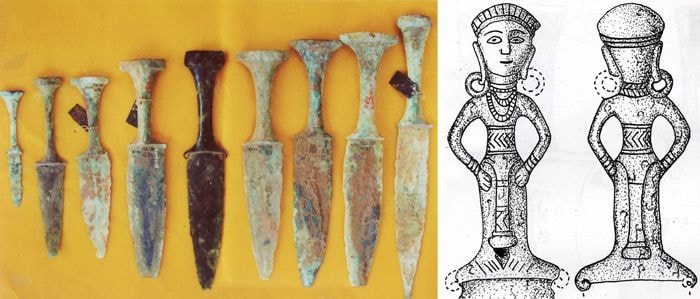 |
| A collection of T-shaped daggers and images of women on the handles of ancient bronze daggers from Lang Vac village. |
Lang Vac is both an ancient village and a magnificent ancient burial ground. Archaeologists have discovered evidence of this ancient village in the form of a cultural layer filled with broken pottery fragments. Lang Vac is one of the famous relics of the Dong Son culture, dating back more than 2,000 years. Scientists have analyzed a sample of charcoal ash from this site using radiocarbon dating, yielding results of 1990 ± 85 years from 1950, which is approximately 40 BC. In other words, it dates back to the 1st century BC. During that time, the Han dynasty invaded Vietnam. In the lowlands, there were cultural massacres of the Lac Viet people with a policy of eradicating bronze drums, collecting them to cast bronze horses and the Ma Vien bronze pillar, as recorded in ancient texts. Yet, in the mountainous region of Nghia Dan, the ancient Vietnamese people in Lang Vac still preserved the identity of the Dong Son culture and the Dong Son bronze drums. The Han dynasty did not reach the Lang Vac region, which is why we know how glorious the Dong Son culture was even after 111 BC, the year the Han dynasty ruled our country.
From the collection of artifacts from Lang Vac village, we also learn that the ancient people of Lang Vac had a fairly advanced material culture. They knew how to dress beautifully, as shown in the dresses depicted on the female figures of the dagger handles. Scientists have also discovered that the fabric used for clothing was hemp, thanks to the analysis of a fabric sample found in a Lang Vac burial site. They also knew how to adorn themselves with many bracelets, earrings, and tubular rings made of copper, precious stones, or glass. Thanks to the discovery of a type of ceramic pot in Lang Vac, scientists have confirmed that the people of Lang Vac knew how to cultivate glutinous rice and use it to make sticky rice dishes. The carvings on the Lang Vac bronze drums also show that the ancient people knew how to build racing boats and raise cattle, as seen in the carvings of humped cattle on the drums.
The people of Lang Vac also had a rich spiritual life, as evidenced by the depictions of the people of that era on bronze drums. Scientists have also learned about the spiritual beliefs of the ancients through their burial customs: death was a "migration" to another world, therefore, they needed to take along valuables such as bronze drums...
It can be said that the inhabitants of Lang Vac village were a mountainous community in Nghe An province, part of the larger ancient Vietnamese community of the Dong Son culture. As a glorious milestone, the Lang Vac civilization and its people contributed significantly to the formation of the Vietnamese nation from its very beginning, 2,000 years ago!
On the 7th, 8th, and 9th days of the 2nd lunar month each year, the Lang Vac Festival is jointly organized by the local government and the community to commemorate the contributions of the Hung Kings in founding the nation, and to look forward to a new year filled with good fortune, favorable weather, bountiful harvests, and national peace and prosperity. Many events are held during the festival, but the most important are the procession of the nine-handled bronze cauldron and the procession of the bronze drum to the temple. The Lang Vac Festival has been held for 15 years and has become an indispensable spiritual activity in the area. Along with the Lang Vac archaeological site belonging to the Dong Son culture, this place records the strong vitality of ancient Vietnamese civilization in the formation and development of the Vietnamese nation. |
Assoc. Prof. Dr. Nguyen Giang Hai
Director of the Institute of Archaeology
| RELATED NEWS |
|---|