

World Overview 2014 - Final Part: What Scenarios for 2015?
(Baonghean) - Looking back over 365 days, it can be said that 2014 was a year full of uncertainty, risks, insecurity, and chaos in all areas! On a regional level, the picture was a mix of bright and dark. Latin America was relatively calm, while North Africa was plagued by bloody conflicts in Tunisia and Libya… Will the economic, political, and security “weather” in 2015 be brighter than in 2014?
| RELATED NEWS |
|---|
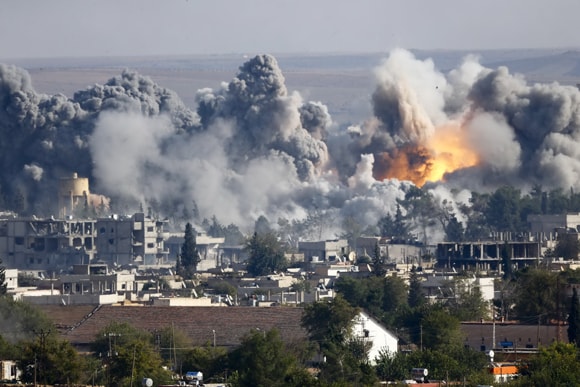 |
| The US-led coalition bombed ISIS targets in the town of Kobani in Syria. Photo: Reuters |
Regional hotspots
When discussing regional hotspots, people often think of North Africa, the Middle East and South Asia, East Asia, and Latin America.
In 2014, Latin America was relatively calm, except for the bloody conflict on February 12, 2014. Observers should note that opposition forces in Venezuela, as well as in Ukraine and Syria, were fully supported by the US and the West in their efforts to overthrow the constitutionally elected presidents Maduro, Yanukovych, and Bashar al-Assad. Those who died in the bloody clashes on February 12, 2014, in Venezuela were not killed by police or security forces, but by US-trained snipers who shot at protesters and then blamed the Maduro government for repression and massacre, thereby creating a pretext to overthrow the legitimate and constitutional government. The bloody clashes from February 18-20, 2014, in Kyiv (Ukraine) followed the same US-orchestrated scenario as in Venezuela.
In 2014, a dark and gloomy sky hung over North Africa with a series of terrorist attacks in many countries and bloody conflicts in Tunisia and Libya. After three years of the so-called "Arab Spring," the people of Tunisia, Libya, and Egypt not only failed to live in peace but were plunged into hardship and instability.
In East Asia, relations between North and South Korea have always been a subject of international attention. In 2014, nothing particularly remarkable happened on the Korean Peninsula. South Korea conducted joint military exercises with the US, and North Korea issued threats of "annihilating the enemy." It was a recurring theme, familiar and commonplace, yet things remained the same. Those in power in Pyongyang have a volatile temperament, like the storms in the Philippines, making it difficult to predict what will happen on the Korean Peninsula.
In 2014, when discussing regional hotspots, it's impossible not to mention the "Occupy Central Movement" of Hong Kong students, which lasted from September 28, 2014 to early December 2014. While the movement has since subsided, its consequences for China are significant and long-lasting. Regardless of its purpose or motivation, the "Occupy Central Movement" of Hong Kong students profoundly impacted the 23 million people of Taiwan in their choice of development path: the "One Country, Two Systems" model like Hong Kong, or independence (not joining the mainland).
The Kuomintang's (pro-Beijing) heavy defeat in the November 2014 local government elections was the bitter fruit of the "Occupy Central Movement" in Hong Kong, and it foreshadowed a bad omen for the Kuomintang in the 2016 elections for power on the island.
In 2014, the hottest region in the world was the Middle East and South Asia, with the Israeli-Palestinian conflict and the war against the so-called Islamic State (IS).
The 50-day offensive (starting July 8, 2014), primarily involving Israeli missile strikes against Hamas forces in the Gaza Strip, killed over 2,000 Palestinians, mostly women and children, destroyed tens of thousands of homes, left hundreds of thousands homeless, and caused over $10 billion in total damage. This was the bloodiest war since 2001.
On June 10, 2014, the Islamic State (IS) captured Mosul – Iraq's second-largest city – directly threatening the existence of the Maliki government. If the Maliki government were to collapse and Iraq fell to IS, it would be a catastrophe not only for the Middle East region, but also a serious threat to the security and safety of the United States and its allies.
It can be said that if the "Bush Jr." administration had not launched the invasion of Iraq in March 2003, there certainly would not have been ISIS. ISIS is an inevitable product of the war to overthrow the government of S. Hussein. For three years (2011-2013), the US and its allies provided full support to ISIS to wage war to overthrow President Bashar al-Assad in Syria.
History proves that those who sow the wind will reap the whirlwind.
In the 1980s, the US provided full support to the Taliban to fight the Soviet Union in Afghanistan, and then (after the Soviet Union withdrew from Afghanistan) the Taliban and Al Qaeda turned against the US.
Currently, ISIS, created by the US and once supported and nurtured by the US to fight against Bashar al-Assad, has turned its guns directly against the US and its allies.
The primary goal of the US is not to destroy ISIS; the US is using the war against ISIS as a pretext, as a means to remove the Bashar al-Assad regime in Syria. In other words, through the war against ISIS, they aim to remove Bashar al-Assad, thereby directly threatening Iran and forcing it to abandon its nuclear program.
The US-led coalition against ISIS comprises 60 countries, with 10 core nations. While seemingly large and powerful on the surface, the coalition members have differing, even conflicting, motives and objectives for participating in the conflict. The US and its allies support the so-called "moderate forces" within the motley army fighting against the Bashar al-Assad regime. In Syria, the anti-Assad forces are constantly at odds with each other, even killing each other, and exist intertwined and interwoven. The so-called "moderate forces" lack a distinct territory for the US and its allies to support.
Therefore, US and allied airstrikes against IS in Syria would inflict losses on other forces and risk causing anti-Bashar al-Assad forces to consolidate and unite against the US.
From every perspective, the fight against IS is fraught with uncertainties, risks, and risks, and in the remaining two years (2015-2016), Obama will certainly not achieve his goal of "destroying IS."
Man-made disasters and natural disasters
In 2014, nearly 20 aircraft accidents occurred, with Malaysia suffering two catastrophic ones. On waterways, 2014 also saw numerous major ship and ferry sinkings, with South Korea experiencing the greatest risks and losses. It was also the year with the most catastrophic aircraft, ship, and ferry accidents in over 50 years. Also in 2014, the Ebola epidemic claimed the lives of over five thousand people in West Africa.
Considering airplane accidents, shipwrecks, and the Ebola epidemic, it can be summarized that 2014 was a year of many risks and losses for humanity.
Looking back at the 365 days of 2014, what can we say about our world?
Was 2014 a year full of uncertainty, risk, insecurity, and chaos in all areas, from economics to politics, security, and society?
Is the world today unipolar, multipolar, or infinite?
Perhaps the world is currently in a state of infinity, instability, insecurity, and unpredictability.
What will 2015 be like?
Over 90% of predictions for 2014 were wrong. Therefore, few dare to make definitive predictions about what will happen in 2015. However, as is often the case, after the storm comes the calm.
- Economically, things remain basically stagnant and gloomy, hopefully not worse than 2014; the US economy is still growing positively, but not enough to pull the entire global economy up.
- In terms of politics and security at a global level, predictions are very difficult.
Have US-Russia and US-China relations hit rock bottom? Hopefully, these two major relationships won't worsen beyond 2014. Neither side will back down, and further tension wouldn't benefit any superpower. Moreover, despite their own calculations, schemes, and ambitions, the US, China, and Russia, to varying degrees, are still mired in numerous economic, political, security, and social challenges.
President Obama has two years left in his second term. In 2015, he will likely focus on cleaning up domestic and international instability, especially the fight against ISIS and stabilizing Afghanistan after the US and coalition forces withdraw their direct combat forces from the South Asian nation in preparation for the handover to the White House in late 2016 or early 2017. Therefore, the White House is unlikely to take a tough stance against both Russia and China.
On the opposite side (or rather, the confrontational side), the Kremlin leader and the ruler in Zhongnanhai (Beijing) will also choose a cautious approach towards the US, one that avoids confrontation.
If the above calculations are reliable, it can be assumed that US-Russia and US-China relations in 2015 will not be worse than in 2104. "The sky is not yet calm, the sea is not yet still," but the parties will remove the bullets from their guns and lower the alert level! Facing the abyss of confrontation, Obama, Putin, and Xi Jinping, whether they like it or not, have to back down; they are not yet eager to shake hands, but they are not pointing guns at each other.
In the regional hotspots, the only hope is that Iran's suspected nuclear program will be resolved in 2015; other hotspots remain deadlocked.
Two things are undeniably predictable: 1. If Washington deliberately removes the Bashar al-Assad regime in Syria, the entire Middle East and Southeast Asia will descend into an unprecedented and uncontrollable spiral of bloody violence; 2. In 2015, the US and its allies will suffer numerous devastating suicide bombings.
Predicting world events is as difficult as walking on a tightrope, but it's something you have to do. It requires courage and a willingness to take risks. If you're 50% right and 50% wrong, that's acceptable.
Associate Professor, Doctor of Science, Major GeneralLe Van Cuong
Former Director of the Institute for Strategy –Science Department, Ministry of Public Security