
Gac fruit exported to Que Son
(Baonghean) - Leading us on a tour of his 2.5-hectare gac fruit garden, which is currently in its growth phase, Mr. Nguyen Van Doan from Na Tooc village, Que Son commune (Que Phong district) confidently said: “We only sowed the seeds in mid-January of the lunar calendar, and now the plants have already started climbing. The initial investment was quite substantial, but the profits will be substantial in the long run.” He explained that to secure the initial investment of over 500 million VND, in addition to his family's savings over many years, four other families also contributed as “shareholders.” Remarkably, all the families trusted him completely.
(Baonghean) - Leading us on a tour of his 2.5-hectare gac fruit garden, which is currently in its growth phase, Mr. Nguyen Van Doan from Na Tooc village, Que Son commune (Que Phong district) confidently said: “We only sowed the seeds in mid-January of the lunar calendar, and now the plants have already started climbing. The initial investment was quite substantial, but the profits will be substantial in the long run.” He explained that to secure the initial investment of over 500 million VND, in addition to his family's savings over many years, four other families also contributed as “shareholders.” Remarkably, all the families trusted him completely.
Regarding the reason for choosing gac fruit trees for investment, Mr. Doan said: For the people of Que Phong, gac fruit trees are not unfamiliar, but many families only consider them as secondary crops for hedges, shade, or as an ingredient in sticky rice. However, through information from books, newspapers, and television, he learned that many people in Bac Giang, Ha Nam, etc., have become wealthy from gac fruit, specifically hybrid gac. Therefore, based on discussions and agreements among families to change the crop structure, mainly focusing on mixed orchards with low economic value, he packed his bags and went to learn firsthand. After researching, he directly signed a contract with Dai Thang Export Trading Company, headquartered in Hanoi, a company that has long supplied gac fruit seedlings and also guaranteed the purchase of products from gac fruit-growing localities for export such as Bac Giang, Ha Nam, Hai Duong...
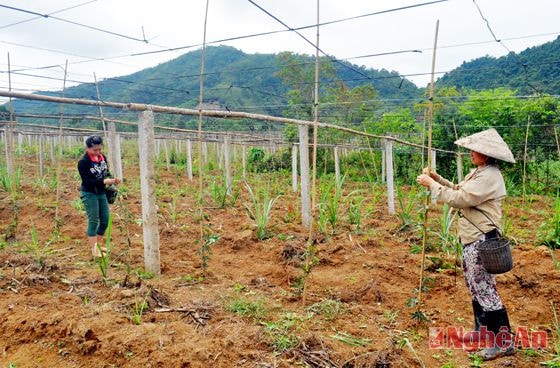 |
| The gac fruit plant is in its growth phase, beginning to climb and cling to the ground. |
Back in his hometown, after investing time and money in preparing the land and constructing a trellis made of concrete posts and woven telephone cables, he began sowing seeds. And indeed, the land rewarded his efforts; the seeds sprouted into tender green shoots. Thus, he had achieved initial success.
Diligently tying each stem of the plants, Ms. Ha Thi Hanh, one of the five "shareholders" of the model, said: "Previously, we planted gac fruit, but the traditional variety had small, thorny fruits with thick, fibrous flesh, mainly for local consumption. The gac variety we are currently growing is a hybrid that is favored by the export market." With her existing experience, she added: Because gac is grown from seeds, it's easy to grow male gac plants that don't bear fruit. Therefore, as soon as the young plant reaches about 20 cm, the male gac must be removed. Gac is a climbing plant, so a trellis is necessary. Regularly weed and lightly loosen the soil around the base of the plant, 25-30 cm away, to stimulate root development. Instead of using nitrogen fertilizer, use microbial and organic fertilizers to help the plant grow, produce more fruit, and have larger fruits. You can dig a wide trench, spread the fertilizer evenly on the ground 20 cm away from the base of the plant, then lightly hoe to cover the fertilizer. Layer dry grass or straw on the surface to retain moisture and prevent erosion. Regular spraying with pesticides is necessary to control fungi, pests, and diseases.
According to Mr. Doan's calculations, hybrid gac fruit has outstanding advantages such as: thick flesh, purplish-red pulp, and an average yield three times higher than native gac fruit, with a lifespan of 20-30 years for a single gac tree. Therefore, in the first year, 1 hectare will yield 25-30 tons of fruit. 1 ton of fruit will yield 40 kg of dried fruit after processing. The price has been stable for a long time, with 1 kg of dried fruit being purchased at 180,000 VND. Therefore, his model is expected to generate 150 million VND in revenue in the first season. In subsequent years, because there is no need to invest in initial seedlings or trellises for the gac vines to climb, and the yield is even higher, the income will increase further.
Mr. Trinh Duc Son, the agricultural officer in charge of Que Son commune, assessed: "This is the first time in Que Son, as well as in Que Phong district, that people have independently invested in building a model for growing gac fruit for export. This is a model that people in many provinces and cities have applied and achieved high economic efficiency."
Text and photos:Quang An