

Changes at the Khe Bo Hydropower Resettlement Area
(Baonghean) - From the Khe Bo intersection, we followed National Highway 48C to reach the resettlement area for people in the villages of Tam Dinh commune, Tuong Duong district. Seen from afar, the Khe Bo hydroelectric power plant stands out as a highlight in the majestic landscape of the Western mountains and forests. The lives of the people in the two resettlement villages here are changing day by day, becoming more prosperous and civilized…
(Baonghean) - From the Khe Bo intersection, we followed National Highway 48C to reach the resettlement area for people in the villages of Tam Dinh commune, Tuong Duong district. Seen from afar, the Khe Bo hydroelectric power plant stands out as a highlight in the majestic landscape of the Western mountains and forests. The lives of the people in the two resettlement villages here are changing day by day, becoming more prosperous and civilized…
In 2006, after the Prime Minister approved the Khe Bo Hydropower Plant construction project, authorities developed a plan to relocate residents from the reservoir area. Initially, the plan was for 276 households from Dinh Huong and Dinh Thang villages to be moved from the reservoir area to a resettlement zone in Cao Veu, Phuc Son commune, Anh Son district. However, after dozens of surveys of land availability, soil conditions, and climate in Cao Veu, and considering the general wishes of the residents, the Tuong Duong district government decided not to relocate the households from Dinh Huong and Dinh Thang villages to Cao Veu, but instead to organize on-site resettlement. This plan received strong support from the people. After receiving the consent of the residents regarding the on-site relocation plan, the construction of resettlement infrastructure in the two villages of Dinh Huong and Dinh Thang was quickly implemented: constructing an 8 km long dirt road into the two villages, building a kindergarten, a primary school, and a community cultural center. By March 2013, the relocation of residents from the two villages of Dinh Huong and Dinh Thang was basically completed.
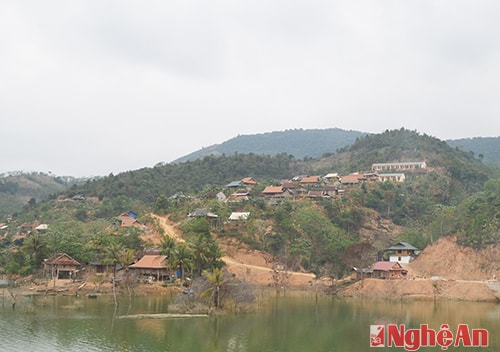 |
| A view of the Dinh Huong resettlement village, Tam Dinh commune, Tuong Duong district. |
Now, the lives of the people in Dinh Thang and Dinh Huong villages have truly changed. 100% of the relocated households have built spacious houses; the road from National Highway 48C into the villages has been leveled and widened. Dozens of households in the villages have bought motorbikes to transport goods from the village to sell at Khe Bo market. Various services such as grocery stores, timber and bamboo purchasing points have also gradually appeared in the villages... In particular, children in both villages now attend school in modern schools, replacing the makeshift classrooms of the past. Many households have invested capital in planting acacia trees and purchasing milling machines. Some other households grow hybrid corn on their hillside land, yielding high economic returns. Mr. Kha Van Bong from Dinh Huong village said: "Thanks to the government's price support, this season I planted 10 kg of corn seeds, estimated to bring in tens of millions of dong in income." Mr. Luong Van Loi's family boldly bought a rice milling machine to serve the villagers. Mr. Loi said: "The lives of the people in Dinh Huong and Dinh Thang villages are gradually changing... With compensation money, people are using it to buy cows and pigs to raise; with roads, trade is developing, corn, rice, pigs, chickens, etc., are all brought to Khe Bo market to sell at good prices. Soon, with electricity and clean water, life will definitely be better..."
Since the hydroelectric dam started impounding water, aquatic products such as fish and shrimp have become more abundant and diverse. Mr. Lu Doan, Party Secretary of Dinh Thang village, nicknamed the "Khe Bo otter," said: "Not only me, but many other households have a stable income from catching fish and shrimp in the reservoir and selling them to traders. Most families have bought nets, metal boats, or dugout canoes to catch aquatic products on the river. On peak days, each household setting traps can catch 3-5 kg of shrimp, selling them to traders for more than 100,000 VND/kg. Some households have bought multi-layered nets and caught carp and tilapia weighing 2-3 kg. Recently, Mr. Lo Van Thang's household caught a catfish weighing 12 kg, selling it for more than 7 million VND..." According to Mr. Lo Thanh Hung - Head of Dinh Huong village, currently, the number of poor households in Dinh Huong village is only over 60. In Dinh Thang village, the number of poor households is also gradually decreasing year by year. In the 2014 assessment, the village had 106 poor households and 12 near-poor households remaining.
Mr. Trinh Minh Chau, Chairman of the People's Committee of Tuong Duong District, affirmed that the advantage of the resettlement work for the Khe Bo Hydropower Plant is that most people only lost their residential land, not much of their agricultural land in the fields and planted forests, so their lives were not significantly affected. Currently, the project to bring electricity to the people of the two villages is entering the completion phase. The district is also requesting the project investor to quickly pave the road into the village and develop a plan to concrete the internal village roads according to new rural standards, gradually improving the lives of the people... Importantly, this form of relocation does not cause much cultural disruption to the people, they do not have to leave their ancestral homes... so they do not need time to stabilize their thoughts and lives...
Text and photos:Nguyen Khoa