
Memories shatter the "steel shield" of Phan Rang.
With overwhelming fighting spirit, our troops shattered the "steel shield of Phan Rang," contributing to the great victory in the spring of 1975.
With overwhelming fighting spirit, our troops shattered the "steel shield of Phan Rang," contributing to the great victory in the spring of 1975.
Following their defeats in the Central Highlands and the Central Coastal provinces, the South Vietnamese army was determined to build a defensive line at Phan Rang to halt our advance and maintain a distant defensive position to protect Saigon. However, with overwhelming fighting spirit, our troops shattered the "steel shield of Phan Rang," contributing to the great victory in the spring of 1975.
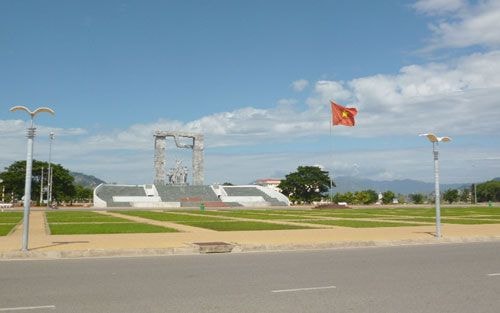 |
| April 16th Square, Phan Rang - Thap Cham city, Ninh Thuan province |
The city of Phan Rang - Thap Cham is a rapidly developing urban center in Ninh Thuan province. Forty years ago, it was the site of fierce battles fought by our forces to crush the distant defensive line of the puppet regime of Nguyen Van Thieu. Mr. Le Van Nhiem, former Head of the Political Department of the Ninh Thuan Provincial Front Command C, recounted: In early April 1975, following the directives of the Politburo, the Regional Party Committee, and Military Region 6, Ninh Thuan province was instructed to mobilize all forces in the delta and base areas, immediately advance to attack the enemy, and support the people's uprising to dismantle enemy hamlets and liberate their homeland. The Ninh Thuan Provincial Party Committee and Provincial Military Command decided to consolidate the Front Command C, ready to join the main forces in liberating Ninh Thuan.
Mr. Le Van Nhiem stated: "The main task of Forward Unit C is to fight the enemy and liberate Highway 11 as quickly as possible, to act as a pillar preventing enemy reinforcements from reaching Lam Dong, and also preventing enemy reinforcements from Lam Dong from reaching Phan Rang. At the same time, we will coordinate with the main forces to contribute to the liberation of Ninh Thuan province."
From April 1st to 3rd, after suffering defeats in Lam Dong and Khanh Hoa, the remaining enemy forces in Da Lat, fleeing along Highway 11 towards Phan Rang, were intercepted by our troops. Our forces also launched successive attacks to capture hamlets along Highway 11, liberating Krong Pha district. Local troops from Bac Ai and Anh Dung districts, along with several other units from the province, were assigned to reinforce Battalion 610, tasked with holding Deo Cau Pass, intercepting enemy counterattacks from Thanh Son airfield, protecting Highway 11, and preparing to coordinate with the main forces to liberate Phan Rang town.
At this time, in Phan Rang, the Saigon regime mobilized a formidable military force, including: the 6th Air Force Division, the 2nd Parachute Brigade, the 2nd Infantry Division, the 31st Special Forces Regiment, two armored squadrons, along with artillery, security, militia, and police forces, totaling over 10,000 men; 150 aircraft of various types were ready for a counterattack. Offshore, the 7th Fleet was also ready to provide support. The puppet army used the Du Long gateway, more than 20 kilometers from Phan Rang, as a key defensive line. Along Highway 1 from Du Long to Ca Du, they also organized many strong defensive lines.
In accordance with the Politburo's directive to complete the liberation of South Vietnam in April, Lieutenant General Le Trong Tan, Commander of the Coastal Army, ordered the 3rd Golden Star Division and the 25th Regiment of Military Region 5 to immediately capture Phan Rang. At dawn on April 14th, our artillery and infantry captured the Du Long district headquarters and surrounding positions, eliminating a significant portion of the enemy forces and repelling numerous enemy counterattacks.
Mr. Huynh Huu Long, former Chief of Staff of the Forward Command Post C supporting the Coastal Army in liberating Ninh Thuan province, recounted: “On the morning of the 14th, our troops shattered the forward steel shield in Du Long district and captured Suoi Vang, Suoi Da, and Ba Rau. At that time, the enemy mainly responded with aircraft dropping bombs and helicopters firing artillery, while ground troops used artillery to fire at our positions. But they couldn't succeed because we had fired and limited all those support responses.”
On the morning of April 16th, our forces were divided into three main prongs: The first, led by tanks, advanced along Highway 1, and after capturing Phan Rang, would proceed to Thanh Son airfield. The second, approaching from the northwest, would directly attack Thanh Son airfield. The third would capture Ninh Chu port, preventing the enemy from escaping to the sea. In coordination with the main forces, the 311th Regiment at Ca Du Mountain launched an attack, flanking the retreating enemy. In the northwest, special forces and engineers of Military Region 6, in coordination with local forces, penetrated directly into Phuoc Thien and Ninh Quy, attacking the Bao An - Thap Cham area.
General Nguyen Vinh Nghi of the puppet army launched 37 air raids against the 101st Regiment, but our troops still advanced rapidly into the town. By 9:30 AM on April 16th, the victory flag flew over the Administrative Building – the headquarters of the puppet regime in Ninh Thuan province, marking the complete liberation of Ninh Thuan. Mr. Pham Viet Dung, formerly an Assistant Military Mobilization Officer of the 18th Regiment, 325th Division, 2nd Corps, who advanced to liberate Phan Rang, recounted: “At that time, we were informed that the 101st Regiment of the 325th Division had spearheaded the attack along with other units to liberate Phan Rang. On April 16th, we crossed Du Long and began advancing into Phan Rang – Thap Cham town. 105mm artillery shells were scattered along both sides of the road; at that time, not a single puppet soldier was left to flee.”
The victory at the Phan Rang defense line held immense historical significance, playing a crucial role in the historic Spring Offensive of 1975. Mr. Nguyen Trong Nghia, Chairman of the Ninh Thuan Provincial Veterans Association and former Chief of Staff of Battalion 610, stated: “The crushing of the Phan Rang defense line had many implications. Firstly, it thwarted the Saigon puppet regime's long-range defense strategy. Secondly, the enemy's defense line in Du Long and Ninh Thuan province was completely liberated. Thirdly, it created an opportunity and a springboard for the main force – the Central Coastal Army – to quickly launch attacks on the southern provinces, shattering the Xuan Loc defense line and contributing to the liberation of Saigon.”
Ninh Thuan was liberated. The "steel shield" of Phan Rang – a distant defense line protecting Saigon – was shattered, marking the failure of the enemy's last attempt to protect the Saigon regime. From this point on, the morale and fighting spirit of the puppet army weakened, signaling the impending end of the Saigon regime and the imminent liberation of the South.
According to VOV
| RELATED NEWS |
|---|