

"Decoding" the direction for Muong Que
(Baonghean) - Towards the end of April, when the crape myrtle blossoms displayed their purple hues across the border region of Que Phong, we had the opportunity to join a provincial delegation led by Comrade Nguyen Xuan Duong, Deputy Secretary of the Provincial Party Committee and Chairman of the Provincial People's Committee, to visit several agricultural economic models here...
The inspection was accompanied by insightful suggestions on how to think and act in the locality, stemming from practical experience. The first destination for the Chairman of the Provincial People's Committee and the delegation was the integrated farming and livestock farm of Mr. Hoang Quoc Hai's family in Na Den village, Tien Phong commune. Originally from Dien Lam (Dien Chau), he started from nothing and established his business in Que Phong. Thanks to his hard work, eagerness to learn, and dedication, Mr. Hai's family transformed barren land into a farm generating nearly a billion dong in profit each year. Currently, on an area of about 6 hectares, he has invested in large-scale barns raising thousands of pigs for meat and breeding sows; in addition, he also cultivates 2 hectares of rubber trees and 2 hectares of fish ponds… His success in economic development has not only built a prosperous life for his family in their new homeland but also provided employment for many workers with relatively high and stable incomes.
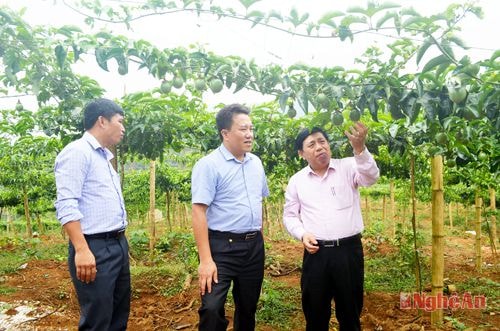 |
| Comrade Nguyen Xuan Duong visits a passion fruit garden belonging to a local resident in Tri Le commune (Que Phong district). |
Another vivid example of innovation is the farm model of Mr. Hoang Trung Thong's family in Kim Son Town. This hardworking Vice Chairman of the Kim Son Town People's Committee boldly borrowed capital to invest in planting 3 hectares of pepper and 3.8 hectares of Xa Doai oranges, along with hundreds of guava, mandarin orange, and green pomelo trees… The pepper plants, only 6 months old, are already over 2 meters tall and developing well. The orange trees, after 1-2 months of planting and with the application of drip irrigation technology, are growing and developing very well. Mr. Thong said: “This is the first time orange and pepper plants have been planted on a large scale in Que Phong. Although it has only been a short time, these varieties are very suitable for the local climate and soil. We are determined to make this model successful, thereby creating a ripple effect and opening up a new direction for agriculture in Que Phong district.”
...This is just a glimpse into two of the hundreds of thriving farm economic models that have developed in Que Phong district over the past few years. According to statistics from the District People's Committee, the district currently has 162 farms, of which 87 farms generate an average income of 35-40 million VND/year; 7 farms have revenue of 500 million VND/year (meeting the standards according to Circular 27), including 2 farms with revenue reaching 1.5-2 billion VND/year. The final numbers are still high, as assessments show that the integrated agricultural, forestry, and fisheries farm economic model is increasing rapidly year by year.
The next stop on the delegation led by the Chairman of the Provincial People's Committee was the passion fruit growing area in Tri Le commune. The success of the passion fruit cultivation model in Tri Le has been confirmed. These models have initially created widespread impact, developing into large-scale commercial production with concrete linkages between farmers, businesses, scientists, and the government. Currently, Napaga Agricultural Investment and Development Joint Stock Company, a subsidiary of Nafoods, has fully invested in a seed production center in the area, with a first phase covering 1 hectare, capable of producing 2 million seedlings annually with the participation of Taiwanese experts. Currently, this is the largest passion fruit seed production center in the region.
With this quantity of seedlings, the company not only supplies the local raw material area but also exports to China. The company is preparing to build phase 2 of the seed production center, expected in October 2015, on an area of 2 hectares to supply seedlings to the passion fruit growing area of approximately 5,000 hectares in the Central Highlands and 5,000 hectares in the Northwest, which have been approved by the Ministry of Agriculture and Rural Development. The passion fruit growing area in Que Phong district is also planned with an area of 800 hectares, and currently 150 hectares have been planted, of which 115 hectares belong to local people, and the rest belongs to Napaga Agricultural Investment and Development Joint Stock Company.
Mr. Pham Duy Thai, the company's director, said: "This year, the total passion fruit production is about 4,000 tons. The expected purchase price ranges from 8,000 to 10,000 VND/kg. We have signed consumption contracts with passion fruit farmers since the beginning of the season and guarantee to buy all of their produce. In addition, besides the approved passion fruit growing area, we are currently proceeding with procedures to apply for an additional 600 hectares of passion fruit cultivation in Que Phong district." With these developments, Que Phong is becoming one of the largest centers for passion fruit seed production and cultivation in the country. Income from this agricultural product has opened up a way out of poverty, and even created wealth for the local people.
Thus, it can be affirmed that the agricultural sector of Que Phong has gained new qualitative development experiences. From farm models to the development of raw material areas, production is oriented towards commercial scale and is gradually proving effective in actual production and business; thereby, not only bringing benefits to specific individuals and units but also initially creating a ripple effect, significantly impacting the awareness and farming skills of a considerable portion of the local people who have a passive and dependent mindset.
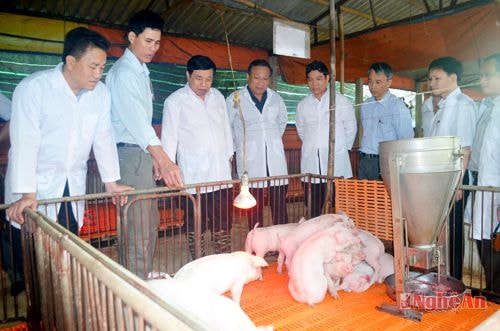 |
| Comrade Nguyen Xuan Duong visits the farm of Mr. Hoang Quoc Hai's family. |
Agricultural production models such as NK compressed fertilizer, cage fish farming, Muscovy duck farming, passion fruit cultivation, Japonica rice, and mushroom cultivation have been successfully developed and replicated, contributing to the transformation of the agricultural production structure and rural economy towards a rapid increase in production value per unit area of cultivated land in Que Phong. During a meeting with district leaders, the Chairman of the Provincial People's Committee noted that Que Phong's poverty reduction rate has not yet matched its potential and development speed. Where does the root cause lie?
The Chairman of the Provincial People's Committee suggested that in the coming period, the district needs to do a good job of protecting forests, preserving natural resources and the environment, improving the economic efficiency of forests and income from forests. It should develop household economies and replicate effective economic models; identify production areas linked to specific locations, and create favorable conditions for businesses to invest in the area. Over the next five years, based on practical experience and analysis, it can be seen that the main growth model that will help Que Phong exploit its potential and escape poverty is to strengthen linkages between stakeholders by enhancing existing products and continuing to develop other products considered strengths that will be implemented in the near future.
Nhat Le