
The soul of the city - the soul of the people
(Baonghean) - Autumn is the most beautiful season of the year in Hanoi, when the sun bathes the rooftops of the ancient houses, which some poets have likened to "waves of houses," in the poignant melodies of Trinh Cong Son. Hanoi's autumn, in the melancholic tunes of Trinh Cong Son, not only evokes a sense of wistfulness: "Yellow crape myrtle trees - Red banyan trees - Lying side by side - Old streets, ancient houses - Dark brown tiled roofs," but also brings back the tragic and heroic echoes of the depth of historical past: "Here is Ho Guom Lake, Hong Ha River, Ho Tay Lake. Here lies the soul of mountains and rivers for a thousand years. Here is Thang Long, here is Dong Do, here is Hanoi," in the epic poem "People of Hanoi" by poet-songwriter Nguyen Dinh Thi.
(Baonghean) - Autumn is the most beautiful season of the year in Hanoi, when the sun bathes the rooftops of the ancient houses, which some poets have likened to "waves of houses," in the poignant melodies of Trinh Cong Son. Hanoi's autumn, in the melancholic tunes of Trinh Cong Son, not only evokes a sense of wistfulness: "Yellow crape myrtle trees - Red banyan trees - Lying side by side - Old streets, ancient houses - Dark brown tiled roofs," but also brings back the tragic and heroic echoes of the depth of historical past: "Here is Ho Guom Lake, Hong Ha River, Ho Tay Lake. Here lies the soul of mountains and rivers for a thousand years. Here is Thang Long, here is Dong Do, here is Hanoi," in the epic poem "People of Hanoi" by poet-songwriter Nguyen Dinh Thi.
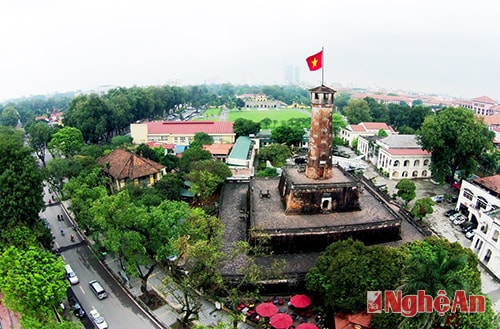 |
| Hanoi flagpole. Photo: Internet |
Like people, every street and alley here has a soul. The soul of the streets is deeply intertwined with the soul of the people, as expressed in ancient folk songs: "Long Thanh is the most prosperous city - Streets like a loom, roads winding like a chessboard." There is a "Phai Street" (a street painting by artist Bui Xuan Phai). The scenery of "Phai Street" appears strangely haunting. From the artist's perspective, the houses in the painting are beautifully rendered. Its rhythm, with interwoven shades of light and dark, is like traces of time imprinted on the brushstrokes, preserving memories. Hanoians are open yet discreet, subtle and profound, not noisy or superficial, just as the soul of the streets is solemn and ancient yet graceful and profound... creating an elegant and refined charm, a lifestyle of the capital's people.
Hanoi's streets are imbued with the green of nature, of expansive lakes. Each street is associated with a particular type of tree. Around Ho Guom Lake, there are two characteristic trees: the willow tree, reminiscent of the graceful figure of a young woman in an ao dai (traditional Vietnamese dress), and the crape myrtle, its branches casting strings of tiny red flowers like firecrackers onto the clear blue water of the lake in the autumn sky. And the fragrance of milk flowers on Nguyen Du Street, the scent of starfruit flowers on Ly Nam De Street, and the subtle fragrance of magnolia on Thanh Nien Street all encircle the youthful vitality around West Lake. These scents and flowers create a different depth to the city's soul, especially on late nights in the quiet little streets and alleys, awakening cherished memories. The Ho Chi Minh Mausoleum, like a shimmering flower garden illuminated by lights, with its vast, rustling bamboo groves, seems to encompass the essence of the countryside and the spirit of the nation. There is a street named after a local specialty: Cha Ca Street (Fish Cake Street). There is an alley named after a humble way of life: Tam Thuong Alley. There is a lake named after a seal imprinted on it: Thien Quang Lake. There is a most beautiful season of the year in Hanoi: autumn, creating a proactive lifestyle in harmony with nature. The clear, melodious voice of the radio announcer is the "Hanoi accent." There was a regiment that fought valiantly in the early days of the resistance against the French, named the "Capital Regiment," when "Hanoi was engulfed in flames - Hanoi rose up" in Nguyen Dinh Thi's heroic song, creating the portrait of "Hanoi people" with their thousand-year-old refined cultural traditions. This autumn, we fondly recall 60 years ago, the victorious troops returning to liberate the capital with joyful eyes and enthusiastic smiles, the red flag with a yellow star fluttering in the wind as they marched in triumphant songs. During these joyful days, the face of the capital city is brighter, greener, cleaner, and more beautiful, reflecting the elegant values of the ancient Thang An people, which serve as the foundation for building the civilization of the cultured capital – a “City for Peace” today and in the future!
WriterNguyen Ngoc Phu